The partition of the Subcontinent in August 1947 created two independent states, India and Pakistan, but it also left unsettled questions about the future of more than 560 princely states. The rulers of the princely states were instructed to decide whether to accede to India or Pakistan, while the circumstances of each state varied according to its demography, socio-political conditions, geography, and the decision of its ruler. The princely state Jammu and Kashmir emerged as one of the most significant cases. Jammu and Kashmir was a Muslim-majority state governed by a Hindu Dogra ruler, Maharaja Hari Singh, and shared economic and geographical links with both newly established countries. Its future became a dispute that outlasted the circumstances of Partition itself.Maharaja Hari Singh, the ruler of the state, initially sought to preserve the independent status of Jammu and Kashmir. In August 1947, his government proposed standstill agreements with India and Pakistan to preserve existing arrangements while the ruler considered his options. The situation changed on 26 October 1947, when Maharaja Hari Singh wrote to Lord Mountbatten, the Governor-General of India, requesting immediate military assistance. He also explained that the state had not previously acceded to either dominion and that he had considered the possibility of remaining independent. Mountbatten’s reply of 27 October highlighted the question of the people’s right to decide the future of Jammu and Kashmir. He added that, “as a matter of policy, where accession was disputed, the question should be settled by reference to the people once law and order had been restored and the territory cleared of crisis.” On 27 October 1947, the Maharaja called for military assistance, but that assistance turned into an occupation that has continued for 79 years. The government of India did not fulfill the commitment made by Lord Mountbatten in his letter of 27 October 1947, and the people of Jammu and Kashmir remained deprived of the opportunity to decide their own future.The United Nations became involved as the conflict continued. On 21 April 1948, the Security Council adopted Resolution 47, recommending measures to restore peace and establish conditions for a free and impartial plebiscite on whether Jammu and Kashmir should accede to India or Pakistan. Disagreements over the withdrawal of forces and the sequence of implementation prevented the proposed process from taking place. Then, on 5 January 1949, the United Nations Security Council passed another resolution that affirmed the right of the people of Jammu and Kashmir to decide their future through a free and impartial plebiscite. The people of Jammu and Kashmir were never given the plebiscite envisaged in the international framework. What began as a dispute over accession consequently developed into a prolonged conflict over sovereignty, political representation and self-determination.
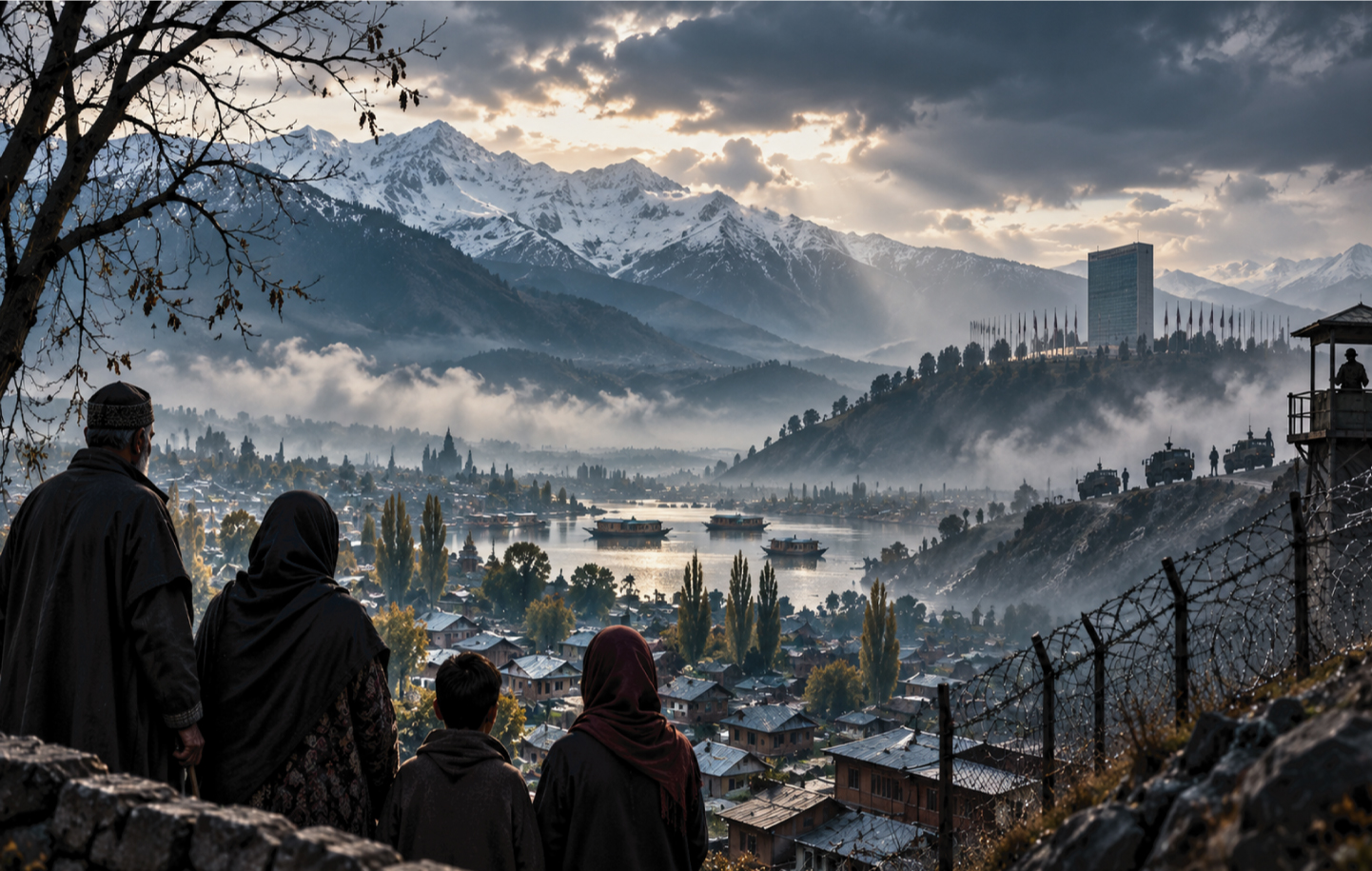
For generations of Kashmiris, it has shaped political life, family experiences, personal freedoms and expectations about the future. The unresolved question is not only which state holds the stronger claim, but also how the wishes and rights of the people themselves are to be addressed.On 5 August 2019, India revoked the special autonomous status of Jammu and Kashmir under Article 370, including the protections associated with Article 35A, and subsequently reorganized the former state into the union territories of Jammu and Kashmir and Ladakh. The Indian government presented the changes as measures to strengthen integration and promote development. But the ground realities unfolded demographic shifts and less representation of the Kashmiri Muslims. The unilateral constitutional changes could not settle the status of a disputed territory. For Kashmiris, the changes brought renewed questions about political representation, autonomy, identity and their role in decisions affecting their homeland.The consequences of this unresolved history extend beyond constitutional law and diplomacy. The region has endured decades of conflict, insecurity and political uncertainty. Families have experienced loss and separation; journalists, civil society members and ordinary citizens have faced difficult questions about the limits of public expression. The escalation following the Pahalgam attack in May 2025 was another reminder of how quickly tensions between two nuclear-armed states can intensify, with consequences extending well beyond the immediate site of violence.The cost of an unresolved history is carried by people, not by treaties. Families have been separated by lines they did not draw. Journalists, activists and ordinary citizens have learned where the limits of public expression lie. And the risk extends beyond Kashmir: the escalation after the Pahalgam attack in 2025 showed how quickly a tragedy can bring two nuclear-armed neighbors to the edge.Seventy-nine years after 27 October 1947, the people of Jammu and Kashmir remain deprived of their fundamental right to self-determination and the opportunity to determine their own future. For Kashmiris, 27 October is observed as a Black Day, marking the beginning of a prolonged occupation and an unresolved struggle for their rights and dignity. Lasting peace in South Asia requires addressing the aspirations of the Kashmiri people and ensuring that their right to self-determination is respected.