
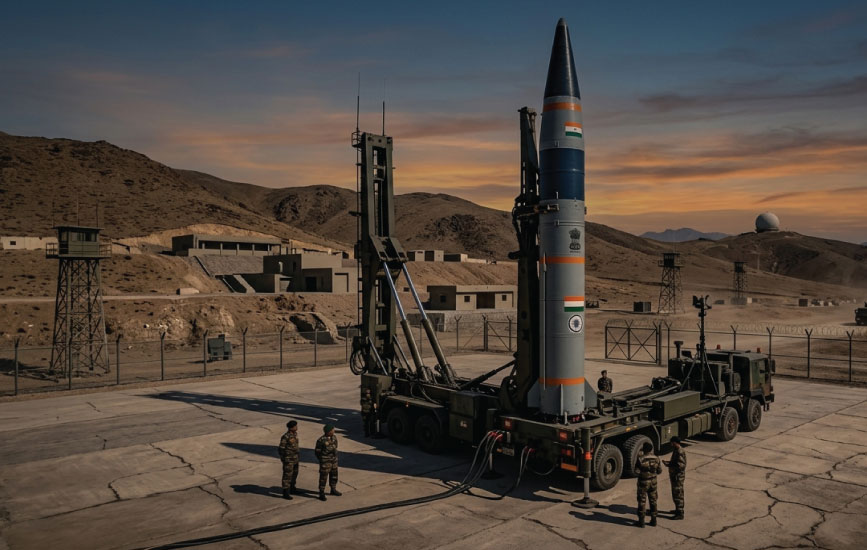
In international relations, there are no permanent friends or enemies, only permanent interests. John Mearshimer’s offensive realism explains the structural reality that capabilities matter more than intent. Today’s strategic partner can easily become tomorrow’s competitor, as military capabilities ultimately outweigh diplomatic intentions. This structural reality is currently being tested by India’s Defence Research and Development Organization latest push for Agni-VI missile. The Agni-VI is a next-generation four-stage Intercontinental Ballistic Missile equipped with Multiple Independent Re-entry Vehicle (MIRV) and Maneuverable Re-entry Vehicle (MaRV) technology. It is reportedly have an updated range between 10,000-12,000 km that would be enough to reach not just China, Middle East and Europe but also the US and Canada, transforming India’s nuclear posture from regional deterrent into global hazard.
Agni-VI missile range is not the only thing that is alarming but it is the institutional reliability. The Command and Control system of India have already demonstrated vulnerabilities, most notably in March 2022, when a nuclear-capable missile Brahmos misfire into Pakistani territory. It was subsequently followed by another one in March 2023, where three surface-to-air missiles were misfired by India during Pokhran exercises near the Pakistan border. India’s incompetence and negligence in holding sensitive equipment exposed in these regional crises would be alarming when applied to an ICBM with global reach. If India cannot effectively dealt with its short-range missiles, the deployment of MIRVed THAAD penetrating ICBM creates a high stake environment where a single technical mishap could trigger a global nuclear exchange.
The risk further intensified with a steady trickle of nuclear theft and trafficking incidents. A chronology compiled by the South Asia Strategic Stability Institute (SASSI) lists 18 incidents between 1994 and 2021 involving theft or loss of more than 200 kilograms of nuclear material in India. While, another incident reported in 2022 and further three incidents in 2024 fueling concern that a black market is taking root.
Nuclear Security Index by the Nuclear Threat Initiative has placed India below the median on key measures, and SIPRI has documented the steady growth and diversification of nuclear arsenals worldwide, including India’s emphasis on longer-range delivery systems. The danger is not merely regional: as capabilities expand, any breach reverberates far beyond South Asia.
Parallel to these technical risks is a volatile shift in India’s political and ideological discourse. The callous arrogance shows Hindutva ideologues have taken control of India’s nuclear establishment deviating from the norms of responsible nuclear state. The provocative nuclear rhetoric is evident in Indian Prime Minister speech following the Balakot Strike on February 27, 2019 threatening it would be “Qatal ki Raat.” While in a rally, he claimed, “Nuclear weapons not being kept for Diwali.” These nuclear rhetoric evolved into anti-west narrative as depicted in Indian former Major General Gagan Deep Bakshi (Retd.) statement recently in live TV seen threatening to nuke New York and Washington two main cities of the US, with nuclear weapon using Agni-V ICBM and K-5 SLBM. Bakshi was also threatening to use nuclear weapons against any nation that imposes sanctions on India, as well as to nuke Pakistan and its military leadership.
Following May 2025 crisis, there is also a growing resentment in India against the US, where India was reluctant to accept the US role in mediating the conflict and Trump’s repeated reminders regarding the loss of Indian jets and his intervention in de-escalating the crisis. Followed by abstaining India’s purchase of Russian oil, along with the US-India trade deal that is widely criticized domestically. At this point of time, the announcement of Agni VI missile with a capability to nuke the US increasingly framed as a tool to mitigate the domestic grievances. It signals New Delhi’s willingness to risk the annihilation of the entire world for petty political gains.
The Agni VI proposed development would ultimately change the global security, even though it awaits government approval. India’s deterrence posture that was regional centric would transform into global one by placing the US and Canada within a strike zone. As Mearshimer highlights that in anarchic system capabilities matter more than intent. The US may consider India its strategic partner, its capability to deploy Agni-VI, THAAD penetrating ICBM would pose a significant threat to the US.
The vulnerabilities in its command and control system further aggravate the situation. A state struggling against the nuclear theft incidents and has a history of accidental launches, the move towards a global ICBM would be a recipe for catastrophe. To ignore this escalation is to ignore the reality that a state driven by ideological volatility and technical negligence is now ready to acquire the capability to threaten global annihilation for the sake of petty political gain. The international community can no longer afford to view India’s nuclear ambitions through a regional lens; the mere readiness to develop the Agni-VI has already made it a global problem.