

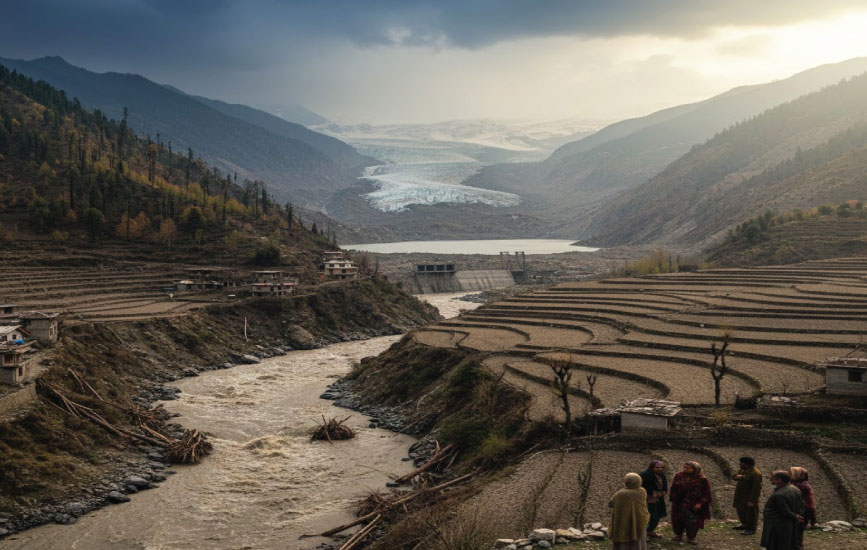
Climate change in Azad Jammu and Kashmir no longer exists as a distant environmental concern or a future scientific projection. It is impacting everyday life through erratic rainfall, shrinking glaciers, recurring floods, landslides, forest degradation, and growing water stress. In this context, the AJK Climate Change Policy 2017 stands as one of the most important yet least internalized policy documents produced by the region’s government. Officials often cite the policy in statements and development plans, yet they rarely translate its warnings into meaningful action.
The government did not draft the policy as a ceremonial document. It intended the policy to serve as a strategic alarm that explains how climate change threatens ecological stability, economic sustainability, and human security in AJK. Eight years later, the central issue is not the quality of the policy but the lack of political seriousness in its implementation.
The policy remains relevant because it correctly identifies AJK as one of the most climate vulnerable regions in South Asia. Its mountainous geography, glacial systems, river basins, and forest cover expose the region to climate induced disasters at a scale far greater than the national average. The policy clearly outlines how rising temperatures, changing precipitation patterns, and accelerated glacier melt threaten water availability, agriculture, hydropower generation, biodiversity, and rural livelihoods.
Today, the realities on the ground validate these assessments. Floods in the Jhelum and Neelum valleys, declining agricultural productivity, heat stress, and seasonal water shortages now occur with increasing frequency. The policy framed climate change as a development and security challenge rather than a narrow environmental issue. This framing remains critical because climate impacts now affect food security, energy reliability, disaster preparedness, and social stability across AJK.
The policy also aligns climate action with sustainable development goals and emphasizes that economic growth cannot survive without ecological resilience. In a region where communities depend heavily on forests, water resources, and land, the policy’s focus on adaptation reflects necessity rather than idealism.
The AJK Climate Change Policy raised several alarms that demand urgent attention. The first alarm concerns water insecurity. Despite AJK’s image as a water rich region, the policy warns that climate variability threatens seasonal water flows and hydropower sustainability. Glacier retreat and erratic rainfall patterns increase the risks of both floods and water shortages. The state ignored this warning and continued to treat water abundance as a permanent reality rather than a fragile balance.
The policy also highlights ecological degradation as a key driver of climate vulnerability. Deforestation, soil erosion, and unplanned land use weaken natural defenses against floods and landslides. These environmental losses do not remain confined to ecosystems. They directly affect human settlements, agriculture, and infrastructure. The policy implicitly questions development models that prioritize short term gains over long term ecological stability.
Another major warning focuses on disaster preparedness. The policy anticipates an increase in climate related disasters and stresses the need for early warning systems, institutional readiness, and local response capacity. Recent floods and landslides reveal that the government failed to act on this warning. Emergency responses often remain reactive, delayed, and under resourced.
The policy also recognizes social vulnerability as a core concern. It explains how climate change disproportionately affects women, rural populations, and marginalized communities. Increased water scarcity, agricultural stress, and disaster exposure deepen existing inequalities. The state has yet to integrate this social dimension into climate planning in any meaningful way.
The AJK government’s most serious failure lies in weak implementation. Authorities did not mainstream climate change into sectoral planning despite clear policy guidance. Agriculture, infrastructure, energy, tourism, and housing projects often proceed without climate risk assessments. This approach increases long term vulnerability and undermines resilience.
Institutional coordination also remains inadequate. Climate governance in AJK operates through fragmented departments that lack clear authority and accountability. The Climate Change Center exists, but it lacks the power, resources, and political backing required to influence decision making across sectors. Without institutional leadership, the policy cannot shape outcomes.
The government also failed to mobilize climate finance effectively. The policy emphasizes access to national and international climate funding, yet AJK struggles to translate vulnerability into viable project proposals. This gap reflects limited technical capacity, weak data systems, and insufficient engagement with global climate mechanisms.
Local level implementation presents another major weakness. Communities in climate vulnerable districts rarely understand the policy or participate in its execution. Adaptation strategies work best when communities lead them. The government continues to rely on top down approaches that overlook local knowledge and ownership.
The AJK government must treat climate change as a human security challange rather than a peripheral environmental issue. Authorities must integrate climate risk assessments into all development planning. No infrastructure or tourism project should move forward without evaluating its ecological and climate impact.
The government must strengthen institutional leadership on climate change. It should empower the Climate Change Center with legal authority, budgetary resources, and oversight mechanisms. Strong coordination across departments will determine whether the policy moves beyond paperwork.
Investment in data, research, and early warning systems must become a priority. Climate adaptation requires reliable information on glaciers, rainfall patterns, land use changes, and disaster risks. Partnerships with universities, research institutions, and think tanks can strengthen evidence based policymaking.
The state must also prioritize community based adaptation. Local communities manage forests, water systems, and agricultural land on a daily basis. Their participation determines success or failure. The government should place women and youth at the center of resilience strategies rather than treating them as passive beneficiaries.
Finally, AJK must position itself strategically within national and international climate frameworks. As a highly climate vulnerable region, it holds a strong case for climate finance and technical support. The government must engage proactively and professionally to secure these opportunities.
Climate change will not wait for political convenience or administrative reform. Environmental neglect now threatens economic stability, human security, and social cohesion in AJK. The government must choose between managing recurring disasters and building long term resilience. The time for symbolic commitment has passed. Only decisive action can prevent irreversible damage.