THE US wants India as a partner against China, not as an emerging superpower as New Delhi perceives itself.
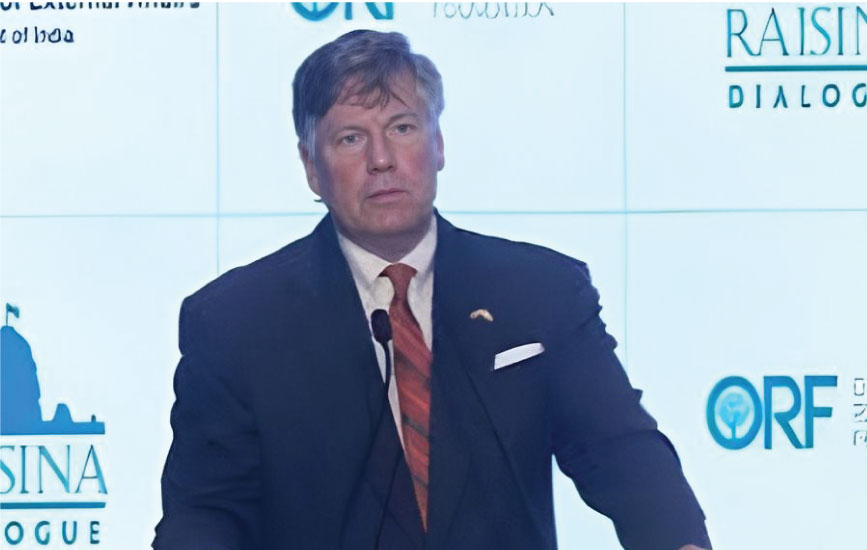
US Deputy Secretary of State Christopher Landau made it clear at the Raisina Dialogue, India’s flagship conference on geopolitics and geo-economics, that there would be no free ride to India’s rise. He emphasized that US foreign policy pursues the interests of its people, with “America First” as its main objective rather than serving the interests of other states. Criticizing decades of foreign policy, he argued previous approaches focused on problems rather than solutions. Economic and commercial diplomacy, central to Trump’s Administration, were reflected in sweeping tariffs on global imports.
Landau highlighted India’s commercial and economic importance in the 21st century, arguing trade deals could unlock limitless potential. He warned, “India should understand that we are not going to make the same mistakes with India that we made with China 20 years ago.” Washington sees a powerful India as a counterweight to Chinese influence, reflected in previous National Security Strategies identifying India as a strategic partner. The US has invested in India through agreements in defense, trade, economy, space, AI and emerging technologies. The National Security Strategy 2025 signals an end to strategic altruism: India must now deliver strategic returns. Landau clarified that ‘America First’ does not mean ‘America Alone’; objectives will be achieved through cooperation, implying India can no longer evade great power rivalry under the pretext of strategic autonomy.
He reflected on India’s Cold War-era non-alignment, noting that India kept the US at arm’s length, but now must move beyond that model. Deepened relations must be based on reciprocity and mutual respect, signaling limits on India’s autonomy, as the US will provide no free lunch. Ensuring freedom of navigation in the high seas remains a shared interest, with India playing a key role in securing Indo-Pacific sea lanes, logistics and QUAD operations. The US has strengthened India’s strategic position via the Master Ship Repair Agreement and concluded agreements like LEMOA, BECA and COMCASA to enhance military collaboration.
Recent events have tested this partnership. The IRIS DENA, invited by India to participate in the International Fleet Review and Milan exercises 2026, could not return home after a US nuclear-powered submarine torpedoed it near Indian waters. The sinking of the unarmed Iranian frigate, India’s guest, in the Indian Ocean was a strategic embarrassment, signaling New Delhi’s compliance. Following the incident, the US granted India a 30-day waiver to purchase Russian crude, illustrating that India can no longer act independently of US interests. Tariffs, market access and supply chains serve as instruments to enforce alignment; strategic partners must comply or face punitive trade measures, while waivers are offered only to those who adhere to US directives.