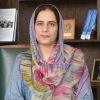
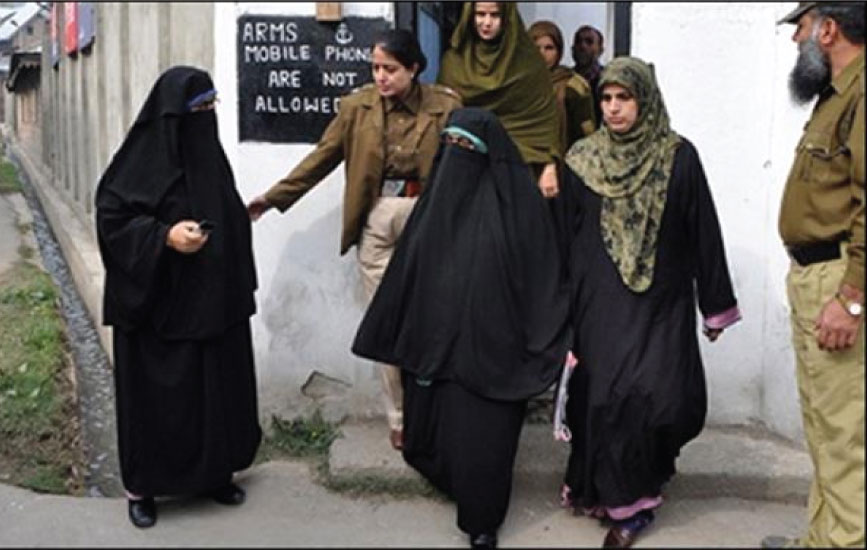
The recent verdict delivered by the Indian Supreme Court sentenced a Kashmiri brave woman to life imprisonment after she had already been in the Tihar jail in Delhi for nearly a decade, without a conclusive trial. Asiya Andrabi, the chairperson of the Dukhtaran-e- Millat, a renowned organization of Kashmiri women, and two of her colleagues, Nahida Nasreen and Fehmeeda Sofi, were arrested in 2017 amid a sweeping crackdown on supporting the right to self-determination and raising a voice against Indian occupation in Indian illegally occupied Jammu and Kashmir.
Dukhtaran-e-Millat, the organization, is an all-women scio-political and religious group that advocates for the freedom from Indian illegal occupation, and also helps orphans and widows of those martyred by Indian forces since 1989, which was later banned by the Indian government in 2018.
Asiya Andrabi, a 64-year-old woman, was detained under the Unlawful Activities Prevention Act (UAPA). She is an educated scholar, teacher, and the founding chairperson of the organization. She has spent years in isolation, separated from her family, suffering from illnesses, and enduring a process that has detained her and her two close companions. Her colleague, Fehmeeda Sofi, who is in her thirties, was first detained when she was in class 10 under the draconian law, the Public Safety Act (PSA). Repeated detentions ruined her education, and she also requires spinal surgery, which has been denied throughout her imprisonment. Meanwhile, Naheeda Nasreen, a 61-year-old woman who holds a postgraduate degree in zoology and Islamic Studies, has been refused basic medical care.
These women, who suffer from severe illnesses, are denied proper medication and food and are subjected to inhuman treatment in the Tihar Jail. Asiya Andarbi’s husband is also in a different prison, and the couple is not allowed by jail authorities to see or meet each other for decades. Although the court order permits them a monthly call.
This is a clear violation of Articles 5 and 25 of the Universal Declaration of Human Rights (UDHR), -1948 which states that “No one shall be subjected to torture or to cruel, inhuman treatment or punishment, and everyone has the right to a standard of living adequate for health and well-being, including medical care and food.”
These violations are not abstract; they have devastating impacts on the affected women, their families, and the wider Kashmiri population, who see these actions by the authorities as proof that their voices are being suppressed rather than addressed through dialogue.
After spending eight years in the Tihar jail without any trial, they were finally convicted on charges that include providing logistical support to freedom fighters, waging war against the state, and conspiring to disturb the public order. Vague accusations of organizing protests, recorded conversations, and the claims that the women’s political actions constituted terrorism were central to the prosecution’s case. In court, there was no reliable eyewitness statement, no tangible forensic evidence, and no clear chain of custody for the alleged digital data.
The verdict against Asiya Andrabi raises critical questions about whether the Indian court truly delivers justice. The rapid use of draconian laws in Kashmir, especially after the revocation of Articles 370 and 35A, shows a gap between law and fairness. Andrabi has been sentenced to life imprisonment, while her two close companions, Naheeda and Fehmeeda, have received 30-year terms under laws such as UAPA.
The verdict is not merely a legal one; it is designed to appease the supporters of the Hindutva agenda, the ruling party in India, the BJP. It is an act of repression of political liberty that has long sought to suppress dissent in Kashmir against Indian occupation.
The Indian ruling party, BJP, which is the right-wing political arm of the RSS, has introduced several tactics to silence dissent in Kashmir by imposing draconian laws like UAPA, PSA, Armed Forces Special Powers Act (AFSPA), and Cordon and Search Operations (CASOs). Numerous news outlets have been banned, journalists and politicians have been detained, and even ordinary citizens who raise their voices against this aggression have been imprisoned. This strategy of suppression is portrayed to the world as a return to normalcy.
The resistance and resilience are other defining traits of Kashmiri women. The women of Kashmir have a long history of contributions to their society, standing by the side of their men regardless of circumstances. From Lal Ded (Lala Arifa), the 14th-century Sufi poetess of Kashmir, who raised her voice against domestic violence, and Habba Khatoon, another remarkable poetess of Kashmir, and a series of brave Kashmiri women, their legacy reflects courage and strength.
Historically, the politics of Kashmir have seen influential figures like Begam Akbar Jahan, Zooni Gujari, Fazli Begam, and many others. The Kashmir conflict gave them a dual role: contributing to the freedom movement while enduring multiple forms of trauma. The term “Half Widow” is a unique concept found in Kashmir that refers to women whose husband disappeared, leaving them uncertain of their fate.
The resistance is in the blood of Kashmiri women, who have witnessed several incidents of mass rape by Indian armed forces, including the victims of “Kunan Poshpora”. Despite social stigma, they refused to remain silent; they spoke out, sought legal action, and chose visible over invisible. Their courage uplifts the other women who are subjected to similar injustice; by doing this, they turned their individual trauma into a type of group resistance.
The case of Asiya Andrabi is not isolated; there are other multiple examples of Kashmiri women who contributed in their own way, such as Parveena Ahangar, whose son disappeared at the hands of Indian forces. She led the formation of the Association of Parents of Disappeared Persons (APDP), which supports the families of missing persons in Kashmir.
The current uprising in IIOJK has involved a large number of Kashmiri women. Despite imprisonment, harsh legislation, and being cut off from their families, they never gave up. The so-called largest democracy, India, presents itself as a progressive society, yet it uses Kashmiri women as war trophies and rape as a weapon.
The struggle in Kashmir persists despite the brutal tactics of the Indian government, with women like Asiya Andrabi and many others participating at every level of the movement. Their remarkable resilience lies in confronting trauma while continuing the fight, a strength that Kashmiri women have consistently exemplified.
The experiences of Kashmiri women remind the world that empowerment is incomplete without accountability, protection, and recognition of lived realities shaped by conflict and marginalization. Justice delayed is justice denied, and justice perverted poses a threat to the very fabric of civilization. It is now the responsibility of the international community to listen to the voices of the Kashmiri people, because their voices and their lives matter.
Today it is Asiya Andrabi; tomorrow, it could be someone else, as has repeatedly happened to Kashmiris since the onset of Indian occupation. The issue of Kashmir must be resolved, and the right to self-determination should be granted to the people of Kashmir, for which they have struggled for over 78 years. Their sacrifices demand dignity, yet their voices for freedom are suppressed by authorities through allegations of terrorism, even as they seek their fundamental right to determine their own future, as recognized by the United Nations Security Council (UNSC).
If this right continues to be denied, more individuals like Asiya Andrabi may face similar detention. The world must take notice and move beyond rhetoric by implementing the laws that currently remain confined to documentation.
The author is a research officer at the Center for International Strategic Studies, Muzaffarabad, Azad Jammu and Kashmir.