

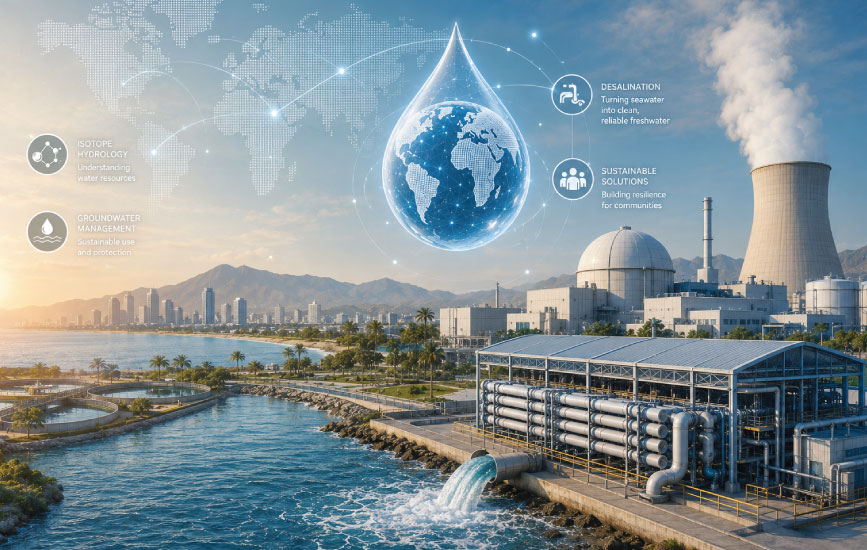
The world is running out of fresh water. According to the United Nations, by 2050 nearly 5.7 billion people could face water shortages for at least one month every year. In many dry and water-stressed regions, desalination has become one of the few reliable ways to produce drinking water.
Desalination is the process of removing salt from seawater .However, it requires large amounts of energy. Most plants are powered by fossil fuels which makes them expensive and carbon-intensive. This dependence on fuel also makes them harder to operate in remote or energy-poor areas.
Small Modular Reactors (SMRs) could offer a practical solution to this challenge.
What SMRs bring to table?
Small Modular Reactors (SMRs) are nuclear reactors that produce up to 300 megawatts of electricity. They are much smaller than traditional nuclear power plants and are built in factories as modular units. This allows them to be transported and assembled more easily, reducing construction time and cost.
Because of their compact size and flexible design, SMRs can be deployed in areas that do not have large electricity grids. This makes them especially suitable for coastal regions, island nations, and remote communities the very places that are often most affected by water scarcity.
The idea of combining nuclear energy with desalination is not new. Nuclear-powered desalination has been in operation since the 1970s. According to the International Atomic Energy Agency, there have been more than 175 reactor-years of global experience in this field. What SMRs bring is greater economic flexibility and easier deployment making it more realistic to expand nuclear desalination projects across developing countries.
The Energy–Water Nexus:
But why does the energy source matter so much for water production? The answer lies in the sheer scale of power required. Desalination is energy-intensive by nature. Reverse osmosis the most widely used desalination technology requires about 3 to 4 kilowatt-hours of electricity to produce one cubic meter of fresh water.
A mid-sized desalination plant producing 100,000 cubic meters per day would therefore require roughly 15 to 20 megawatts of continuous power. That is a significant and constant energy demand. When powered by fossil fuels such plants are exposed to fluctuating fuel prices, rising carbon costs, and supply chain risks all of which undermine long-term water security.
Pairing desalination with a Small Modular Reactors changes this equation. Nuclear fuel is extremely energy-dense and relatively price-stable allowing plants to operate reliably for long periods without frequent refueling. An SMR can provide steady electricity for reverse osmosis systems and where needed process heat for thermal desalination. This combined efficiency is difficult to achieve with other low-carbon energy sources at the same scale.
Unlike solar and wind energy, SMRs operate continuously regardless of weather conditions. Water production cannot stop when the sun sets or the wind slows. Reliable baseload power is essential and nuclear energy provides it.
Strategic Relevance for Water-Stressed Nations:
For countries in the Middle East, North Africa, South Asia, and Pacific island regions the combination of SMRs and desalination is not a luxury it is a strategic necessity.
Nations such as Pakistan, Egypt, and Saudi Arabia are experiencing rapid groundwater depletion while their populations continue to grow. Without sustainable alternatives water shortages could threaten economic stability, food security, and social cohesion.
These countries need solutions that can be deployed at municipal or regional levels, operate independently of volatile fuel imports, and remain financially sustainable over decades. SMRs meet these requirements.
The International Atomic Energy Agency through programs such as PLEX and ALPS, already provides technical frameworks to help countries assess the feasibility of nuclear desalination projects. What is now required is political commitment and innovative financing. Encouragingly, global climate finance mechanisms are beginning to recognize nuclear energy as a legitimate low-carbon option.
SMRs alone will not solve the global water crisis. Conservation, efficiency improvements, and renewable energy must also play critical roles. But when paired with desalination infrastructure, SMRs represent one of the most scalable, low-carbon and energy-secure solutions available to water-stressed nations.
If water security is a priority, nuclear energy should be considered seriously. Small Modular Reactors offer a stable and low‑carbon way to support large-scale desalination. Fresh water is essential for life and progress. Energy policy must reflect that.