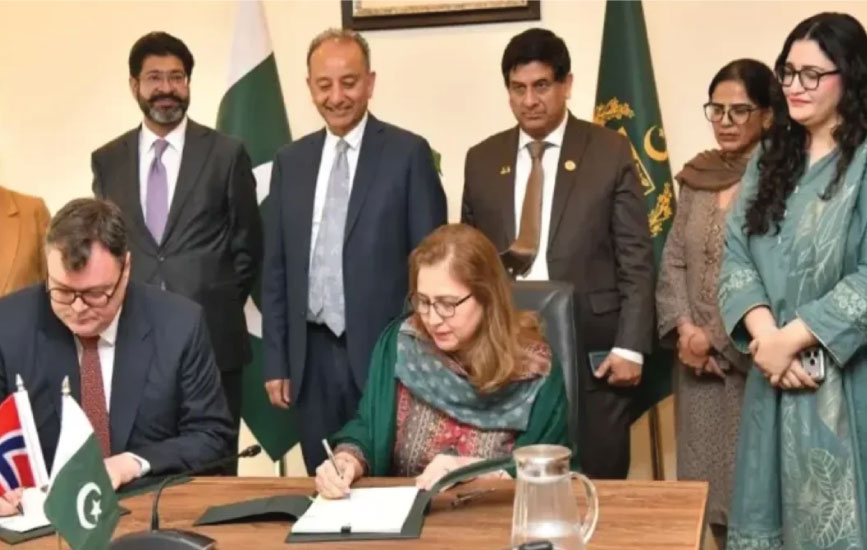
On April 1, 2026 Pakistan entered the global carbon market by signing it’s first-ever carbon market agreement with Norway under Article 6.2 of the Paris Agreement. This development proves to be a milestone in Pakistan’s fight against climate change and a potential solution to nation’s sustainability challenges. However, as Pakistan embarks on this journey, the key question remains: Is the country prepared to turn this promising deal into concrete action?
The Paris Agreement, signed in 2015 set ambitious targets to reduce greenhouse gas emissions and limit the rise in global temperatures to below 2°C. Under this global framework, countries pledged to reduce their emissions.For that that carbon markets was emerged. A system that allows countries or ccompanies to trade carbon credits in order to meet their emission reduction targets. These credits represent the reduction of carbon emissions achieved through sustainable projects like solar energy, wind power and climate-smart agriculture.
The idea of carbon credits emerged from the Kyoto Protocol an international treaty signed in 1997 and enacted in 2005. This agreement marked a pivotal moment in the fight against climate change committing 192 countries to specific targets for reducing greenhouse gas emissions. A key innovation of the Kyoto Protocol was the Clean Development Mechanism (CDM), which allowed industrialized countries to finance emission-reduction projects in developing countries. In return they earned carbon credits that could be used to meet their own emission targets hence laying the foundation for an international carbon market.
Carbon credits aim to create a flexible, economically viable system for reducing global emissions. Instead of imposing uniform reductions, this system allows countries to tailor solutions to their specific needs by investing in clean technologies or supporting environmental projects abroad. Over time, this system evolved, and with the advent of the Paris Agreement carbon credits became more significant. The agreement expanded their role by involving all countries in a collective effort to meet global emission reduction goals.
Today carbon credits continue to play a vital role in the fight against global warming. They offer a way for countries and companies to offset their emissions by investing in projects that reduce or remove carbon from the atmosphere such as renewable energy installations, forestation, and energy efficiency improvements. As global interest in these markets grows, Article 6 of the Paris Agreement established a framework for the international trade of carbon credits.
Through Pakistan’s recent agreement with Norway the country can now generate carbon credits by initiating projects that reduce emissions. These credits can be sold to Norway which has committed to becoming climate neutral by 2030. This presents a golden opportunity for Pakistan to attract investment for clean energy projects and promote sustainable development while tackling the serious climate challenges it faces.
Carbon credits function as a financial tool. For example, when a country builds a solar plant it earns credits for the carbon that would have been emitted if the energy had come from fossil fuels. These credits can then be sold to other nations or businesses struggling to meet their emission goals. For Pakistan this offers a chance to generate revenue, attract foreign investment, and promote green technologies that reduce carbon emissions and foster economic growth.
To capitalize on this opportunity, Pakistan has developed the National Carbon Market Policy, approved by the federal cabinet in January 2025. The policy provides guidelines for generating and trading carbon credits and includes a National Carbon Registry to track credits and prevent double counting. This is crucial for maintaining international trust and ensuring that Pakistan’s carbon credits meet global standards.
The agreement with Norway highlights Pakistan’s strong mitigation potential in sectors like renewable energy, agriculture, transport, and waste management. These are sectors where Pakistan can reduce emissions while creating jobs and attracting investment. For example, solar and wind energy projects can generate clean power while climate-smart agriculture can reduce emissions and improve food security..
Norway’s commitment to purchasing Internationally Transferred Mitigation Outcomes (ITMOs) from Pakistan is part of the country’s goal to achieve climate neutrality by 2030. This financial support from Norway’s Global Emission Reduction Initiative (NOGER) with a budget of $1.5 billion. This will help bridge the climate finance gap and provide the muchneeded resources for Pakistan’s climate projects.
Although this agreement opens up new opportunities Pakistan must also address several challenges. The country needs to build the right infrastructure, develop suitable technologies, and establish strong regulatory frameworks to ensure its carbon credit projects are effective, measurable, and attractive to international buyers. This requires a robust institutional framework and clear rules to meet global standards for transparency and accountability.
As Musadik Malik, Pakistan’s Minister for Climate Change emphasized, carbon markets cannot be seen as a goal in themselves. They must be used to finance sustainable development, create jobs, attract technology, and deliver real benefits to local communities. This agreement is just the beginning of Pakistan’s larger effort to transition to a low-carbon economy and build a resilient, sustainable future.
As global demand for carbon credits rises, Pakistan has a chance to become a key player in the international carbon market. This deal is not only about selling carbon credits but also about unlocking international cooperation, attracting green investments, and promoting clean energy development. If implemented well, this agreement could be a game-changer for Pakistan and the region. For Pakistan needs ensure that its carbon credit projects meet international standards and deliver effective results.