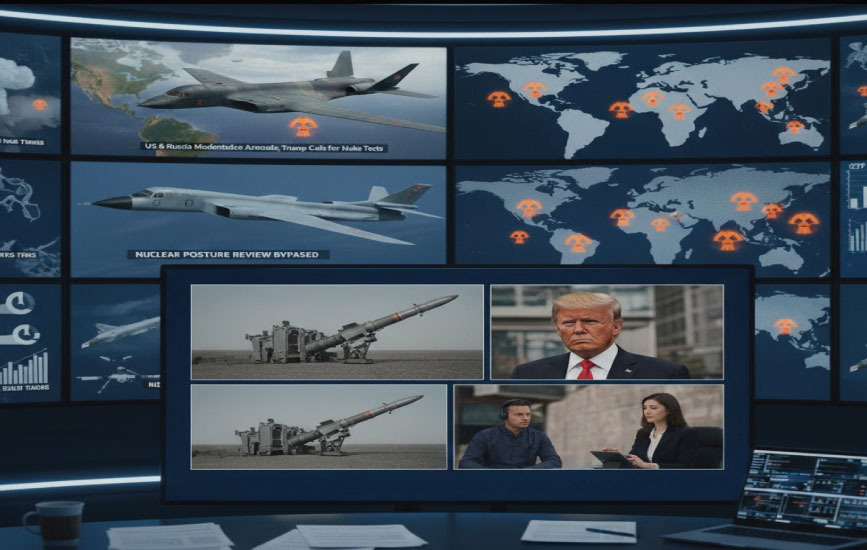
The world is in a phase of transition where multiple poles are arising with another nuclear arms race in the horizon. The only treaty to regulate nuclear policy between the US and Russia that possess 90% of nuclear stockpiles expired in February 2026. The ongoing crisis such as Russia-Ukraine war and the Israel-Iran war 2025 highlights the significance of nuclear weapon. Furthermore, the kidnapping of Venezuela President defines the future trajectory of conflict between the nuclear and non-nuclear state. The year 2025 marked with the realization among the states how security guarantees could not be an alternative to have the nuclear power. The super powers are also aiming to modernize their nuclear arsenals as evident in Trump’s call to resume nuclear testing. The Trump in his second term has bypassed Nuclear Posture Review, this policy gaps creates an ambiguity in nuclear doctrine of the US. Trump’s in its 2018 Nuclear Posture Review (NPR) maintains to have modern, flexible and resilient nuclear capabilities where nuclear use could be consider for non-nuclear strategic attacks. In its National Defence Strategy, the US intends to maintain robust and modern nuclear deterrent. A signal towards modernizing nuclear arsenals along with ambiguity in its nuclear posture would spur nuclear arms race. The Stockholm International Peace Research Institute (SIPRI) also signals towards emerging nuclear arms race with a weakening arms control regimes. The erosion of arms control framework reflects how strategic competition has replaced the cooperative security management. The nuclear capabilities are not the weapon of last resort but the instrument of geopolitical advantage. The weakening of institutional restraints, coupled with technological advancements such as hypersonic systems, missile defence, and precision-strike capabilities, has intensified security dilemmas among rival states. In such an environment, deterrence stability becomes fragile as states prioritize flexibility and survivability over predictability, thereby accelerating competitive nuclear modernization.
As global nuclear restraints weaken, it would have implications for South Asia as well, where India is recalibrating its nuclear posture. There are growing debates within Indian strategic circles over counterforce options. The pursuit of counterforce capabilities, supported by advances in surveillance, intelligence, and precision targeting, indicates a shift toward seeking escalation dominance. As per SIPRI findings, there is continued growth in Indian nuclear arsenals, its nuclear stockpile increases from 164 to 172 in 2024 and stands at 180 in 2025. India is already expanding its nuclear stockpiles, developing new types of nuclear delivery system and putting canister-launched ballistic missiles into operation with multiple warheads. These developments suggest a gradual shift towards offensive capabilities, a shift from No First Use doctrine rather than mere modernization. The political leadership also communicated the message clearly, where the Defence Minister Rajnath Singh claimed following the Balakot crisis; “India has strictly adhere to NFU doctrine. What happens in future depends on the circumstances.” The former US Secretary of State Mike Pompeo in his memoir, Never Give an Inch explains the intensity of the crisis. Mr. Pompeo says he does “not think the world properly knows just how close the India-Pakistan rivalry came to spilling over into a nuclear conflagration in February 2019.” The conflict between the two nuclear-armed states, Pakistan and India demonstrates how nuclear weapons cannot prevent a conflict. The May 2025 escalation once again pushed South Asia region to the brink of nuclear catastrophe. The missile misfire incidents be it Brahmos or Pokhran exercise misfire, raised a question on India’s command and control system. With the growing nuclear arsenals given the poor command and control system, risk of escalation intensifies, that might lead to catastrophic miscalculation in the age of information warfare.
The recurring crises between nuclear-armed rivals demonstrate an important paradox of nuclear deterrence. The strategic weapons may prevent full-scale war, they simultaneously create space for limited conflicts under the nuclear threshold. Political leaders may assume escalation can be controlled, yet the presence of advanced delivery systems, real-time media pressures, and cyber and information warfare complicates crisis signaling. Misinterpretation of military movements or technological failures can rapidly escalate tensions. The stability-instability dynamic therefore remains a defining feature of South Asian security, where deterrence prevents total war but fails to eliminate recurring confrontation. These developments carry direct implications for Pakistan, as India modernize and expand its nuclear arsenals with doctrinal ambiguity, the minor crisis risk generating disproportionate escalation. The emerging reality is one of crisis-prone deterrence, in which rapid force development, and weakening global arms-control norms collectively increase the risk of miscalculation, making South Asia particularly vulnerable in an increasingly deregulated nuclear order.