The United Nations’ Sustainable Development Goals (SDGs) provide a comprehensive framework to tackle emerging global challenges such as poverty, hunger, healthcare water scarcity, and climate change. Achieving these goals is very important for human security. In 2015, all UN Member States adopted Agenda for Sustainable Development and its 17 Sustainable Development Goals. These provide a universal set of goals that has to be achieved by 2030. Here raises the question how nuclear technology belongs in the SDGs conversation?
Nuclear technology is always considered as strategic asset but in the fact it has dual use and can contribute in achieving SDGs. Sama Bilbao y León, Director General of the World Nuclear Association, emphasizes, nuclear technology contributes directly to all 17 SDGs.
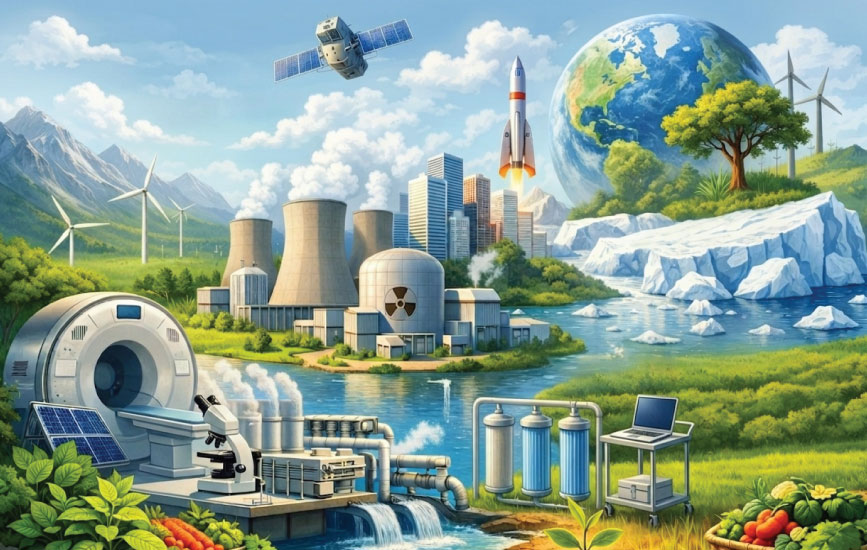
Nuclear technology provides clean, low-carbon and affordable electricity (SDG 7). In agriculture, nuclear techniques increase crop yields, control pests, and develop climate-resilient varieties (SDG 2). Effective use of nuclear technology in agriculture can help control food related diseases and improve both the quantity and quality of food. Globally, up to 40% of crop yields and millions of livestock are lost each year due to pests and disease. As a result, approximately 822 million people are malnourished, not merely because of insufficient food, but also due to poor food quality and nutrient losses. Around 9 million people die annually from hunger and hunger related diseases.
Nuclear medicine and cancer treatment expand access to life-saving healthcare (SDG 3). Nuclear-powered desalination and water recycling enhance water availability (SDG 6), while low-carbon nuclear energy mitigates climate change (SDG 13). Nuclear energy promises clean, affordable and reliable source of energy. It emits no greenhouse gases that’s why it is also considered as clean source of energy.
A report titled “ Nuclear’s contribution to achieving the UN Sustainable Development Goals” compiled through collaboration by the Canadian Nuclear Association (CNA), European nuclear trade body Foratom, the Japan Atomic Industrial Forum (JAIF), the Nuclear Energy Institute (NEI), the Nuclear Industry Association (NIA) and World NuclearAssociation.
This report highlighted how nuclear technology can contribute to addressing issues such as eliminating hunger, improving health, providing access to affordable and clean energy, generating decent work and economic growth, and mobilizing climate action. To tackle these issues is the goal of SDGs.
This will not only strengthen the energy security but also contributes directly to climate mitigation. Since climate issue is a global issue by investing nuclear energy in one region would have broader benefits for the world. Nuclear energy is the clean source of energy. Tom Greatrex Chief Executive, Nuclear Industry Association also stated that “Reliable nuclear carbon-free energy provides the foundation of a clean energy future to reach climate goals and improve public health and quality of life”. The IPCC has identified nuclear power as important for limiting global warming to 1.5°C. Integrating nuclear technology with SDGs thus creates a strategic way to attract investment for climate friendly world.
Different countries are using nuclear technology to achieve SDGs and here are few examples;
China has very high electricity demand because of its large population and fast economic growth. Currently China has more than 50 nuclear reactors with over 60 GWe nuclear capacity. In 2023, China produced about 9548 TWh of electricity, and nuclear power provided 435 TWh .Most electricity still comes from coal and other fossil fuels which cause pollution. That’s why several more reactors are under construction so that more nuclear energy can be produced.
United States is the largest producer of nuclear energy in the world. It produces about 30% of the world’s nuclear power. In2024 nuclear reactors in the United States generated about 816 TWh of electricity which made up around 18% of the country’s total electricity production. At present the United States has 94 operating nuclear reactors with nearly 97 GWe of capacity.The U.S government has also set a long-term goal to increase nuclear capacity to about 400 GWe by 2050.
Russia is also a global leader in nuclear energy and innovation. The country has 38 reactors spread across 11 power plants with a total capacity of 27.9 GWe supplying 19.7% of its electricity. Russia have advanced reactor technologies including fast neutron and sodium-cooled reactors.The country also exports nuclear technology and is building about 20 reactors in other countries.
Canada produces 15 percent of its energy from nuclear energy. The country has 19 reactorswith a total capacity of 14.6 GWe. Nuclear power is very important for Canada to reach its net-zero targets by 2050. There is also a big focus on Small Modular Reactors (SMRs) to increase clean energy capacity in the future.
These examples show that nuclear energy is very important for achieving many SDGs as energy every sector, like health, agriculture, water, and industry. Without reliable energy nothing can work properly. That is why many countries are investing directly in clean and sustainable energy including nuclear power. By focusing on energy they can support multiple Sustainable Development Goals at the same time such as affordable and clean electricity, climate action, health, and food security.
Developing countries often face energy shortages which impact their economy badly. Globally, electricity demand in developing countries is projected to more than double by 2035.They mostly depend on imported oils to meet their energy demands which becomes very expensive. For them nuclear power can make a big difference. It is affordable clean, reliable energy that can help to improve health, farming, and industry. Small Modular Reactors (SMRs) are especially suitable for such countries because they are cheaper, easy to build making nuclear energy more practical for countries with fewer resources.
Pakistan serves as a clear example that how developing countries can effectively use nuclear technology for SDGs. Pakistan became an SDG member in 2015 and its parliament formally endorsed the SDG framework to align national development priorities with global goals. The country has integrated nuclear technology into this strategy to address energy, health, agriculture, water, and climate challenges.
Pakistan six operational nuclear power plants and its nuclear electricity production has increased from 21.3TWh in 2023 to a new all-time high of 21.7TWh (net) in 2024.The share of electricity from nuclear power plants to the commercial grid increased from the 16.2pc peak in 2023 to a record 17pc in 2024. Pakistan’s nuclear plants prevent over two billion tonnes of CO₂ emissions annually.
During recent visit of PM Pakistan to IAEA, he stressed that Pakistan reaffirmed its commitment to SDGs. DG IAEA also recognized Pakistan as responsible nuclear state
Nuclear medicine facilities, managed by the Pakistan Atomic Energy Commission (PAEC), perform over one million procedures annually across 19 cancer hospitals and one is under construction in Muzaffarabad, Azad Jammu & Kashmir. Pakistan was designated a Regional Center for cancer treatment under IAEA’s “Rays of Hope” program
In agriculture, nuclear techniques have developed more than 150 high-yield, disease-resistant crop varieties along with Integrated Pest Management programs improving millions of acres of farmland. Food irradiation preserves crops and reduces pathogens.
Pakistan is not member of NPT still it has maintained the status of responsible nuclear state. Recently, DG IAEA Rafael Grossi stated that Pakistan is “well placed” to help other member states in the peaceful applications of nuclear technology. Still Funding remains a challenge as Pakistan is also not a member of the Nuclear Suppliers Group (NSG) which limits it access to certain civil nuclear technologies. However it is strictly committed to SDGS and has been integrating nuclear technology in SDGs.
Nuclear technology has increasingly become part of the SDGs conversation. One important reason is funding. The United Nations provides financial support for initiatives linked to the SDGs. By framing nuclear technology within this agenda it can attract findings. This would be particularly significant for developing countries many of which lack access to resources for civilian nuclear programs. Linking nuclear technology to SDGs allows these countries to receive loans, grants, and technical support from international organizations. Consequently, investments can flow into different aspects of nuclear technology, especially clean and low-carbon energy.
Recently, World Bank Group (WBG) has also ended its longstanding ban on funding nuclear project first imposed in 2013. This also opens new avenues for developing countries. President Ajay Banga signed an agreement with the IAEA in June 2025 to support safe, secure, and responsible nuclear energy integration. This partnership enables WBG to provide loans, grants, and expertise for lifetime extensions of existing reactors and the deployment of Small Modular Reactors (SMRs).
This is the best opportunity for developing countries to get funding for nuclear energy. By linking nuclear projects to the SDGs these countries can access financial support, technical expertise and international cooperation from organizations like the World Bank and IAEA. Such support can help them build clean, reliable, and low-carbon energy systems and reduce dependence on fossil fuels which will strengthen energy security and sustainable development goals.