

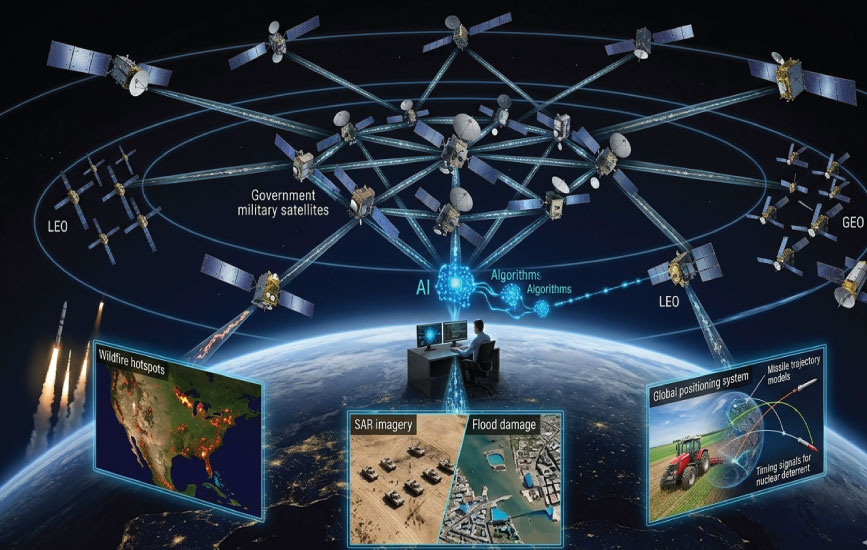
Space based nuclear command, control and communications (NC3) systems were developed as highly classified and sovereign systems, insulated from external influence and designed to survive in the most extreme circumstances. Constructed in the 1960s, the systems made sure that states were able to reliably identify and retaliate against threats, maintaining deterrence stability.
Contemporary space-based capabilities are frequently used to play dual national security and civilian purposes. An example of this is how the SBIRS and DSP constellations which were launched to detect missile launches, are now used to detect wildfires and volcanoes through their thermal signatures. Likewise, Synthetic Aperture Radar systems such as COSMO-SkyMed are vital in reconnoitering the ground positions of military forces and at the same time, aid in disaster relief and agricultural planning. Military NC3 infrastructure is defended by strategic satellites such as Vigil and DSCOVR against space weather, and is used to defend civilian power grids against blackouts caused by the sun. Lastly, GPS is the most well-known dual-use system, which both furnishes the nuclear timing and targeting required by defense as well as the global navigation and financial synchronization of billions of people daily.
The overall space architecture for almost all nuclear states is transitioning toward a hybrid approach that uses commercial, international, and government systems and capabilities to enhance space mission assurance. The benefits of this hybrid approach are clear for mission areas, but it is not necessarily ideal for NC3.
This dimension of space based NC3, which I would call Hybrid NC3, a system in which state-managed, dual-use infrastructure — serving both civilian and military functions — is increasingly embedded within NC3 architectures. Though such hybridization leads to greater resilience, flexibility, and technological innovation, it also exposes new vulnerabilities that current arms control systems are poorly prepared to respond to. By doing so it is quietly changing not only the functioning of nuclear systems, but the way in which nuclear risks are created, perceived and possibly miscalculated.
Hybrid NC3 around the world
In nuclear-armed countries, this hybridization is already far advanced. In the United States, the new programs like the Joint All-Domain Command Control are intended to be able to utilize the conventional battlefield sensors including those that are made possible by commercial technologies to a common command architecture that may be connected to the nuclear decision-making processes. The convergence indicates a larger shift towards data-centric warfare where the lines between conventional and nuclear space are becoming permeable.
The institutionalization of the integration of dual-use systems in China is in its policy of Military-Civil Fusion. Civilian space infrastructure such as BeiDou Navigation Satellite System and reconnaissance systems such as Yaogan satellite series are aimed at helping spur economic growth as well as strategic military endeavors. This model makes sure that commercial innovation is directly beneficial to the national defense, including its applicability to NC3.
Likewise, Russia is also dependent on a hybrid solution and uses its GLONASS constellation to provide both civilian and military navigation. It is also reported that Russia has integrated commercial satellite assets into its conflict with Ukraine as well as commercial satellite imagery into its larger strategic systems as well, as a sign of evolution in technological warfare and the limitations of international sanctions.
In India, parts of the command structure utilize infrastructure of the civilian domain, such as radar systems at commercial airports and hyperspectral imaging satellite data. Instead of creating completely different systems, India seems to follow a cost-effective hybrid approach, which involves the exploitation of the available communication satellites in strategic use where possible.
The strategic lure is apparent. Commercial constellations (especially in low Earth orbit) offer the benefits of redundancy. Artificial intelligence is used to improve the capacity to process large amounts of data in real time and increase situational awareness. Hybrid NC3 has a more flexible and adaptive command system in operations.
Strategic ambiguity and the new escalation risks
But these benefits come with great danger. Dual-use technologies have blurred the line between civilian and military assets and have resulted in a strategic ambiguity. Satellite navigation systems like the Global Positioning System, BeiDou Navigation Satellite System and the GLONASS are all used to assist civilian life as well as provide precision targeting of the nuclear-capable systems at the same time. Commercial imagery, commercial communication networks do the same dual role.
A foe desiring to undermine nuclear command systems can strike civilian systems that are functionally strategic. These measures can be viewed as the first stage of a nuclear first strike. Militarily, crippling space-based systems accomplishes two vital goals: blinding early warning and cutting command communications. Consequently, satellite attacks — intentional, limited and even accidental — may lead to escalatory reactions based on deeply rooted doctrinal assumptions.
This threat is compounded by nuclear decision-making time constraints. Early warning systems normally give 15 to 30 minutes to evaluate an impending threat. The decision window is so small with these systems that at the time of any greater uncertainty, leaders might face the use-it-or- lose- it problem that adds to the probability of miscalculation.
This time constraint problem is then dealt with by incorporating artificial intelligence within NC3 architectures to accelerate decision-making processes. AI-enabled decision support systems, such as the Maven Smart System used by the U.S., can rapidly process vast streams of satellite, drone and intelligence data to assist in targeting and operational planning. Evidence suggests these systems dramatically increase operational tempo; for instance, U.S. forces reportedly struck 2,000 targets within four days in its conflict with Iran, a scale that previously required months. The Israeli military is reported to devote roughly 20 seconds to validating targets flagged by the AI-enabled Lavender system. However, the incorporation of AI introduces its own set of destabilizing risks. Automation bias may lead decision makers to over-trust algorithmic outputs, while cognitive offloading can erode critical human judgment over time. Additionally, the black box nature of AI systems limits interpretability and transparency, and the secrecy surrounding their development inhibits accountability. Together, these dynamics risk accelerating conflict, compressing decision time further and increasing the likelihood of miscalculation in already volatile nuclear environments.
Solving the Hybrid NC3 challenge
To address these risks, states must move beyond general principles and adopt concrete regulatory and institutional measures. First, dual-use space assets integrated into NC3 should be formally classified as strategic infrastructure, regardless of their commercial status. This proposition is supported by research from the Stockholm International Peace Research Institute, which highlights how the integration of space systems into nuclear deterrence creates new escalation pathways. Yet current legal frameworks, including the Outer Space Treaty, remain rooted in a 20th-century paradigm and are ill-equipped to regulate the realities of a commercialized space domain.
Second, states should work toward developing non-targeting norms. It could be done potentially through the United Nations Office for Outer Space Affair. This initiative could discourage attacks on commercial satellites linked to military command systems. Existing International Humanitarian Law already prohibits indiscriminate and disproportionate attacks, but the blurring line between military and commercial satellites makes this difficult. For instance, the use of Starlink in Ukraine or Maxar imagery in conflict zones has already placed private assets in the crosshairs, proving that adversaries may not respect their commercial status if they provide a military advantage.
Third, national regulatory regimes must impose mandatory obligations on private satellite operators, including risk disclosure, encryption standards and operational transparency, particularly where their systems support military functions. This is necessitated by evidence that many commercial satellite communications remain vulnerable, creating potential single points of failure for entire industrial and military operations. But the positive development is that groups such as the Space Information Sharing and Analysis Center are already working towards bridging this gap between corporate operations and national security requirements.
Finally, crisis management mechanisms must be institutionalized through incident notification agreements and data-sharing protocols for space-based disruptions. Historical experience (most notably the Cuban Missile Crisis) demonstrates the critical role of communication in preventing escalation, yet no equivalent system currently exists for space-based incidents. Without such mechanisms, the risk of misinterpretation in a congested and contested orbital environment will continue to grow.
The development of Hybrid NC3 is indicative of a more general change in the character of power, in which the lines between state and market, between civilian and military are growing less distinct. But nuclear stability is based on control, reliability and clarity. The hybridization of command systems is at risk of sabotaging these pillars without the relevant governance. States are not simply improving their capabilities in modernizing their nuclear infrastructures, they are transforming deterrence itself. The threat is not just that these systems will fail, but they will fail in a manner that is not well understood. That is a danger that the international system can ill afford in an area where miscalculation can be disastrous.
Qurat-Ul-Ain Shabbir is a PhD scholar at Quaid-i-Azam University, Islamabad, and currently serves as a research officer at the Centre for International Strategic Studies AJK.