NARENDRA Modi, after assuming office in 2014, initiated the Make in India drive, which fundamentally aims to reduce reliance on foreign arms imports and build robust domestic defence manufacturing. This vision reflects India’s aspiration to emerge as a leading global power in defence production. The initiative is formally termed “Atmanirbhar Bharat” or self-reliant India.
India has historically relied heavily on Russia for arms imports. Over time, due to affordable pricing, updated technology systems and joint production platforms, nearly 86% of India’s defence infrastructure became Russian in origin. This strategic alignment dates back to the Cold War era, when both states maintained a strong partnership. From 2011 to 2021, Russia held the largest share in India’s defence imports, with no other country surpassing it, except France in 2021 with imports worth $2.1 billion. Although the Russia-Ukraine conflict reduced Moscow’s role, Russia still accounts for around 40% of India’s arms imports.
A critical review of the Atmanirbhar Bharat drive reveals that India has struggled to achieve true self-reliance in arms production. The Stockholm International Peace Research Institute (SIPRI) report on international arms transfers (2025) identifies India as the second-largest arms importer globally, accounting for 8.2% of total global imports—roughly one out of every twelve weapons exported worldwide.
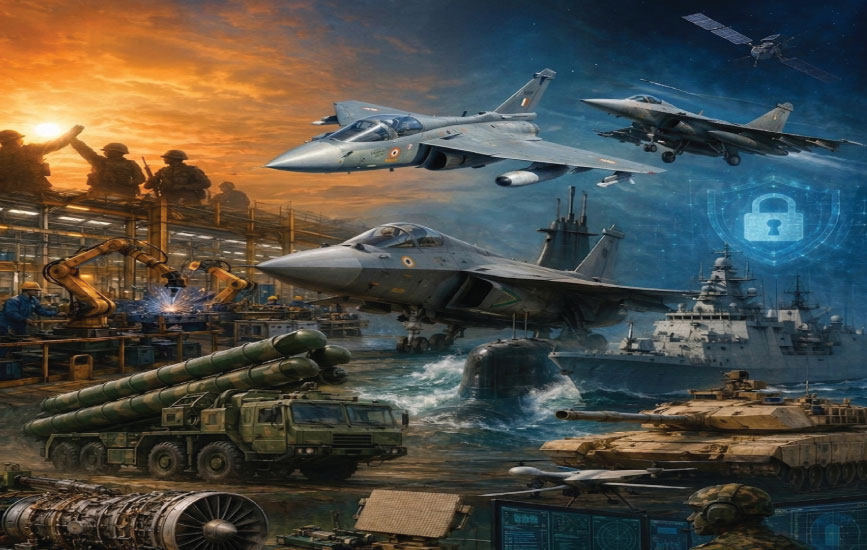
Although India’s arms imports declined by 4% between 2016–2020 and 2021–2025, domestic production has faced persistent delays and reliability issues, pushing New Delhi back toward foreign suppliers. For instance, the Tejas Light Combat Aircraft (LCA) has experienced repeated delays in full-scale induction into the Indian Air Force, along with technical setbacks, including crashes that led to temporary grounding. Similarly, delays have affected Project 75(I) submarines and the Advanced Medium Combat Aircraft (AMCA) programme. These logistical and technical challenges undermine India’s doctrine of self-reliance and reinforce dependence on external sources.
India continues to prioritize military modernization through major foreign procurements, including plans to acquire and co-produce 114 Rafale jets with France, additional S-400 systems and a submarine deal with Germany. While some involve co-production, many advanced platforms are directly imported. India’s 2026 defence budget rose from $74 billion to $86 billion, with $23 billion allocated for capital expenditure on new weapons and systems. Such large-scale imports contradict its self-reliance goals. Russia remains the largest supplier with a 40% share, followed by France at 29% and Israel at 15%.
India’s ambition to become a global defence manufacturing power exceeds its current capabilities, as indigenous production still depends on foreign suppliers for critical technologies. These include jet engines, UAV systems, submarine propulsion, advanced air defence platforms and essential components such as semiconductors, radars and sensors. Even domestically produced platforms like the Su-30MKI and Tejas rely on imported engines, avionics and subsystems.
India is also shifting its strategic focus from border security to maritime dominance and high-tech warfare. To sustain this posture, it is investing in advanced technologies such as space-based systems, cyber defence units and autonomous platforms. According to reports, India’s arms imports are driven by its perceived competition with China and Pakistan, contributing to a growing arms race in South Asia. This expanding military expenditure risks intensifying regional instability and undermining deterrence stability.
Despite the rhetoric of self-reliance, India remains dependent on foreign suppliers for key defence platforms and technologies. The gap between policy vision and ground realities highlights the limitations of the Atmanirbhar Bharat initiative in achieving genuine strategic autonomy.