

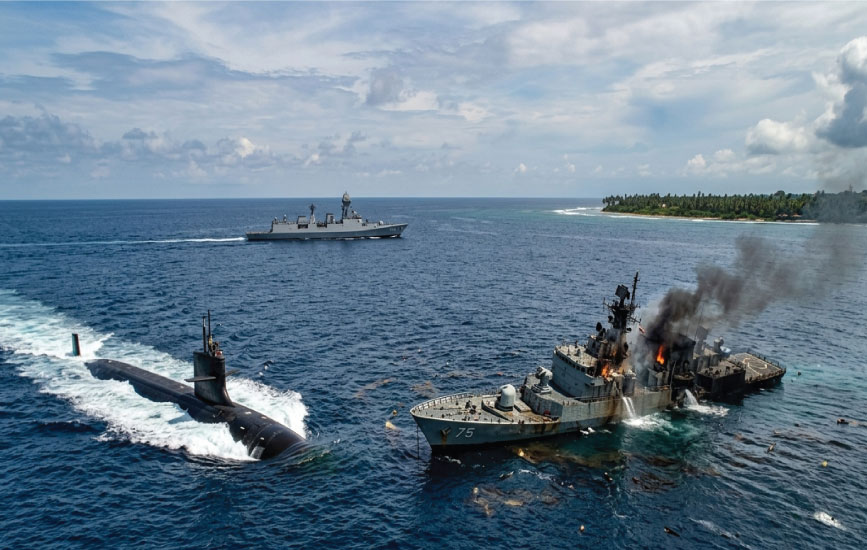
India’s aspiration to emerge as the preeminent security provider in the Indian Ocean faced an unexpected test on March 4, 2026. The sinking of the Iranian frigate IRIS Dena by a U.S. Navy submarine, while the ship was returning from India’s flagship MILAN 2026 naval exercises, exposed the tension between India’s lofty maritime ambitions and the practical limits of its “multi-aligned” foreign policy. The incident starkly contrasts with Prime Minister Modi’s claims under the SAGAR (Security and Growth for All in the Region) vision, raising fundamental questions about India’s credibility as a regional security guarantor.
India’s SAGAR initiative, launched to position New Delhi as the “preferred security provider” and first responder in the Indian Ocean, is central to its maritime strategy. The policy frames India as a promoter of a “rule-based order” and the guardian of vital shipping lanes—essential for trade and energy security. By 2025-2026, India elevated this vision to MAHASAGAR (Mutual and Holistic Advancement for Security and Growth Across Regions), signaling global ambitions and the intent to counter China’s influence in the region.
Through SAGAR and MAHASAGAR, India projects itself as the anchor of stability for the Global South, promising security not only for allies but also for non-aligned regional powers. However, the IRIS Dena incident revealed a glaring gap between rhetoric and operational capability.
On March 4, 2026, the IRIS Dena, returning from MILAN 2026 exercises hosted by the Indian Navy in Visakhapatnam, was sunk by a U.S. submarine in the Indian Ocean off Sri Lanka. While the strike occurred in international waters, it struck a vessel closely tied to India’s regional engagement efforts. The United States described the operation as part of Operation Epic Fury, a distant theater action, while India’s Ministry of External Affairs denied any involvement of Indian facilities.
The IRIS Dena was not an ordinary ship; it was a participant in India’s flagship naval exercise. By failing to intervene—or even strongly protest—the attack on a vessel invited under India’s auspices, New Delhi sent a troubling signal to other regional actors. Middle powers such as Indonesia, South Africa, and Brazil may interpret India’s behavior as proof that its security guarantees are contingent on U.S. approval.India appeared more as a spectator than a provider, undermining the SAGAR claim of unconditional maritime stewardship.
SAGAR promises “security for all,” yet the IRIS Dena incident suggests a narrower interpretation. The presence of a U.S. submarine conducting offensive operations within the Indian Ocean, without Indian resistance or diplomatic pushback, indicates that the region remains a playground for superpowers. India’s ability to assert strategic autonomy is constrained when its “zone of influence” is effectively shared with or overshadowed by external powers. Critics argue that if SAGAR cannot protect the vessels and actors it invites, its credibility as a framework for regional security is severely weakened.
Historically, India has positioned itself as a champion of the Global South, seeking to combine moral authority with strategic leverage. Yet, the IRIS Dena episode frames India as a junior partner in a U.S.-led order, rather than an independent leader. If New Delhi cannot ensure the safety of international waters immediately off its neighborhood, its claim to being the “Net Security Provider” is largely aspirational. The credibility gap in the Indian Ocean is now public, and India’s claim to independent leadership faces tangible skepticism. The IRIS Dena incident is a wake-up call for India’s maritime strategy. Ambitions under SAGAR and MAHASAGAR cannot rely solely on rhetoric; operational credibility and assertive diplomacy are equally essential. Otherwise, lofty visions risk being dismissed as aspirational narratives, while the realpolitik of superpower influence continues to define security in the Indian Ocean.