The Israel–US war with Iran has evolved into a protracted, asymmetric conflict in which neither side can secure a decisive victory, with escalating global economic and strategic consequences.
The Middle East is on the brink of an unprecedented escalation. Recent US–Israel operations against Iran—Roaring Lion and Epic Fury—have shattered previous assumptions about the regional balance of power. Thousands of strikes have targeted Iranian leadership, military infrastructure, and critical civilian systems, employing a combination of kinetic bombardment and psychological pressure designed to force Tehran’s hand.
Yet, rather than collapsing under duress, Iran has demonstrated remarkable resilience, retaining substantial missile and drone capabilities that repeatedly frustrate Washington and Tel Aviv. Efforts to cripple Iran’s nuclear and defence sectors have fallen short, exposing the limitations of conventional military superiority against an adaptive, asymmetric adversary.
For Israel and the United States, the strategic calculus is now stark: the conflict may only conclude through negotiated exit terms—terms that preserve face for both sides. Yet diplomacy demands Iran’s consent, a commodity Tehran has little reason to offer prematurely, particularly after losing key leaders and enduring severe infrastructural damage. As one scholar aptly noted, “you cannot keep peace where there is no peace to keep.” Pushing Iran through coercion may only prolong hostilities, magnifying global economic and security risks.
Washington and Tel Aviv have explicitly framed regime change as a strategic objective. They have amplified domestic dissent within Iran through digital campaigns and political messaging. Yet raising expectations of an imminent collapse carries political risk: failure to achieve regime change may be interpreted as defeat, imposing reputational costs on both governments. Analysts widely doubt that the Islamic Republic will crumble in the near term.
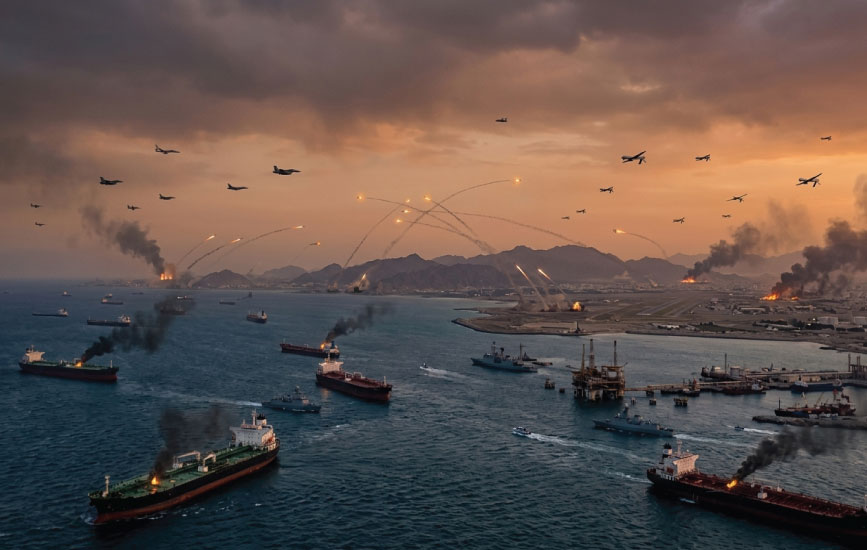
Operationally, the conflict has reached a historic scale. Israel reportedly deployed roughly 200 fighter jets to strike hundreds of Iranian targets, including missile launchers and air defence sites, marking its largest sortie in modern history. Concurrently, the United States executed Epic Fury, employing Northrop B-2 Spirit bombers, F-35 Lightning II aircraft, Tomahawk cruise missiles, and drones against Iranian command centres and ballistic missile facilities. Iran responded with over 170 ballistic missile launches on the first day alone and has since sustained continuous missile and Shahed-136 drone attacks against Israeli and US positions across the Gulf, from Qatar to Saudi Arabia.
The asymmetrical dynamics of this conflict are stark. Shahed-136 drones cost roughly $20,000–$50,000 each—sometimes up to $80,000—while defensive interceptors are exponentially more expensive. Israel’s Iron Dome Tamir interceptor costs $40,000–$100,000 per launch, David’s Sling roughly $1 million, and Arrow 3 or US Patriot PAC-3 systems $3–4 million, with THAAD interceptors exceeding $10 million.
By targeting US bases and controlling the Strait of Hormuz, Tehran raises the economic and strategic costs of war, consolidating its current advantage while deterring future aggression.
Low-cost Iranian strikes can thus impose immense financial and operational burdens on advanced militaries, especially under saturation attacks. Analysts estimate that the first hundred hours of defence operations alone cost between $1.2 and $3.7 billion. Contemporary warfare is increasingly a test of economic endurance, where success depends as much on inventory management as battlefield dominance.
The conflict’s intensity escalated dramatically following Ali Khamenei’s assassination. Israel transitioned from a protracted confrontation with Hezbollah to a full-scale incursion into southern Lebanon on 16 March 2026, combined with extensive airstrikes across Beirut that displaced over one million civilians.
Meanwhile, Iran’s strategic counter-move—blocking the Strait of Hormuz—represents a decisive turning point. This chokehold, disrupting roughly 20 per cent of global oil exports, challenges US hegemony and signals a shift towards a multipolar world order. Efforts by President Trump to mobilise an international coalition were rebuffed, with London maintaining a strategic distance and Berlin declaring bluntly, “this is not NATO’s war.” Brent crude has surged past $100 per barrel, with war-risk insurance premiums tripling and a geopolitical risk premium of approximately $18 per barrel. Prolonged closure could push oil prices to $130–$200, threatening a global energy shock not seen since the 1970s.
Israel, despite its technological superiority, confronts structural vulnerabilities. Its small geographic footprint, densely populated urban centres, and the proximity of critical infrastructure constrain strategic depth. The 2025 Iran–Israel 12-day war revealed the limitations of Israel’s layered missile defence network, which struggled against adaptive Iranian tactics and saturation attacks.
Today, a critical “interceptor gap” has emerged. With Arrow and David’s Sling interceptors nearing depletion, the Iron Dome is no longer an invincible shield but a dwindling resource. Cost asymmetry—interceptors up to fifty times more expensive than incoming drones or missiles—underscores a sobering reality: in modern attritional warfare, technological advantage alone may not suffice.
Iran has leveraged this asymmetry through its forward-defence doctrine and proxy networks, extending its operational reach without full-scale invasion. By targeting US bases and controlling the Strait of Hormuz, Tehran raises the economic and strategic costs of war, consolidating its current advantage while deterring future aggression.
Central to Iran’s strategy is the Decentralised Mosaic Defence (DMD) doctrine, activated on 2 March 2026. Thirty-one autonomous IRGC units now operate independently, capable of missile launches, drone strikes, or guerrilla operations without direct orders from Tehran. This decentralisation ensures operational continuity even in the event of leadership decapitation, rendering conventional decapitation strategies less effective.
For Pakistan, Iran’s immediate neighbour and a strategic partner of Saudi Arabia, the conflict demands careful navigation. Islamabad has condemned Israeli actions, affirmed Iran’s right to self-defence under UN Charter Article 51, and offered diplomatic mediation. While some speculate that Pakistan could become a target, officials dismiss this scenario, emphasising conventional and nuclear deterrence. Pakistan’s domestic protests underscore public outrage but have not influenced policy, positioning the country as a potential mediator capable of reducing escalation while managing economic risks arising from disruptions in the Strait of Hormuz.
The Israel–US war with Iran is no longer a conventional confrontation—it is an asymmetric, attritional, and economically entangled conflict with global repercussions. With neither side able to secure a decisive victory in the near term, the crisis is likely to evolve into a protracted, multifaceted conflict that tests the limits of modern military power, economic endurance, and regional diplomacy.