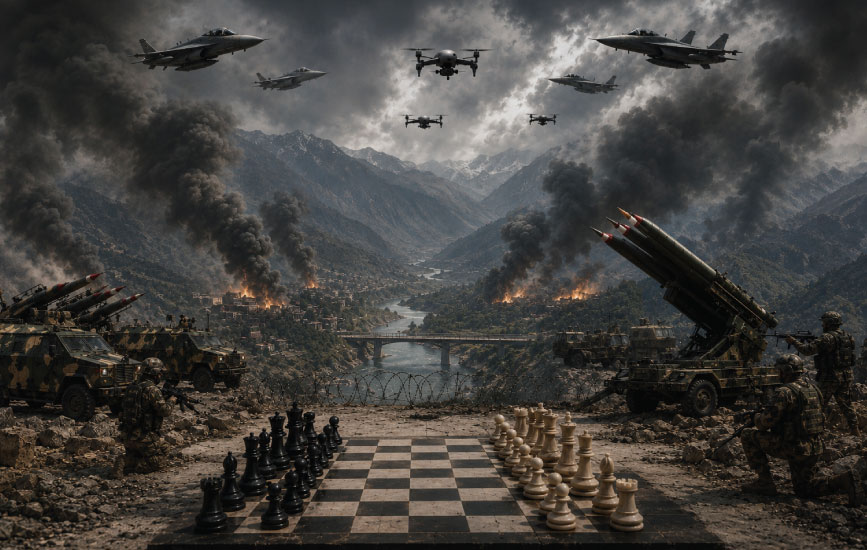
Jammu and Kashmir a disputed territory between Pakistan and India has been termed as “the most dangerous place on earth,” by the former US president Bill Clinton in late 1990s. Relations between Pakistan and India remained precarious since both nations established in 1947 where Kashmir issue remains a cause of disagreement between the two. Following the advent of nuclear weapons, many scholars argued that they were so powerful that no two nuclear-armed powers would dare engage in combat, or at least; they would be discouraged from doing so. Kenneth Waltz, an American political scientist, argues that the cost of nuclear conflict is too high, rational actors would avoid direct war. Bernard Bordie, military strategist also argues that war under a nuclear overhang becomes catastrophic and less usable as a policy option. Despite possessing nuclear weapons, India and Pakistan fought three major wars and faced frequent escalations linked to Kashmir. May 2025 escalation provided the latest reminder of the ease with which Kashmir could transform into a nuclear flash point.
Crisis emerged between Pakistan and India following Pahalgam attack in Indian Occupied Kashmir on April 22, 2025. India immediately blamed Pakistan while refusing its call for independent investigation. In the days that followed India and Pakistan engaged in aggressive military escalation. On night of May 6-7, 2025, India launched missile strike on Pakistan and its Administered Kashmir. Pakistan retaliated under its right to self-defence, downing India’s fighter jets while targeting its critical infrastructure. Within four days, the situation had escalated into most dangerous crisis both countries had experienced since their overt nuclearization. The crisis was on brink of major war, as this episode witnessed an unprecedented escalation involving cruise missile and drone strikes. India deliberately choose to target Pakistan and Azad Kashmir beyond Line of Control. Pakistan too had never responded in such a tit-for-tat manner in previous crisis. The US Vice President J.D. Vance in his interview on the conflict on May 8, 2025 said, “Our hope and our expectation is that this is not going to spiral into a broader regional war or, God forbid, a nuclear conflict.” It was sixth major India-Pakistan crisis since 1998. In each episode, the third party was principally the US brokering a ceasefire. The 2019 Balakot crisis, where Indian airstrike responded by shot down of Indian plane and capture of Indian pilot by Pakistan, also de-escalated with the US intervention. The former US Secretary of State Mike Pompeo in his memoir, Never Give an Inch: Fighting for the America I Love, says he does “not think the world properly knows just how close the India-Pakistan rivalry came to spilling over into a nuclear conflagration in February 2019.”
As per SIPRI findings, there is continued growth in Indian nuclear arsenals, its nuclear stockpile increases from 164 to 172 in 2024 and stands at 180 in 2025. India is already expanding its nuclear stockpiles, developing new types of nuclear delivery system and putting canister-launched ballistic missiles into operation with multiple warheads. These developments suggest a gradual shift towards offensive capabilities, a shift from No First Use doctrine rather than mere modernization. The political leadership also communicated the message clearly, where the Defence Minister Rajnath Singh claimed following the Balakot crisis; “India has strictly adhere to NFU doctrine. What happens in future depends on the circumstances.”
The May escalation had left South Asian crisis management in a more challenging place as this conflict escalated more quickly than previous ones over Kashmir between the nuclear-armed hostile neighbors. During this crisis, a number of military equipment used in novel ways which neither India nor Pakistan had during their previous conflict in 2019. This conflict serves as a baseline, the next India-Pakistan conflict may have very different characteristics due to the speed at which military technology is developing. Furthermore, the crisis has increased the threshold of escalation between the two nuclear-armed neighbors. Christopher Clary in his working paper on Four Days in May: The India-Pakistan Crisis of 2025 rightly argued that “ceasefire is not peace… this crisis will provide the foundation upon which the next crisis will unfold.”
The ceasefire may have halted immediate hostilities, but it did not resolve the underlying drivers of conflict. Instead, the May 2025 escalation may establish a new and more dangerous baseline for future India-Pakistan crises, particularly as emerging technologies reduce reaction time and blur traditional escalation thresholds.
What distinguishes the recent crisis from earlier episodes is not merely the scale of force employed, but the speed and opacity of decision-making enabled by advanced military technologies. The integration of real time intelligence, surveillance, and reconnaissance (ISR), precision strike systems, and electronic warfare capabilities has significantly compressed escalation timelines. In such an environment, traditional mechanisms of signaling meant to communicate intent, restraint, or resolve become less reliable. Actions intended as limited or symbolic can be misinterpreted as escalatory, particularly when decision-makers have little time to assess intent. This creates a condition of signaling failure, where the risks of miscalculation increase pushing both states to the brink of nuclear catastrophe.
Given the severity of the situation, the US President following brokering ceasefire between the two, offered to work with India and Pakistan to achieve a ‘solution’ for the disputed territory of Jammu and Kashmir. A sustainable reduction in these risks ultimately requires addressing the underlying drivers of conflict. The Kashmir dispute continues to provide structural context within which these crisis emerge. Given the history of confrontation of two nuclear-armed states, managing escalation is not solely bilateral concern but one with broader implication for regional and global security. Without meaningful efforts to reduce tensions and improve crisis communication mechanisms, the combination of unresolved disputes and rapidly advancing military technologies will continue to pose significant nuclear threat to stability in South Asia.