

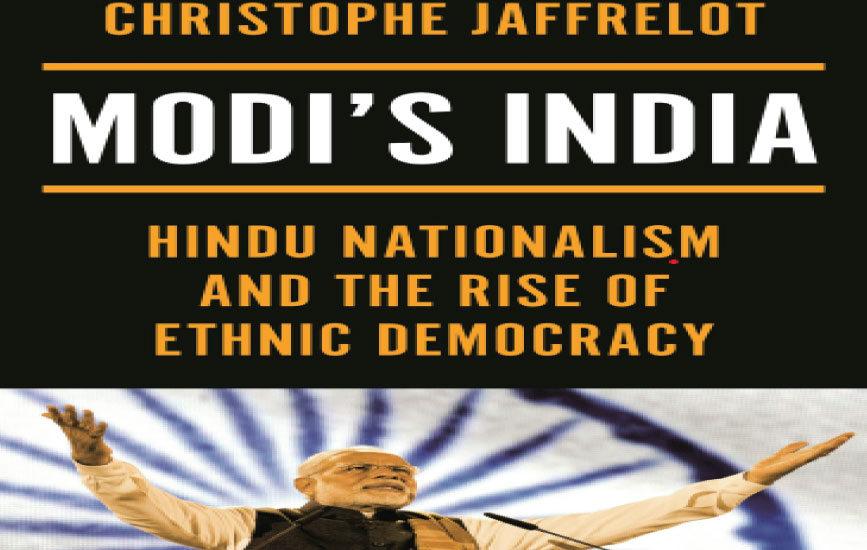
Modi’s India: Hindu Nationalism and the Rise of Ethnic Democracy by Christophe Jaffrelot presents a coherently robust claim about the transformational nature of the political project of Narendra Modi and the Bharatiya Janata Party to change the nature of Indian politics by re-interpreting decades of Hindutva sentiment into a political programme. According to the author, this has gradually altered a pluralistic democracy into an ethnic democracy whereby the country is now synonymous with the majority community. The book is structured around the three ages of India’s democracy, a detailed construction of Modi’s political formation and his rise in Gujarat, an examination of the types of politics the BJP has employed to mobilize hope, fear, and anger, and an extended discussion on the targeting of minorities. The increasing vigilante politics and the institutionalization of authoritarian practices argue this belief thoroughly and with rich empirical details. Jaffrelot begins by historicizing Hindutva, tracking the ideological strains of organisations (particularly the RSS and its affiliates) and social constituencies that predate Modi many decades but that gave form to his national project. He is then able to provide a fine-grained account of Modi and his years as Gujarat chief minister, how the image of a technocratic and development-led leader was created, how incidences of communal violence and hate were handled and presented, and how patronage operations at the local level and media strategies were perfected as a national model. The author empirically shed light on how the BJP under Modi has managed to perfect a contemporary way of electoral mobilization that is a combination of welfare propaganda, performance statements, and symbolic politics. A scarcely perceptible process, the ability of the state to deliver infrastructure, subsidies, and public goods comes coupled with an increasingly assertive majoritarian cultural agenda, and this two-pronged approach has been able to expand the ideological net of the BJP. While doing this, they successfully naturalized the processes of exclusion by coating the rhetoric of cultural otherness with benevolence.
Much of the book is occupied with Jaffrelot’s analysis of the processes whereby minorities, particularly the Muslim and, to some extent, Christian minorities, have been turned into political objects rather than adversaries in a manner that undermines equal citizenship. He traces legislative and administrative action, rhetoric in the mass media, and the rise of vigilante organizations, whose acts also remain condoned by weak prosecution or merely tacitly approved. He argues that such mechanisms translate social ostracism into a sustainable political reality. Jaffrelot is mindful of registering the micro politics of coercion as well as the macro politics of institutional change (patterns of appointment, co-optation, or undermining of autonomous institutions, pressures on the courts and the media, and the mobilization of law and order forces) that collectively result in what he terms a de facto Hindu Rashtra in much of the dissimulation of public life. While writing, he had conducted extensive interviews, studied election results, policy writings, and media studies that, when cold, add up to a convincing argument of systematic, not merely occasional, democratic erosion.
The equally significant attention paid by the author is to how the Indian political elite transformed the populist methods. Jaffrelot demonstrates how Modi gave a Hindu flavour to the world trends of populism by merging popular religious identity with the promises of bringing economic growth and national pride. Therefore, constructing a powerful narrative, which discredits rivals as anti-national or elitist, and justifies forceful action against perceived domestic threats. This thesis is developed in extended chapters discussing the electoral cycles of 2014 and 2019 when a personal brand and tactical use of imagery, as well as a restructured BJP organization, transformed electoral majorities into mandates to make far-reaching changes to institutions, including citizenship legislation and the reconfiguration of federal relationships with states. Jaffrelot does not black-and-white this advance to moralizing criticism. Instead, he traces the trade-offs and the politics of hate that make this transformation stable. How social engineering, such as through refined welfare and exploiting media eco-systems and social media, and nationalism in foreign policy, can help maintain public consent despite the diminution of pluralist checks.
One of the most frightening additions that the book makes is in its densely empirical chapter on vigilante politics and social violence. Jaffrelot reports coercive patterns of lynching, cow-protection vigilantism, and local-level intimidation that are coded in predominantly moral or cultural terms but are, in reality, forms of coercive exclusions and control. He relates these trends to broader dynamics of state capture and targeted destigmatization of the voices of opposition in universities, civil society, and the media, the re-appropriation of force and state instruments to suppress supporters of the alternative. Using a combination of archival research, interviews in the field, and electoral data results, Jaffrelot is able to document not only isolated incidences but also long-term shifts in the way the Indian state relates to minority groups, which altogether point to a structural rearrangement of this relationship.
And lastly, Jaffrelot poses the question of how this political agenda has impacted democratic institutions and India in the international arena. When comparing short-term benefits of the guarantee of political stability, a perception of economic growth, and a more aggressive foreign policy to the long-term dangers to pluralism, the rule of law, and social cohesion, he balances those quantities. He concludes cautiously but emphatically that India today has passed through a phase of democracy into one of ethnicity, where rights and citizenship depend increasingly on cultural-religious belonging, and that only a political alternative able to reconstitute wide-based coalitions and a civil society able to resist institutional pressures can reverse this trend or even stem it. This master piece is a steady, slow burn, neither ignoring the administrative successes of the BJP nor underestimating the popular attraction of the Modi discourse. Still, he has steadily marshalled the institutional, cultural, and legal foundations with the help of which majoritarianism has become a governing principle.
Jaffrelot provides an authoritative, empirically rich, and theoretically informed reading on how Hindu nationalism under Modi has transformed Indian democracy. A reading that readers with a foundational interest in the subject matter must make. It explains in detail the complete structure of the change in terms of its intellectual antecedents, electoral politics, coercive mechanisms, and institutional outcomes, a compelling book that will be indispensable to all who want to grasp modern India.