Next Generation Air Warfare in South Asia: Risks and Way Forward

by Zohaib Altaf

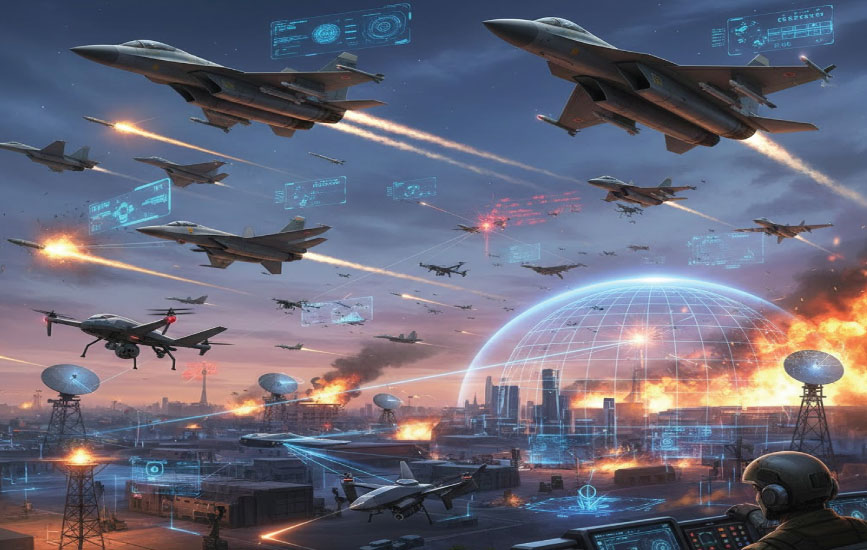
In the early days of May 2025, India and Pakistan engaged in a multi-domain war. It was contested using 125 aircraft with ranges over 160 kilometers (km) as well as a variety of drones. For the first time in decades, major cities and military installations were struck directly using artificial intelligence (AI) targeting. This confrontation between nuclear-armed neighbors in South Asia gave observers a glimpse of the alarming future of warfare in the region with the integration of AI into defense.

In past conflicts, escalation was, in theory, expected to follow a broad but systematic process: detection of a crisis trigger, verification and attribution of that event, political deliberation as to the response, and the execution thereof. While this sequence has rarely been observed in practice—after the Pahalgam attack, for instance, India allegedly launched strikes against Pakistan without confirming the attackers’ identity—AI-enabled systems bypass these stages almost entirely. In an environment where these mechanisms are already under stress, the integration of AI further exacerbates the risks by accelerating decision cycles and weakening human oversight.

As a result, experts around the world fear that the haste to merge AI into command-and-control-systems, battlefield surveillance, autonomous targeting, and decision support tools could shift battle decision-making from traditional human-led “Observe Orient Decide and Act (OODA) loops” to faster, AI-driven “Super OODA” architecture. This would mean reduced human cognition—or the ability of decisionmakers to interpret, evaluate, and contextualize information—and enhanced goal-centric decision-making, in which algorithms prioritize achieving predefined objectives over exercising situational judgment or restraint.

This article examines the platforms that India and Pakistan are each pursuing in the name of diversifying their intelligence, surveillance, and reconnaissance (ISR) capabilities; highlights the dangers of cognitive overload; and offers recommendations to restore predictability and help prevent uncontrollable escalation in South Asia.

India’s Relentless Attempts Toward AI-Integrated ISR

India is attempting to integrate AI and other emerging technologies into its defense structure, particularly in the ISR domain. Its pursuit of AI-enabled or -integrated systems is no different, especially in the few months preceding and following the May 2025 conflict with Pakistan.

In December 2024, for example, the Indian Ministry of Defense announced major upgrades in the Su-30MKI fleet, which was originally inducted by the Indian Air Force (IAF) in 2002. These upgrades included integrating Active Electronically Scanned Array (AESA) radars, extended-range missiles, and jamming systems. These updates could offer the IAF an arguably offensive edge on its strike aircraft that would complement India’s preexisting arsenal of electronic warfare systems, including the SPECTRA electronic warfare (EW) suite. Many of India’s EW capabilities are likely to be upgraded with AI: for example, to manage frequency-hopping, signal discrimination, and adaptive jamming in a highly contested electromagnetic environment. Such AI-assisted integration can act as a complexity accelerant, because rapid automated signal shifts and countermeasures compress decision time in an environment where human cognition is already under pressure. At the operational level, this accelerated tempo can distort situational awareness and narrow the space for deliberate command decisions, effectively turning tactical speed into strategic pressure. In addition to electronic warfare platforms, India has also invested in drone procurement: its imports of Harop and MQ-9 Reaper drones, alongside work by the Defense Research and Development Organization (DRDO) on an indigenous unmanned combat aerial vehicle, are aimed at enhancing India’s military’s situational awareness and integrating AI into surveillance systems and drone swarm capabilities.

India’s modernization push has not remained limited to purely offensive platforms: It is also expanding into AI-based air defense networks that can detect, track, and respond to multiple threats in real time. AI-enabled air defense networks now contribute to broader strike coordination by transmitting real-time tracking and radar data to airborne and ground platforms. In doing so, they blur the traditional boundary between tactical defense and strategic offense. Some of these investments and procurements may have been put to the test in May 2025, when India claimed to have stopped Pakistani inbound airborne drone missiles and other UAVs using its fully AI powered autonomous defense system called the “Iron Dome,” or Akashteer. In the context of multi-domain warfare, it will be increasingly insufficient to view such capabilities as purely defensive assets in the future.

The May 2025 conflict has only accelerated these trends. Within weeks of the announcement of a ceasefire with Pakistan, on May 29, India’s Defense Minister Rajnath Singh approved the execution model for the fully indigenous Advanced Medium Combat Aircraft (AMCA), a fifth-generation stealth fighter jet, which is expected to use AI for mission planning, threat detection, and managing onboard sensors. India also plans to fast track 52 AI-based satellites over the next five years. The Indian army even drew up a detailed roadmap and identified key areas to make use of AI in improving battlefield awareness by developing tools to process large volumes of information in the shortest possible period. It was also reported that the IAF wants to purchase pseudo-satellites, or high-altitude platform systems (HAPS). Taken together, these projects show that India is trying to build an AI-supported command architecture—one that blends air, space, and digital domains that would enable it to make decisions faster and operate with fewer human delays.

From the Indian perspective, these efforts are driven by both strategic competition and national ambition. New Delhi sees China’s rapid progress in AI and defense technology as a long-term threat; however, currently, Pakistan remains a “key security challenge” for India. There is also a sense of prestige that comes from belonging to an exclusive club of technologically-advanced nations, as seen through Indian officials regularly touting science and high tech developments. All of these platforms and procurements are intended both to support faster, informed decision-making processes, and to bolster India’s image as one of the world’s advanced defense powers. In a volatile region like South Asia, however, these developments, no matter their motivations, can act as catalysts for other countries to pursue similar expansions.

Together, these parallel paths have entrenched a cycle of modernization that continues to erode strategic predictability in South Asia.

Pakistan’s Balancing Game  

Pakistan’s airpower modernization reflects its drive to maintain credible and operational effectiveness in an increasingly complex regional security environment. Its efforts are shaped by structural asymmetry and the need to preserve stability. To that end, Pakistan has in the past focused on developing a superior fighter fleet, including the indigenously manufactured JF-17 Block III in 2022, the country’s first 4.5 generation aircraft with the advanced Airborne Electronically Scanned Array (AESA) radar, upgraded sensors, software and engine.

Pakistan has also been working to strengthen indigenous AI capacity. In 2020, Pakistan’s Air Force established the Centre for Artificial Intelligence and Computing (CENTAIC), which focuses on automating threat recognition, data fusion, and cognitive electronic-warfare systems. While the center’s establishment has raised eyebrows in India about the level of possible “integration” between China and Pakistan, especially during the four-day crisis in May 2025—as articulated by prominent Indian opposition leader Rahul Gandhi in parliament—CENTAIC’s work seems focused mostly on local development and training, with some research exchanges, but no sign of shared operational systems or real-time data links.

That is not to say that Pakistan has not successfully deployed Chinese-origin platforms. Building on the momentum of its performance in the May 2025 conflict, the Pakistani government confirmed its plan to acquire 40 Chinese J-35 stealth aircraft in June. The J-35 is a development of the Shenyang FC-31 Gyrfalcon prototype, which will be equipped with China’s PL-17 air-to-air missile, which has a range of 400 km. The Pakistani government also said that Beijing has offered to provide it the new Honq Qi-19 (HQ19) surface-to-air missile system and the Shaanxi KJ-500 airborne early warning and control aircraft. These systems could offer Pakistan a qualitative edge in the near term.

For Pakistan, these acquisitions are a way to narrow the qualitative gap with India (augmented by its expanding defense ties with the United States and other partners), improve early-warning coverage, and strengthen conventional deterrence by denial. They are meant to raise the cost of any limited or preemptive strike in a region where the balance of power is already fragile. Pakistan sees these as necessary steps to maintain deterrence, and sees India’s modernization as driven by its broader pursuit of strategic autonomy, technological superiority, and national prestige. Together, these parallel paths have entrenched a cycle of modernization that continues to erode strategic predictability in South Asia.

Cross-Domain Defense Systems and Potential Risks

In June 2025, the Indian Chief of Integrated Defense Staff (CISC) Air Marshal Ashutosh Dixit said, “future wars will be won by those who complete the Observe, Orient, Decide, and Act (OODA) loop the fastest.”

It is important to understand that while electronic warfare tools are now converging into integrated, network-centric combat webs, they are also compressing political decision-making into faster and more opaque processes. These systems are functionally entangled. Satellite surveillance, for instance, may simultaneously support tactical battlefield awareness and strategic deterrence. Where earlier, tactical and strategic surveillance operated through separate assets and command channels, today, satellite networks fuse both functions, allowing the same data stream to inform real-time targeting and long-term deterrence decisions. This deep inter-connectivity breaks down the traditional escalation ladder that notionally separates tactical and strategic actions. It leads to the emergence of a “strategic state,” in which all systems are entangled across domains, enabling AI-driven and increasingly opaque goal-centric decision-making.

A strategic state operates on a cross-domain architecture of warfare, which perceives a tactical disruption as a strategic provocation. In this case, a limited action—like jamming a radar or disrupting a satellite link—can yield unintended consequences elsewhere in the system. That also leads to overlapping stimuli, which can lead to the system undertaking quick decisions that outpace human cognition. Since Super or Hyper OODA architectures have faster AI-driven systems across multiple domains, a single false positive can trigger retaliation at machine speed, bypassing deliberate decisionmaking and collapsing escalation ladders in seconds.

New Delhi’s declaration that any future terror attack will be treated as an act of war further constrains the space for dialogue and cooperation. With reduced human cognition involved in decisions, a spoofed missile alert could provoke a kinetic response before political leaders can even fully come to terms with what has occurred.

A strategic state operates on a cross-domain architecture of warfare, which perceives a tactical disruption as a strategic provocation. In this case, a limited action can yield unintended consequences elsewhere in the system.

The Way Forward

With both states advance toward highly-networked, AI-enabled, and stealth-augmented force postures—reflected in India’s satellite-linked ISR and autonomous defense systems, and Pakistan’s growing reliance on stealth aircraft and cognitive-EW tools—the margin for error in a potential future conflict is shrinking fast. As the architecture of deterrence—historically reliant on time, buffers, and human judgment—gets increasingly eroded by compressed decision cycles, multi-domain integration, and evolving Super OODA architectures, it is imperative that both states urgently invest in robust crisis communication frameworks. Existing channels would have to be fortified; for example, the DGMO hotline should be upgraded to a 24/7 secure voice-data link that is integrated with air force operations rooms to enable real-time flight deconfliction. In the event of contested jamming or spoofing, raw spectrum logs ought to be shared within 12 hours.

In addition to these tactical steps, both states must develop an understanding on use of AI in the military domain. On the diplomatic stage, India has expressed its support for the principle of openness, safety, trust, and accountability on AI. Pakistan, for its part, has repeatedly stressed in UN fora the need for meaningful human control, along with strong ethical oversight, transparency, and safeguards, in military use of AI.  

In a politically complex neighborhood with a history of conflict, these mechanisms may admittedly be difficult to establish, but the cost of inaction on crisis mechanisms will be catastrophic. Retaining “human-in-the-loop” control, verifiable through third-party escrow, in a depoliticized set-up is of the utmost importance to prevent future conflicts from spiraling beyond control. If both India and Pakistan do not pursue and institute confidence-building measures focused on AI, they risk the peril of technology outpacing human reasoning and insight.

Views expressed are the author’s own and do not necessarily reflect the positions of South Asian Voices, the Stimson Center, or our supporters.