When the OPCW’s Scientific Advisory Board released its Temporary Working Group report on chemical forensics, most capitals either filed it under routine multilateral paperwork or handed it to a junior diplomat to summarize. For Pakistan, this is precisely the kind of document that deserves serious, undivided attention. The nineteen recommendations in that report represents a fundamental rethinking of how the international community investigates chemical weapons incidents, and they demand active participation from capable member states. Pakistan should be reading this as a country with both something to contribute and something consequential to gain.
What This Field Actually Does
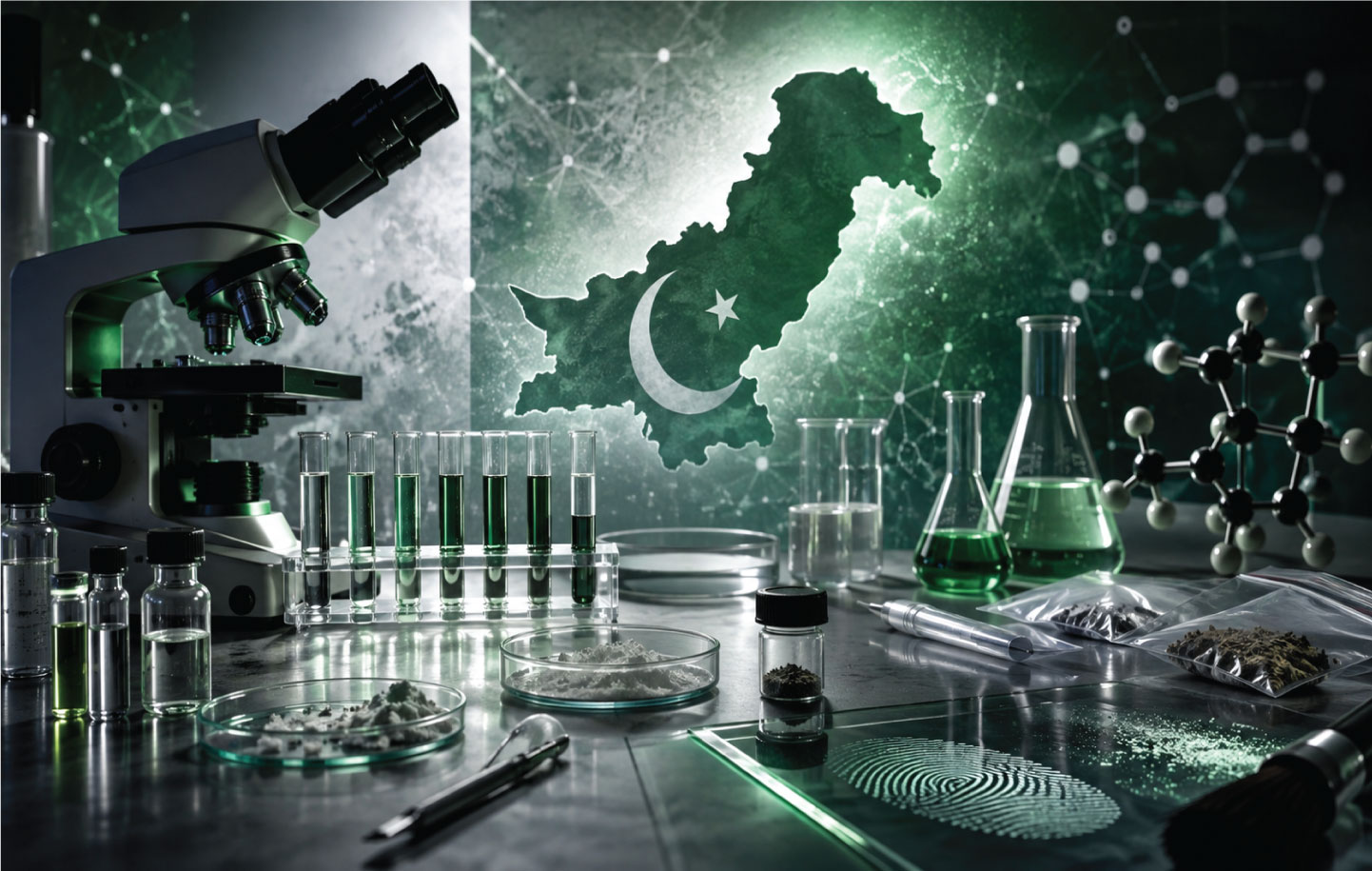
Chemical forensics goes beyond confirming that a toxic agent was used. It establishes how something was synthesized, where precursors came from, and which production pathway was followed. It is the science of attribution. In a world where non-state actors have demonstrated willingness to weaponize industrial chemicals and where state-level denials have grown increasingly sophisticated , tracing a chemical agent back to its source is utmost important.
Pakistan’s Standing and the Opportunities Ahead
Pakistan ratified the CWC in 1997 and has consistently advocated for universal, non-discriminatory implementation. At successive Conferences of States Parties, Pakistani representatives have pushed for capacity building to reach developing nations, arguing that the non-proliferation regime is only as strong as its weakest scientific link. The Ministry of Foreign Affairs has maintained this position firmly across administrations.
What makes the TWG report significant is that it converts Pakistan’s longstanding advocacy into concrete technical recommendations. Islamabad has long called for capacity building. The working group has now defined precisely what that should look like.
Pakistan’s position within the OPCW’s Designated Laboratory network is stronger than many appreciate. The Analytical Laboratory, Defense Science and Technology Organization (DESTO) holds DL status and has consistently performed well under OPCW’s own grading assessments. That is not a minor achievement. Earning and maintaining DL certification demands rigorous quality standards, and DESTO’s track record reflects genuine institutional investment in chemical analysis capability. The TWG’s recommendations on Confidence Building Exercises and capability gap evaluations can therefore push DESTO’s proficiency toward the frontier of what chemical forensics will demand in the coming decade. The Pakistan Council of Scientific and Industrial Research and the National Institute of Health add further institutional depth to this foundation. The task now is to upgrade existing capability toward the more complex, data-driven forensic standards the TWG envisions and to ensure that DESTO’s demonstrated competence translates into a louder, more influential Pakistani voice in how those standards are defined internationally.
The AI Dimension Pakistan Cannot Afford to Miss
Some of the report’s most forward-looking recommendations involve artificial intelligence and machine learning .It pushes to evaluate AI tools applicable to chemical forensics, using computationally generated data to expand reference datasets, and explicitly calling for the OPCW to recruit a data scientist with expertise in machine learning and chemometrics.
This matters more than it might appear. Forensic datasets – spectral signatures, isotopic ratios, and trace impurity profiles- are exactly the kind of high-dimensional data that machine learning handles well. Countries that help develop and validate these tools will shape how attribution works in future investigations. Those that stay on the margins will simply inherit decisions made by others.
Pakistan has been building domestic AI capacity through the National Centre for Artificial Intelligence. The bridge between that capability and the OPCW’s emerging data science agenda does not yet exist institutionally. It should. Pakistani universities produce chemistry and data science graduates who could contribute meaningfully to interdisciplinary forensic research. What is missing is a mechanism that connects this talent to the multilateral framework before the architecture is already built without them.
Shape It or Be Governed By It
The TWG recommends establishing a centralized chemical forensics database, populated through state party contributions and Confidence Building Exercises, governed by a validation group setting data quality standards. It also calls for a common anonymization framework to reduce security risks while enabling database development.
Pakistan’s instinct toward caution here is legitimate. The Ministry of Foreign Affairs has consistently raised concerns about data governance in multilateral settings, particularly where technical findings risk being turned into political instruments. Those concerns are not paranoia, they reflect real patterns in how investigatory mechanisms have functioned in recent years.
But caution cannot mean absence. If Pakistan does not engage in defining the anonymization framework and validation criteria, others will write those rules and the resulting standards may not reflect the security sensitivities of developing nations. There is a meaningful difference between refusing to participate in database governance and shaping it from the inside. Pakistan should choose the latter, using its standing in the OIC and Group of 77 to build a coalition of developing states advocating for equitable access to whatever tools and databases this process produces.
First Responders and Ground-Level Reality
The recommendation for capacity building among first responders, investigators, and laboratory personnel is the least glamorous in the report and among the most practically important. The most sophisticated forensic database is useless if the samples fed into it were improperly collected or documented through incompatible chain-of-custody procedures.
Pakistan’s geography makes this directly relevant. The country borders Afghanistan, where precursor trafficking is a documented concern. The NDMA, civil defense agencies, and relevant law enforcement would all benefit from structured training that properly designed CBEs could deliver. This is low-cost, high-impact investment that Pakistan can begin pursuing immediately through the OPCW Technical Secretariat.
The Grey Areas Still Requiring Pressure
The TWG report is serious work, but it leaves questions that Pakistan and other developing states should continue pushing on.
The most consequential gap is between scientific findings and legal attribution. Chemical forensics can establish synthesis pathways and suggest probable origins. What it cannot yet deliver is legally conclusive proof of state responsibility robust enough to survive political contestation. Pakistan has been consistent in warning against investigatory mechanisms becoming tools of geopolitical pressure. The recommendations on quality management systems and reporting criteria strengthen scientific rigor but do not resolve this tension. Further structured dialogue on the evidentiary standards forensic results must meet — before they drive consequential decisions under the Convention — remains necessary work the OPCW has not yet completed.
The anonymization framework is another area needing far more specificity. Isotopic ratio data may be inherently geographically identifying. You cannot strip location from it without destroying forensic utility. A sophisticated actor could potentially reverse-engineer anonymized signatures. Pakistan should push for peer-reviewed, technically transparent answers to these questions before any data contribution is seriously considered.
And the funding recommendation raises a distributional question the report sidesteps entirely: who benefits from interdisciplinary chemical forensic research if OPCW-supported work produces new tools and databases? Will laboratories in developing countries have genuine access, or will gains flow primarily to well-resourced institutions already dominating the DL network? Pakistan’s position that scientific cooperation benefits must flow equitably, needs to be written explicitly into the chemical forensics program rather than assumed.
Three Things Pakistan Should Do Now
First, the National Authority should conduct an objective assessment of Pakistan’s forensic chemistry capabilities against the standards the TWG recommendations imply. It should be a genuine gap assessment that informs a coordinated, multi-year investment plan across relevant ministries.
Second, Pakistan should formally engage the OPCW Technical Secretariat about structured participation in upcoming Confidence Building Exercises, framed explicitly around generating the capability gap data the TWG recommends. This is not requesting charity — it is using a mechanism specifically designed for this purpose.
Third, at the Conference of States Parties, Pakistan should stake out a constructive position: supportive of the database concept in principle, conditionally engaged on data contribution pending credible anonymization standards, and actively involved in defining validation criteria. That constructive posture, combined with coalition building among developing nations, is how Pakistan converts diplomatic standing into genuine technical influence.
The Stakes Are Clear
Chemical weapons represent a particular category of deliberate human cruelty. The CWC’s value depends entirely on whether violations can be investigated credibly and attributed accurately. Chemical forensics is the scientific backbone of that capacity, and the TWG recommendations represent a serious effort to strengthen it.
For Pakistan, a country that has invested considerable diplomatic capital in its credentials as a responsible non-proliferation actor, engaging fully with this agenda is not a new direction. It is the logical extension of positions Islamabad has maintained for nearly three decades. The entry points are concrete, the recommendations are clear, and the window to help shape this architecture rather than inherit it is open but not indefinitely so.
The question is simply whether Pakistan treats this as another document to acknowledge or an opportunity to actually lead.