

COP30 has ended, which was held in Brazil ,and it unfolds several harsh realities with respect to the future of climate measures. The Global climate situation is not going on the right track if we calculate the actions taken by countries to solve the issue rather than just talking about initiatives yearly.
The need of the hour is to perform duties practically in context of climate crisis. However, a modest agreement was signed during the conference which urges countries to voluntarily speak up for climate action but a soft push towards phasing out fossil fuels which raises questions because the poor communities are suffering majorly because of climate crisis and the powerful ones are strengthening themselves more. For a country like Pakistan, which is among the most vulnerable to climate shocks while contributing about just 1 percent of global emissions. Hence the reliance on global actions is not the only solution, rather self-sustaining ways should be used. Pakistan has ensured to contribute for sustainable development and align with the terms of the Paris agreement.
Pakistan’s clean energy transition greatly depends on renewable energy resources like wind, solar and hydropower. The shift in climate patterns is itself giving harm to the climate dependent energy sources, for example rain quantity, rain patterns, glacier melting phenomenon in short makes hydropower vulnerable. The most feasible solution in this scenario is nuclear energy that was often considered controversial in past but now the viewpoints have changed majorly as many developed countries like France, U.K and China are using nuclear energy for climate resilience strategies. The stability factor is more precise in terms of nuclear energy rather than the other renewables.
In Pakistan’s case, it has been using nuclear energy for peaceful measures for years now as about 12% of electricity is generated by nuclear plants and precisely with no carbon emission. Pakistan Nuclear Regulatory Authority (PNRA) is responsible for regulating the use of nuclear energy sector of Pakistan. PNRA oversights the Civilian nuclear programs and ensures that they are under the safeguards and transparency protocols of IAEA. It allows reporting and material inspection, regular checking and incident measures are also noted but during all these years, there is not even a single major incident reported by PNRA. It shows its capability and effectiveness.
However, one of the main issues is that Pakistan is not a member of Nuclear Suppliers Group (NSG), which poses restrictions on it to access nuclear equipment from other countries. About 45% of Pakistan’s population lies below the poverty line and nuclear plants requiring high costs which concerns Pakistan’s economic stability as well. Small Modular Reactors (SMRs) can be considered as a great alternative which are seen as a future solution in climate action measures at Cop30. SMRs are affordable nuclear reactors which are ideal for small grids, it can be helpful for Pakistan in terms of providing flexible energy but as being a developing country the funding issues should be fulfilled by global climate governance.
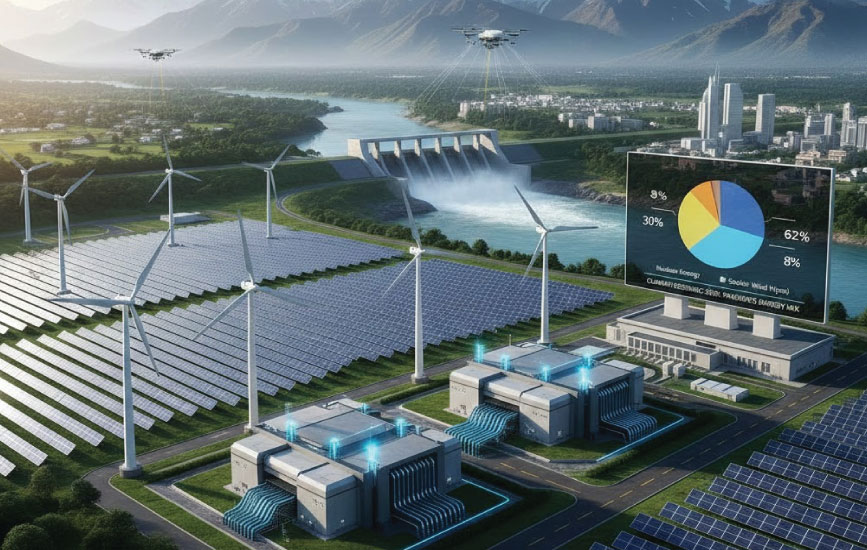
Micro nuclear vectors or micro reactors which are transportable and can be used for remote communities, disaster relief management are also of great importance. Recently, Prime Minister Shahbaz Sharif while Speaking at the Climate Summit 2025 announced that not only Pakistan will increase the share of renewables including hydropower up to 62% of the Country’s energy mix by 2035 but also the nuclear energy capacity will be increased to 1200 Megawatts by 2030 calling it a key step in building climate resilience. The annual expense on import of fossil fuels is about 15 to 17 billion USD. The shift toward nuclear energy can help in reducing dependence on imported fossil fuels. Therefore, not only the carbon emission can be controlled but also the economic stability factor could be achieved.
Thus critically analyzing the situation we can deduct the fact that integration between nuclear and renewable energy defines Pakistan’s energy future. By combining these prospects, Pakistan’s heavy dependence on imported fossil fuels can be reduced. Moreover, nuclear energy along with renewables can provide a sustainable energy system. Nuclear energy through micro reactors and SMRs can be beneficial in terms of growing energy demands in Pakistan. It is up to the policymakers how they balance between nuclear and renewable energy.
It is a fact that ideal thoughts alone cannot construct Pakistan’s climate adaptability. It will be constructed by choices which identifies nuclear energy as a potential boost in combating climate issues. In this regard PNRA is performing commendable work as its National institute of security and safety (NISAS) has now become a regional training center. In 2024, PNRA in collaboration with IAEA conducted a national workshop that focused on how states should use steady communication during emergency situations. Pakistan’s nuclear future is not just about generating power but rather it is about building a future which is safe, secure and predictable. Ultimately by having the right policies and suitable procedures, Pakistan can construct a clean energy future which will be highly beneficial towards global climate measures as well as its own people.