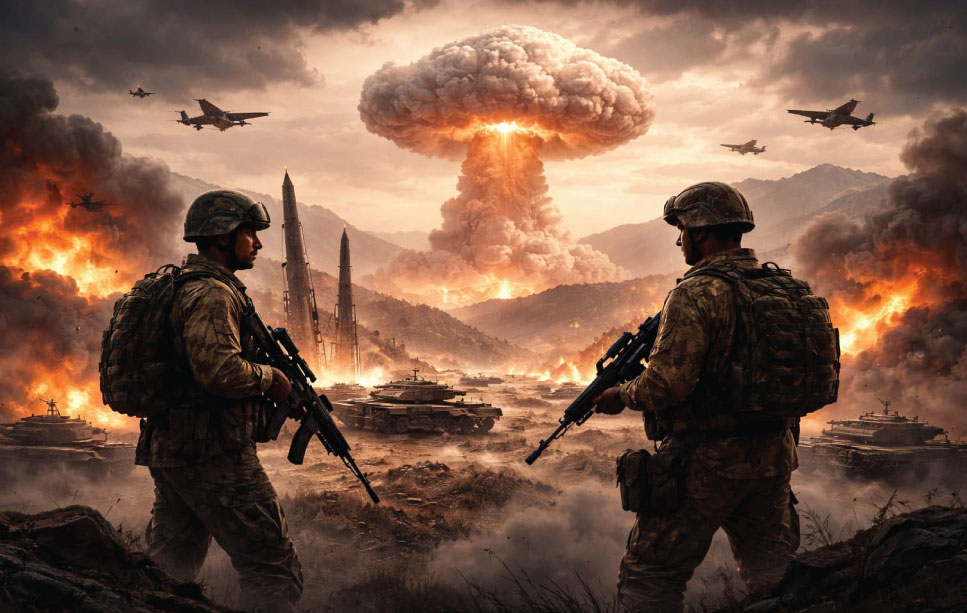
Scholarly debates have intensified over the contours of the “Strategic New Normal” in South Asia following the Pakistan–India crisis of May 2025. The term Strategic New Normal denotes an altered set of engagement rules between states, encompassing the spectrum from peaceful coexistence to kinetic confrontation. Such paradigms typically emerge in the aftermath of major crises or policy realignments, and the latest confrontation between these nuclear-armed neighbours represents a definitive inflexion point.
In broad analytical terms, the Strategic New Normal in South Asia is characterised by heightened volatility in the regional security architecture. Contributing factors include the exploitation of conflict as a political instrument by India’s radical Bharatiya Janata Party (BJP) regime, the pronounced influence of domestic political gains on foreign and defence policymaking, the systemic role of disinformation in Indian strategic calculus, misperceptions of self and others, prestige-driven policy imperatives, flawed conflict management mechanisms, and an elevated quotient of irrationality in Indian statecraft.
The May 2025 crisis, precipitated by what appears to have been a false-flag operation in a nuclearised conflict zone, saw India undertake military action—an overtly irrational choice that underscores the strategic priority of punitive tactical aggression. In the nuclear context, however, tactical operations invariably bear strategic consequences, reverberating across the regional security calculus.
Technological advancements—precision-guided munitions, unmanned aerial systems, long-range strike platforms, critical technologies, cyber capabilities, and electronic warfare—have compressed decision-making timelines, expanded the potential target spectrum, and rendered non-contact warfare a practical reality, even between geographically proximate neighbours. Pakistan’s calibrated responses during the crisis established a new operational baseline, catching Indian strategists by surprise and setting the parameters for the emergent Strategic New Normal.
Limited wars, by their very nature, carry an intrinsic risk of rapid escalation, with a credible probability of transitioning into full-scale conventional or even nuclear conflict. Consequently, the concept of “limited” warfare is inherently perilous in both conventional and non-conventional domains.
The hybrid tools of contemporary conflict—digital, electronic, and print media—have functioned as force multipliers, shaping narratives and amplifying state-sanctioned perspectives with global reach. In both India and Pakistan, media outlets have assumed the role of agenda-setting gatekeepers, often magnifying crisis dynamics.
India’s unilateral suspension of the Indus Water Treaty (IWT), without the consent of signatories, exemplifies a broader disregard for traditional bilateral frameworks, international law, and shared interests that historically underpinned stability. Such acts not only threaten bilateral relations but can be interpreted as assaults on the heritage of the Indus Valley Civilisation, one of the world’s oldest continuous civilisations.
Recognising the perils of zero-sum conflict, initiatives such as Shaking Hands with Clenched Fists: The Grand Trunk Road to Confidence-Building Measures Between Pakistan and India highlight the necessity of shielding peace from spoilers. Yet, during the May 2025 crisis, the Modi regime itself functioned as a spoiler. Peace appears incompatible with the BJP’s majoritarian, supremacy-driven rhetoric, which is underpinned by Hindutva ideology, religious exclusivism, and a prestige-driven strategic outlook.
Understanding crisis escalation necessitates differentiating prestige-driven strategies from survival-driven ones. Pakistan’s strategic doctrine is predicated on safeguarding sovereignty without threatening regional neighbours, whereas Indian strategic thought is often informed by the ideological vision of a “united India” (Akhand Bharat), generating insecurity for neighbouring states. When crises are exploited for political dividends, external de-escalation efforts become exponentially more complex.
Scholars Jonah Lo, Ng Kang Jie, and Hannah Lo, in Reconstructing the Ladder: Towards a More Considered Model of Escalation, elucidate the nuanced dynamics of crisis escalation. However, South Asia’s crisis environment is uniquely contingent upon domestic politics, ideology, strategic prestige, historical grievances, protracted conflicts, and the presence of spoilers. At times, India escalates crises to divert domestic attention from internal challenges, rendering universal escalation models inadequate. These dynamics are further complicated by the integration of critical technologies, including nuclear capabilities.
US Secretary of State Mike Pompeo, in Never Give an Inch: Fighting for the America I Love, recalled that during the 2019 Balakot crisis, India and Pakistan came “close” to nuclear conflagration. The recurrence of such near-catastrophic crises underscores the absence of formalised de-escalation mechanisms in South Asia, leaving regional stability vulnerable to the actions of ideologically driven or overconfident leaders, exemplified by the Modi-led BJP regime over the past decade.
De-escalation during May 2025 was facilitated primarily through third-party intervention, notably by the United States. Modi’s propensity to initiate conflict, confident in the ability of external actors to prevent escalation, has reinforced a cycle of reckless brinkmanship, perpetuating negative peace while bolstering domestic political narratives.
Dr Chiara Cervasio and Professor Nicholas J. Wheeler note:
“The India–Pakistan crisis management playbook has been shaped by two key features. First, beginning with Pulwama–Balakot, each bilateral crisis has set a new and more dangerous threshold for military action on both sides. Second, de-escalation has relied on a mutual confidence that neither side will pursue kinetic actions beyond the point that pushes the other into choosing between a humiliating defeat and nuclear escalation. Elsewhere, we have referred to this as ‘confidence in crisis,’ driven by several key factors.”
Despite geographic proximity facilitating measured escalation during prior crises—Kargil (1999), military stand-off (2002), Mumbai (2008), Balakot (2019), and Pahalgam (2025)—the Modi regime’s ability to convert military engagements into media victories has emboldened audacious posturing, bringing the region perilously close to nuclear confrontation. Inflated claims, such as downing F-16s with MiG-21s or fictitious incursions, further amplify strategic misperceptions.
Pakistan’s nuclear posture, articulated by General Khalid Ahmed Kidwai, founding Director General of the Strategic Plans Division, prioritises deterrence, conflict prevention, and the creation of an enabling environment for political leadership to pursue conflict resolution. Pakistan has consistently demonstrated that conventional war is neither feasible nor desirable, while promoting an even-handed approach to regional stability. Discriminatory measures, such as selective membership in the Nuclear Suppliers Group (NSG), remain counterproductive and unacceptable.
In sum, Pakistan’s strategic framework emphasises deterrence, responsible conflict management, and the pursuit of peace, while India’s prestige-driven ambitions, domestic political imperatives, and ideological narratives continue to destabilise the South Asian security environment, reinforcing the precarious nature of the Strategic New Normal.