

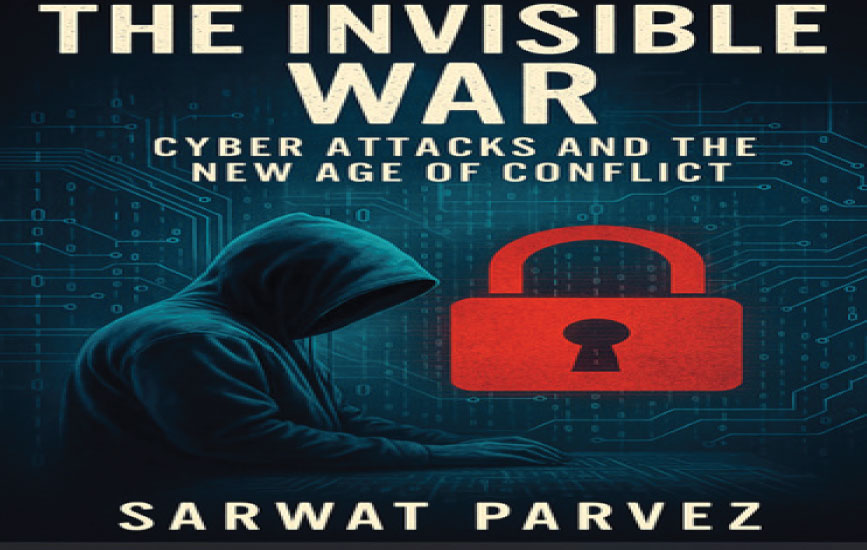
In The Invisible War: Cyber Attacks and the New Age of Conflict, Sarwat Parvez has provided a timely and cutting-edge insight on how war has changed in the digital age. According to Parvez, in modern conflict, it is observed that conflict is taking place more in the cyber arena which is marked by its invisibility, globalization, and the ability to generate effects that can be compared to kinetic operations. The book questions the traditional beliefs regarding war, deterrence, and national security since it places cyber-attacks as intentional acts of statecraft.
Cyber operations are characterized by ambiguity, asymmetry, and the possibility of strategic disruption as well as political impact, unlike traditional conflicts, where there is a clear front line, actual engagement, and the physical control of the territory, which may not involve open violence. Such a redefinition of concepts presents the critical necessity of scholars, policy makers and practitioners in the security field to redefine the lines of the contemporary conflict.
The book has been structured into four themes that are closely connected: the historical development of cyber conflict, the technical processes and strategies behind attack, the case studies of the strategic and operational effects of cyber attacks and a prospective discussion of how the emerging technologies, such as artificial intelligence, automation, and autonomous systems, will shape the future landscapes of conflicts.
At the beginning, Parvez emphasizes that cyber-attacks are not incidents or criminal business; they are politically motivated and capable of causing consequences that will go beyond the digital space and the digital world to infrastructure, governance, and economic stability.
The text manages to contextualize cyber conflict in the larger context of strategic and geopolitical relationships, highlighting the systemic effects of digital activity and the multifaceted nature of relationships between states, non-state actors, and transnational networks.
Parvez contributes largely to the conceptual level by redefining cyber operations as a strategy. He persuasively argues that such operations are capable of undermining key infrastructures, interfering with information spaces and shaping politics, thereby being instruments of statecraft that are as significant as traditional military power. Such framing is consistent with the recent literature on the increasing importance of cyber operations in world politics, such as their use in hybrid warfare, strategic deterrence, and challenging international norms.
According to the author, other distinctive problems of cyber conflict, including the inability to attribute, the high rate of technological change, and the lack of settled legal and normative structures, are also in the limelight. Through this, Parvez places the cyber domain as the locus where policy can be innovated and a locus where scholarly research can be done.
Case studies are an essential part of the analysis presented in the book as empirical evidence. The case of Stuxnet, ransomware, and politically motivated cyber attacks provides a good example of what the practical and strategic impacts of cyber activity can be. Specifically, Stuxnet is employed to show how cyber-attacks can have a kinetic effect by messing with industrial and nuclear infrastructure without direct interaction.
In a parallel manner, the ransomware attacks on energy grids and health systems highlight how vulnerable interdependent structures are and how cyber actions can affect the whole society. As much as such case studies are illustrative and convenient, they are more descriptive than analytically exhaustive.
The empirical adequacy and theoretical contribution of the work would be improved by comparing, critically assessing causal processes, and discussing other ways to interpret results. However, the cases offer a useful basis to readers who want to learn more about the realities of operation and international interests of cyber conflict.
The normative and legal issues of cyber warfare are also involved in the book. Parvez points out the challenges of the implementation of the current international law of cyber operations, especially the problems of attribution, proportionality, and accountability. The reading highlights the conflict between the historic concept of sovereignty and the transnationality of cyberspace, a commentary on the current literature of security studies and international law.
Although the examination of normative frameworks is considered insightful, a more organized approach to the state-of-the-art research on cyber norms, the Tallinn Manual 2.0, and the proposals of the UN Group of Governmental Experts, may be taken into consideration to enhance it. The direct combination of these frames would bring the text to a more serious academic examination of the nexus between law, ethics, and strategic cyber operations.
One of the strengths of the work by Parvez is a prospective approach to the topic of new technologies and the way they can change conflict. Machine learning, artificial intelligence, and automated cyber means are discussed as the sources of offensive innovation and defensive development. Parvez has a solid argument that these technological developments will accelerate the pace, volume and complexity of cyber actions posing profound ethical, legal and strategic questions.
The autonomous cyber operations discussion is particularly handy, as it draws the interest of the potential of escalation, unintended consequences, and mechanisms of governance sought to manage high velocity and high impact operations. The idea of cyber war being subsumed within the greater technological patterns highlights the fact that the new war is dynamic and changing as highlighted by Parvez.
Despite these strengths, there are weaknesses of the book. The social-political and historical factors which contribute to cyber conflict do not enjoy importance as compared to the technical and strategic factors and this could also underscore the complexity of interaction between the technology, policy and the society.
The Invisible War is a valuable contribution to the literature and policy-making process on the subject of cyber conflict and international security. Parvez succeeds in showing that the concept of cyber-attacks is one of the fundamental, tactical dimensions of the modern conflict, which can introduce the systemic interference and affect the geopolitical effects.
The simplification of the tricky technical, strategic, and policy issues is mentioned to be particularly valuable in the book since it is easy to read, compelling in the form of illustrative case-studies, and projecting into the future in terms of threats of emerging technology.
Though it may require additional theoretical participation and methodological development in its academic contribution, the book remains a precious possession to scholars, policymakers and practitioners who want to get an insider perspective of the invisible but important factors of modern warfare. Placing cyber operations in strategic perspective and situating them in the framework of global security, Parvez offers an unobtrusive and timely solution to the threat, opportunities, and danger of the new battlefield.