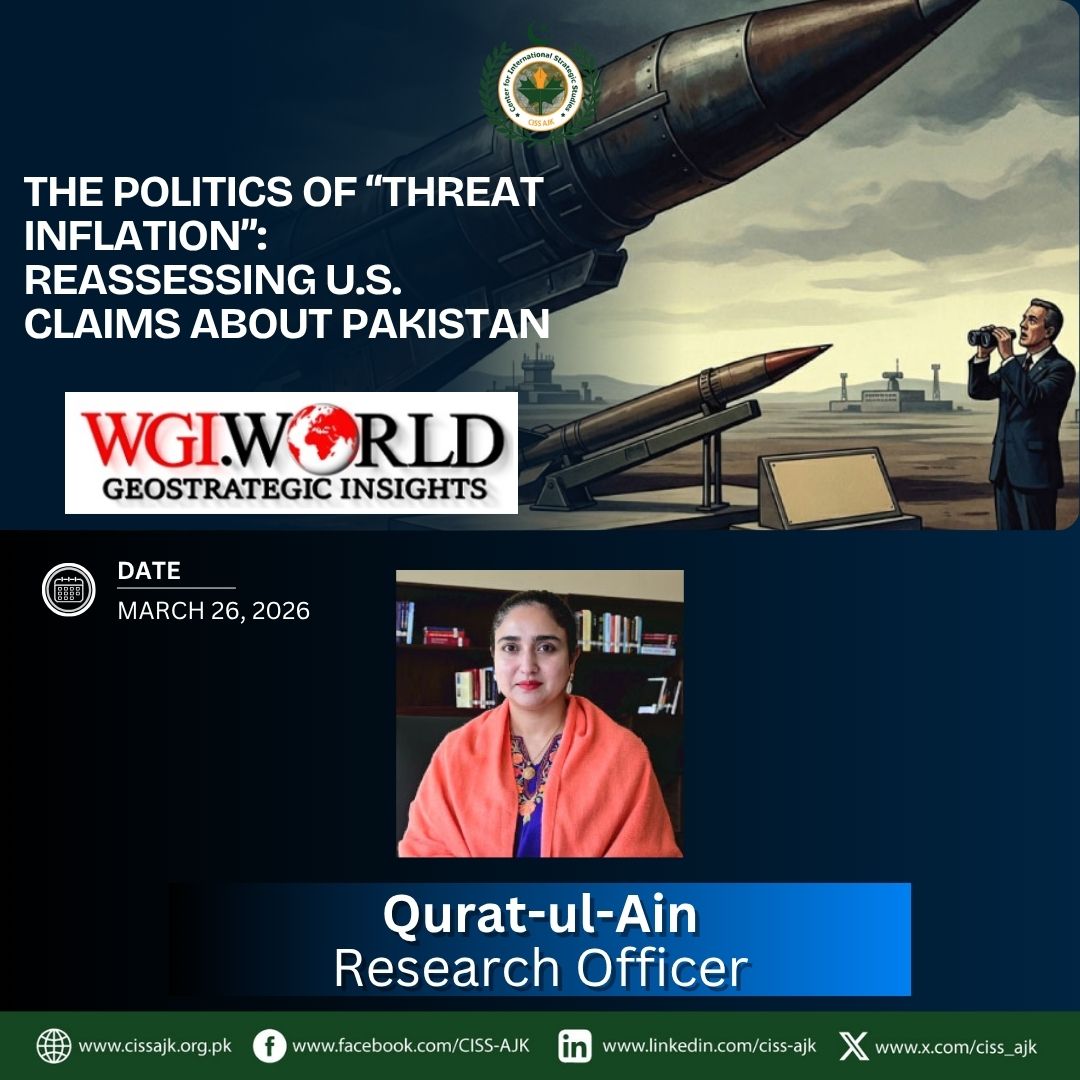
Recent remarks by the Director of US National Intelligence (DNI), Tulsi Gabbard, placing Pakistan among states whose evolving missile capabilities could potentially threaten the United States homeland, raise important questions about the precision and proportionality of contemporary threat assessments.
While the inclusion of major strategic competitors such as China and Russia in such a category is grounded in material capabilities, extending the same logic to Pakistan does not make any sense and here is why.
First of all at the heart of the issue lies a complete lack of understanding of Pakistan’s strategic intent. Pakistan’s missile program has evolved within a very specific geopolitical context, primarily shaped by its enduring rivalry with India. Its deterrence architecture is designed to maintain strategic stability in South Asia, not to project power globally. Even if one were to entertain the possibility of longer-range missile development in the future, there is little to suggest that Pakistan’s strategic calculus includes targeting the United States. Treating hypothetical capabilities as imminent threats risks overstating dangers while obscuring the underlying logic that governs state behavior.
Equally important is the absence of empirical evidence supporting claims of an operational intercontinental ballistic missile capability in Pakistan’s arsenal. Unlike established nuclear powers with proven ICBM systems, Pakistan’s known inventory remains largely confined to short- and medium-range ballistic missiles. For a missile to be Intercontinental its range should exceed 5500 KM. And Pakistan’s longest range missile, Shaheen III has a range of 2750KM. These systems are calibrated for regional deterrence requirements, reflecting strategic priorities. Suggesting that Pakistan is on the cusp of fielding missiles capable of striking the U.S. homeland introduces a speculative element into what should otherwise be a rigorously evidence-based assessment.
Secondly, this mischaracterization also sits uneasily with Pakistan’s declared nuclear doctrine. Rooted in the principle of credible minimum deterrence and later expanded into full spectrum deterrence, Pakistan’s posture has consistently remained regionally oriented. The logic underpinning this doctrine is straightforward: to deter aggression by maintaining a survivable and flexible response capability within its immediate strategic environment.
Thirdly, extending this framework to intercontinental ranges would not only contradict its doctrinal foundations but also impose significant financial and technological burdens that are neither necessary nor strategically rational for Pakistan. Financially speaking, allocating billions to the ICBM program could divert funds from critical sectors and IMF led economic stabilization efforts. Expanding long-range capabilities has already triggered U.S. sanctions on state-linked organizations like the National Development Complex (NDC). Further development would risk financial isolation, blocking access to international commercial systems.
Moreover, Building a dedicated ICBM infrastructure—including massive horizontal solid rocket-motor test stands and specialized launch facilities—requires capital that far exceeds current budgetary allocations for space and strategic programs. Technologically speaking, ICBM warheads re-enter the atmosphere at speeds up to 24,000 km/h (15,000 mph). Pakistan would need to develop advanced ablative materials and heat shields to prevent the warhead from vaporizing due to friction-induced heat. Maintaining accuracy over 5,500+ km requires sophisticated inertial navigation systems and potentially satellite-aided guidance to correct for “clock errors” and atmospheric disturbances during the terminal phase. ICBMs also require high-performance, large-diameter multi-stage rocket motors.
While Pakistan has tested MIRV technology on the Ababeel missile, scaling this to intercontinental payloads requires a level of industrial base and technical “know-how” that current assessments suggest Pakistan lacks. Furthermore, to achieve ICBM ranges, steel motor cases must often be replaced with composite materials, which can reduce weight by up to 20% which also require advanced manufacturing capabilities.
In the light of these facts, grouping Pakistan alongside China and Russia in discussions of homeland threats creates a false equivalence that undermines analytical clarity. Both Beijing and Moscow possess mature and sophisticated ICBM arsenals, supported by decades of technological advancement and global strategic ambitions. Pakistan, by contrast, operates within a constrained regional framework with no comparable capacity or intent to project power across continents. Lumping these distinct cases together risks diluting the credibility of threat assessments by erasing critical differences in capability, doctrine, and geopolitical orientation.
Threat inflation can complicate policy responses
Such framing also reflects a broader tendency within U.S. strategic discourse to expand the spectrum of perceived threats. While this may serve certain bureaucratic or political purposes—such as reinforcing the need for robust defense planning or sustaining budgetary priorities—it can come at the cost of analytical precision. This tendency, often called “threat inflation,” occurs when U.S. defense and intelligence agencies frame regional capabilities as global threats to justify long-term strategic investments. For example, The Pentagon consistently labels China as a “pacing challenge.” While China’s modernization is real, U.S. discourse often emphasizes their DF-26 (“Carrier Killer”) or hypersonic gliders to justify massive R&D budgets for the U.S. Space Force and next-generation interceptors, even when the immediate threat to the U.S. mainland remains lower than the rhetoric suggests.
Even During the Cold War, the “Missile Gap” was a politically manufactured narrative that suggested the USSR had a massive lead in ICBMs. This served the bureaucratic purpose of accelerating U.S. aerospace production, despite intelligence later proving the “gap” was non-existent. Such Overextension of threat narratives not only diverts attention from genuinely pressing challenges but also complicates the formulation of coherent and targeted policy responses. In an era defined by great power competition, clarity in threat perception is not a luxury but a necessity.
There is no denying that Pakistan being a nuclear-armed state occupies an important place in the global security landscape. However, understanding its role requires a context-sensitive approach that recognizes the regional drivers of its policies. Deterrence in South Asia operates under its own dynamics, shaped by historical grievances, territorial disputes, and evolving military doctrines. Transposing these dynamics onto a global framework without due consideration risks misinterpretation.
The implications of such misreadings extend beyond academic debates. They have the potential to influence policy decisions, shape alliance structures, and inform public perceptions. Mischaracterizing Pakistan as a direct homeland threat to the United States could inadvertently contribute to strategic mistrust, complicate diplomatic engagement, and reduce the space for cooperation on issues where interests may converge, such as counterterrorism or nuclear security. In international politics, perception often carries as much weight as reality, and inaccurate threat narratives can generate unintended consequences.
Ultimately, the credibility of any threat assessment depends on its ability to differentiate, contextualize, and prioritize. By blurring these lines, statements like those made in the recent assessment risk doing a disservice not only to analytical rigor but also to effective policymaking. In a strategic environment already marked by complexity and uncertainty, the last thing global security needs is the inflation of threats that obscure more than they illuminate. The challenge, therefore, is not merely to identify potential risks but to interpret them with nuance and discipline. Pakistan’s strategic trajectory demands accurate representation. Anything less risks turning assessment into exaggeration—and strategy into speculation.
Author: Qurat-Ul-Ain Shabbir – PhD scholar at Quaid-i-Azam University, Islamabad, and currently serving as a Research Officer at the Centre for International Strategic Studies AJK.