

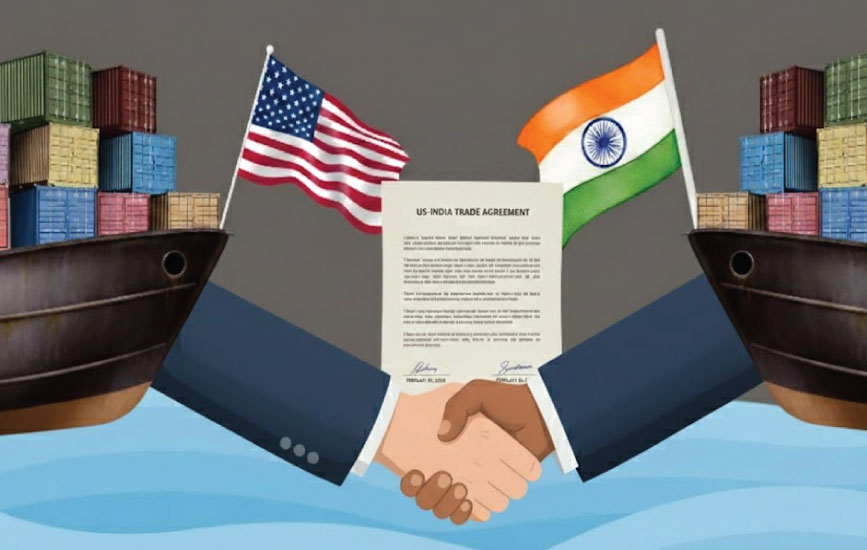
The much-anticipated US–India trade deal was concluded on February 02, 2026. India had been seeking a lucrative agreement with President Trump since the beginning of his second term. However, this period was marked by sweeping tariffs, including a 10% baseline tariff on all global imports and reciprocal tariffs on 57 countries deemed “worst offenders.” These measures were applied not only to competitors but also to allies such as Europe, Australia, Japan, Brazil, India and South Korea. India faced a 25% reciprocal tariff, along with an additional 25% imposed in August 2025 over its continued purchase of Russian oil. The new agreement reduced tariffs on Indian exports from 50% to 18%. While the Indian Government has celebrated the deal as a win-win outcome, details emerging from Trump Administration officials contradict these claims.
The agreement appears more a strategic surrender than a balanced trade deal. Tariffs on US imports into India were reduced to zero, while Indian products will still face an 18% tariff in the US. India also reportedly agreed to halt purchases of Russian oil, shifting imports toward the US or Venezuela. This marks a departure from India’s long-held strategic autonomy, under which it continued buying discounted Russian oil. Additionally, India committed to purchasing US goods worth $500 billion, including agricultural and dairy products. This is contentious for an agrarian country where agriculture supports 45% of the population and contributes 16% of GDP. An influx of cheaper US food products would weaken domestic producers. Farming remains politically sensitive in India, as demonstrated by the repeal of the 2020 farm laws following massive protests. Despite these implications, the Indian Government has maintained conspicuous silence. Moscow also rejected claims that India had committed to halting Russian oil purchases, stating no such declaration was made.
A $500 billion import commitment would further worsen India’s trade imbalance. In FY 2025, Indian imports stood at $720.24 billion, with a trade deficit of $94.3 billion, including $45.3 billion with the US alone. Expanding US imports on this scale would significantly strain India’s external accounts, making the target difficult to achieve.
The deal also resembles the recent US–South Korea agreement, where tariffs were first reduced to 15% and later raised back to 25% after Seoul’s legislature failed to approve it. Similarly, concessions affecting India’s farmers and energy sector are unlikely to pass the Indian legislature, especially ahead of elections in Tamil Nadu, West Bengal and Kerala, where farmer constituencies are politically influential.
Following the May escalation, India lost diplomatic momentum. Trump’s repeated references to jet losses and mediation claims, which India denies, further isolated New Delhi. The release of the Epstein file also weakened the Prime Minister’s position, with opposition parties linking it to what they term a “Trade Dheel.” Farmers have demanded the Commerce Minister’s resignation, while Minister Piyush Goyal has avoided sharing details and External Affairs Minister S. Jaishankar has distanced himself. India’s silence speaks louder than denials, underscoring a shrinking strategic space and a reduced ability to maneuver independently.
—The writer is a Associate Director at the Centre for International Strategic Studies, AJK.