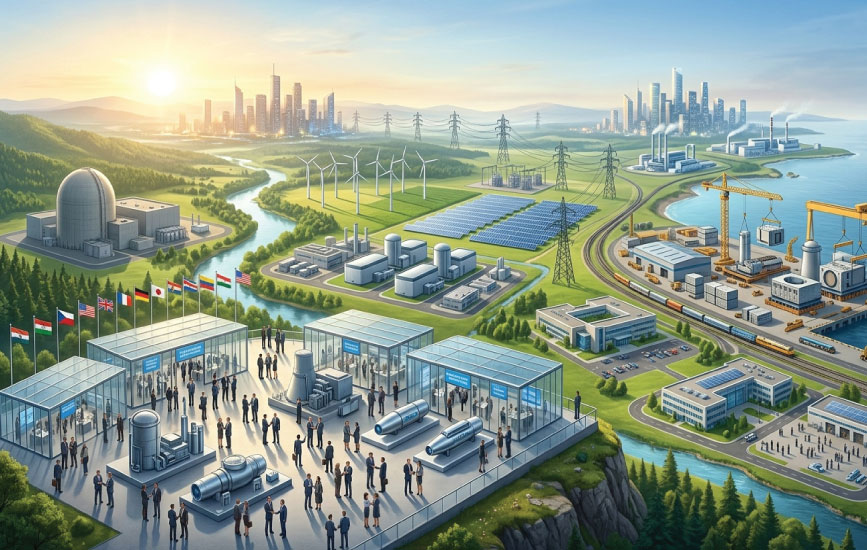
The 2026 Nuclear Energy Summit in Paris was not just another international meeting about clean energy. It was also a political message.
The summit showed that many governments now see nuclear energy as a serious answer to some of the world’s biggest problems: rising electricity demand, energy insecurity, climate pressure, and global tensions. This matters because it shows that nuclear power is taking the center of global energy policy.
The summit was hosted by France in collaboration with the International Atomic Energy Agency. Leaders from governments, financial institutions and industry all delivered a similar message: “Nuclear power is important because it can provide reliable, low-carbon electricity”. French President Emmanuel Macron said nuclear power helps countries achieve both energy independence and carbon reduction. IAEA Director General Rafael Mariano Grossi stressed that the world is now moving toward fully accepting nuclear as part of the global energy mix.
This shift is important because it shows a change in the way nuclear energy is being discussed. For many years, nuclear power was often treated as too expensive, too risky, or too controversial. Most public attention went to renewable energy like wind and solar. Those energy sources remain very important but the Paris summit showed that many countries now believe they are not enough on their own. They need clean energy but they also need energy that is available all the time. As electricity demand grows because of artificial intelligence, data centers, factories, and electrification, nuclear power is becoming more attractive again.
This changing view was especially clear in Europe. Europe’s message at the summit was especially important. Macron argued that nuclear power is not only about climate policy; it is also about national strength and independence. European Commission President Ursula von der Leyen also supported this view. She said Europe made a strategic mistake when it reduced the role of nuclear energy. She also announced plans for a new European strategy on small modular reactors along with financial support for advanced nuclear technology. This proves that Europe is rethinking its energy choices under the pressure of today’s crises.
Other countries also used the summit to show how their nuclear policies are changing. China highlighted its progress in building new reactors and developing advanced nuclear technology. Japan, speaking close to the fifteenth anniversary of the Fukushima disaster, said it has restarted 15 reactors and is once again focusing on nuclear power for energy security and affordability. Countries such as Bangladesh, Egypt, and Türkiye are already building their first nuclear plants. Rwanda and other African countries are exploring SMRs as part of their development plans. This shows that nuclear energy is no longer just an issue for old nuclear powers. It is becoming part of the future plans of many newer countries as well.
However despite this growing support the summit also showed a major weakness in the current nuclear revival. The political support is growing faster than real progress. Leaders support nuclear energy but they also kept returning to the same problems financing, licensing, regulation, and international coordination. That is because the main challenge today is not proving that nuclear matters. The real challenge is building it.
The scale of this challenge becomes clearer when we look at the numbers. According to the summit material, 31 countries currently operate nuclear power plants. Nuclear provides about 9 percent of the world’s electricity and around a quarter of low-carbon electricity. At the same time only 69 reactors are under construction in 16 countries, according to the IAEA’s Power Reactor Information System (PRIS). That shows momentum but it is still far from enough if the world is serious about tripling nuclear capacity by 2050.
One of the biggest reasons for this gap is financing. Financing remains the biggest problem. Grossi said nuclear projects have often been excluded from major international financial institutions although that is starting to change. This may be the most important part of the summit. Big promises mean little unless countries can get the funds, regulatory approval, skilled workers and supply chains needed to build plants on time.
Because of this, the Paris summit does not mean that nuclear energy has already made a full comeback. Instead it shows that more governments now believe nuclear power is important again. They no longer see it as an old or unwanted technology but as something useful for the future. However speeches and promises alone are not enough. They do not build power plants or fix practical problems like supply chains. That is why the real importance of the summit is not what was said but what happens next.
The summit has changed the main question. Before, people were asking whether nuclear energy should be part of the future at all. Now that question is mostly settled. The real question now is different: can governments and investors actually build enough nuclear plants in a safe, fast, and affordable way to keep their promises?
Author: Hira Bashir – Associate Research Officer at the Center for International Strategic Studies, Azad Jammu & Kashmir. Her research focuses on the peaceful uses of nuclear technology.