
Every year on May 28, Pakistan celebrates Yom-e-Takbeer the day in 1998 when Pakistan carried out nuclear tests in Chagai and officially became a nuclear power. These celebrations are important because Pakistan took this decision under intense international pressure, mainly to ensure its security and survival. But what was Pakistan originally trying to achieve with nuclear technology?
Pakistan’s nuclear journey actually began with a vision of development and progress. In 1955, just eight years after independence Pakistan established its Atomic Energy Committee under Dr. Nazir Ahmad. The main purpose of this early initiative was to explore how nuclear science could support a developing country.
This peaceful direction became even more structured in 1957, when the International Atomic Energy Agency was created. Pakistan became one of its founding members and, from the very beginning its civilian nuclear programme was placed under international safeguards. The focus remained clear: nuclear technology was to be used for electricity generation, medical advancement, agricultural improvement, and overall national development.
For nearly two decades, Pakistan remained committed to this peaceful path. The most critical turning point came on May 18, 1974, when India conducted its first nuclear test, known as the “Smiling Buddha” test.
For Pakistan, this development it was a major strategic shock. The situation became even more serious considering that Pakistan had already gone through the deep national crisis of 1971 just a few years earlier. Now, its main regional rival had entered the nuclear era. As a result, Pakistan’s entire security environment changed and it was forced to reconsider its long-term nuclear policy in the context of survival and national security.
At this point, Pakistan’s leadership clearly understood the gravity of the situation. Former Prime Minister Zulfikar Ali Bhutto famously stated that Pakistanis would “eat grass” if necessary, but they would still develop nuclear capability. This statement reflected a deep concern for national survival in a rapidly changing regional balance of power.
Over the next two decades Pakistan worked to develop a nuclear deterrent despite sanctions, political isolation, and strong international pressure. This process was slow and difficult, shaped entirely by security concerns rather than expansionist ambitions. Finally, when Pakistan conducted its nuclear tests on May 28, 1998.
However, an important and often overlooked fact is that Pakistan never abandoned its peaceful nuclear mission. Even while developing its deterrent capability, the country continued to invest in civilian nuclear applications ensuring that nuclear science also served development goals alongside security needs.
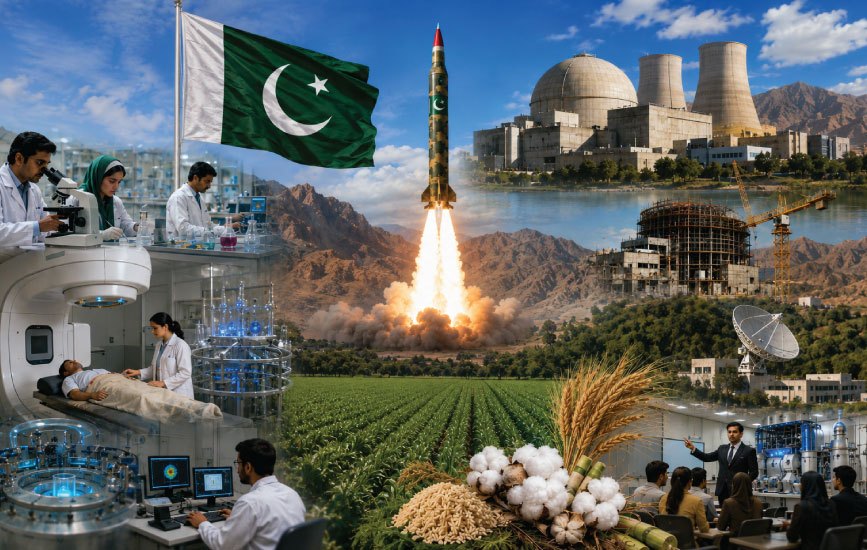
Today, Pakistan operates six nuclear power plants located at Chashma and Karachi, including KANUPP-2 and KANUPP-3, with a combined installed capacity of around 3,620 megawatts. In 2024 alone, these plants generated a record 21.7 terawatt-hours of electricity while nuclear energy’s share in the national grid reached nearly 17 percent. This steady contribution has made nuclear energy an increasingly important part of Pakistan’s energy mix, especially in addressing chronic electricity shortages and reducing dependence on imported fuels.
. The construction of Chashma-5, Pakistan’s largest planned nuclear power project began in late 2024 in cooperation with the China National Nuclear Corporation. It is expected to further strengthen Pakistan’s long-term energy security and increase its overall nuclear generation capacity.
Beyond electricity, nuclear technology in Pakistan plays a vital role in healthcare. The Pakistan Atomic Energy Commission operates 19 cancer hospitals and nuclear medicine centres across the country, forming the largest public cancer care network in Pakistan. Each year, these hospitals provide diagnosis, radiotherapy, and treatment to thousands of cancer patients, many of whom otherwise would not have access to affordable medical care.
Institutions such as the Nuclear Medicine Oncology and Radiotherapy Institute (NORI) have gained international recognition for their services, while the newly established Kashmir Institute of Nuclear Medicine Oncology and Radiotherapy (KINOR) has expanded specialised cancer treatment facilities to underserved regions like Azad Jammu and Kashmir for the first time.
In addition, Pakistan’s nuclear programme has made significant contributions to agriculture. The Nuclear Institute for Agriculture and Biology (NIAB), along with other PAEC research centres, has developed high-yield and climate-resilient crop varieties using nuclear techniques. These innovations have improved the production of key crops such as cotton, wheat, rice, and sugarcane, directly benefiting farmers and strengthening national food security in a country where a large population depends on agriculture for its livelihood.
At the same time, Pakistan continues to invest in education, safety, and scientific research in the nuclear field. The Pakistan Institute of Engineering and Applied Sciences and the National Institute of Safety and Security are both recognized as IAEA Collaborating Centres, contributing to training and capacity-building at both national and regional levels. Similarly, Pakistan’s Centre for Excellence for Nuclear Security has emerged as an important regional hub for nuclear safety and security training.
The Real Meaning of May 28
Yom-e-Takbeer should not only be celebrated but also properly understood. The nuclear tests in Chagai were not the beginning of Pakistan’s nuclear journey; they were a turning point shaped by regional security pressures and changing geopolitical realities.
Pakistan’s original vision for nuclear technology was always centered on development — producing energy, improving healthcare, supporting agriculture, and strengthening national progress. Even after becoming a nuclear power, Pakistan continued to uphold that vision alongside its security needs.
In conclusion, Pakistan’s nuclear story is not only about deterrence; it is also about development. The bomb may represent security, but the atom represents something much broader a long-standing promise to use science for the welfare of its people. That is why May 28 is not just a day of power, but also a reminder of purpose.