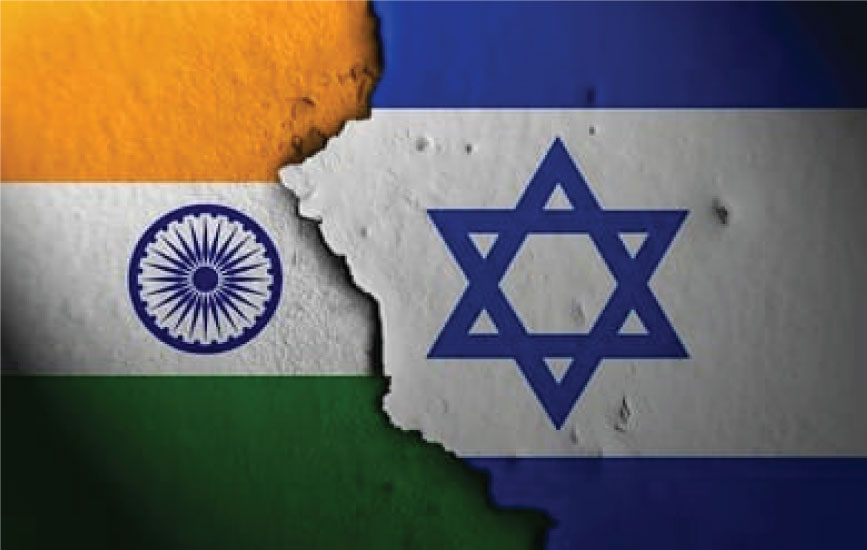
THE ideological connection between Zionism and Hindutva, a far-right Hindu nationalist movement, lies at the heart of the evolving Indo-Israeli partnership. Israeli diplomatic posts in India actively foster this alignment. While the histories of Palestine and Kashmir differ, growing similarities can be observed between Israel’s treatment of the West Bank and India’s approach to Kashmir.
Under the BJP, policies in India and Jammu and Kashmir reflect intensified repression, with the alleged use of tactics inspired by Israel. The recent visit of the Indian Prime Minister to Israel has heightened concerns, particularly among Muslims, as both ideologies are perceived as marginalizing them. Both have been associated with histories of colonization, including the occupation of Palestine and Kashmir, with examples often cited such as the 2002 Gujarat violence and the ongoing situation in Gaza.
Defence cooperation forms a central pillar of India–Israel relations. India remains one of the largest purchasers of Israeli military equipment, investing billions in defence acquisitions. Reports indicate ongoing collaboration, including joint training initiatives. Israel has supplied India with unmanned aerial vehicles, air defence systems, advanced radar and surveillance technologies.
In Kashmir, surveillance has become a major component of governance. Since 2019, increased federal control has led to widespread monitoring, including facial recognition, phone tracking, CCTV expansion and digital identification systems. Combined with new technologies, daily life and political activity are subject to intense scrutiny.
In January 2026, the Indian Army formed the Bhairav Battalion in Jammu and Kashmir, an elite commando unit equipped with advanced technology for rapid operations. Given that the region is already heavily militarized, the expansion of such forces raises questions about its necessity.
Combined Hindutva and Zionist influences have contributed to increased militarization, surveillance and centralized control in Jammu and Kashmir, drawing parallels with governance approaches associated with Israel in Palestine. The spyware Pegasus, produced by the Israeli company NSO Group, remains one of the most controversial security tools linked to India. Reports suggest that journalists, including Siddharth Varadarajan, were targeted through such surveillance technologies.
In Kashmir, authorities frequently stop individuals and check their phones and similar actions are reported during arrests of politicians and journalists. There are concerns that such technologies may be used to monitor private data. To increase military presence, Operation Shiva was launched in 2025, officially to provide security for Amarnath Yatra pilgrims. However, under this pretext, additional forces were deployed and it remains unclear whether they were later withdrawn.
The similarities in occupational policies between Israel and India continue to grow. Some Indian commentators and diplomats have even advocated adopting an Israeli model in Jammu and Kashmir. India has introduced policies such as domicile laws and reservation measures that critics argue alter the region’s demographic and socio-political balance.
Like the occupied West Bank, Kashmir remains in a near-constant state of emergency, shaped by military presence and strict law enforcement, including laws such as the Public Safety Act (PSA) and Unlawful Activities Prevention Act (UAPA). These measures enable sustained control over the population.
The international community and human rights defenders have repeatedly raised concerns about the actions of both states, citing possible violations of international law. While these issues are frequently discussed, stronger mechanisms for accountability and implementation remain necessary. Without meaningful diplomatic and legal efforts, achieving lasting peace and stability will remain difficult.
—The writer is Research Officer at the Centre for International Strategic Studies, AJK.