When homes are destroyed, freedoms surveilled, and education weaponised, Kashmiris are left with little choice but despair—highlighting the human cost of decades-long repression.
On November 10, a car-bomb attack near Delhi’s Red Fort became a breaking point in the socio-political and psychological landscape of India-administered Kashmir.
In the immediate aftermath, the people of Kashmir, as well as those living across India, were treated as suspected elements and forced to face the punishment for crimes they never committed.
In Pulwama, south of Srinagar, the home of Umar Nabi, the main accused of the Delhi attack, was demolished by Indian forces, illustrating both collective punishment and a blatant human rights violation under the Hindutva regime.
Nabi was not an uneducated person, nor was he an unknown, irrelevant, or helpless young man; he belonged to one of the most respected segments of society and was a doctor, a healer, a lifesaver.
This act violates both the domestic law of the Indian Supreme Court, “ruling requiring prior judicial sanction for demolitions”, and international law of the Geneva Conventions, Article 33, “prohibiting punishment of families for alleged offences.”
This is not a new strategy of the Indian government to impose collective punishment on the people of Kashmir.
During the May 2025 crisis, the homes of several Kashmiris were demolished on mere suspicion, without investigation, even though they were not involved in the Pahalgam attack.
Over 2,800 Kashmiris were detained after the Pahalgam terror attack, coupled with accusing and punishing the Kashmiris, reflects the deliberate strategy of the ruling Bharatiya Janata Party (BJP) to suppress and torture the people of the region.
The government of India has intensified the surveillance campaign against the people of Kashmir, monitoring detainees through GPS devices, digital surveillance, collection of biometric data, and mobile phone monitoring has become a tool of intrusion that erodes fundamental rights of freedom and privacy.
These practices violate Article 17 of the ICCPR, which prohibits “Unlawful interference in personal privacy, family, home or correspondence.”
Across India, Kashmiri students and doctors have faced harassment and even detentions by authorities, which is a discriminatory measure raising concerns that increases harassment and labels this life-saving profession as associated with terrorism or white-collar militancy.
BJP is injecting Hindutva-driven bias into professional institutions, demanding the cancellation of 42 Muslim student doctor admissions at Shri Mata Vaishno Devi University, commonly referred to as SMVD.
Such targeted repression in educational and professional spaces compounds the psychological and ethical toll on Kashmiri youth, leaving them trapped between fear and forced complicity.
It is a clear plan to turn sacred spaces and education into an instrument of hate-driven politics. India is moving towards religion-based admissions.
In an attempt to silence every dissenting voice, the independent news outlet, Kashmir Times, denounced raids on its offices and challenged the allegations.
The Hindu right-wing agenda
The question is: Is the Indian government afraid of hearing truths from Kashmiris, or of losing control over the narrative?
Under the leadership of the Hindu right-wing BJP, suppression of media has not only become a tool in India-administered Kashmir but an active instrument in advancing Prime Minister Narendra Modi’s political and Hindutva agenda.
The Indian media, which is widely known for promoting false narratives and AI-generated videos to exaggerate the situation to support the Hindutva political agenda, portrays Muslims, especially Kashmiris, as terrorists as part of its disinformation campaign, and presents the Kashmir freedom movement as terrorism.
Since 2019, after the revocation of its special status of the state, the Indian government has intensified repression, carrying out demolitions on suspicion, criminalising and suppressing dissent under draconian laws like the Unlawful Activities (Prevention) Act (UAPA), and Public Safety Act (PSA), and destroying homes between 2019 and 2024.
During cordon-and-search operations, Indian troops have been accused of torturing and sexually harassing Kashmiri women. The United Nations Human Rights Commission, UNHRC, should also investigate India’s digital surveillance regime and recommend reforms to preserve humanity in the region.
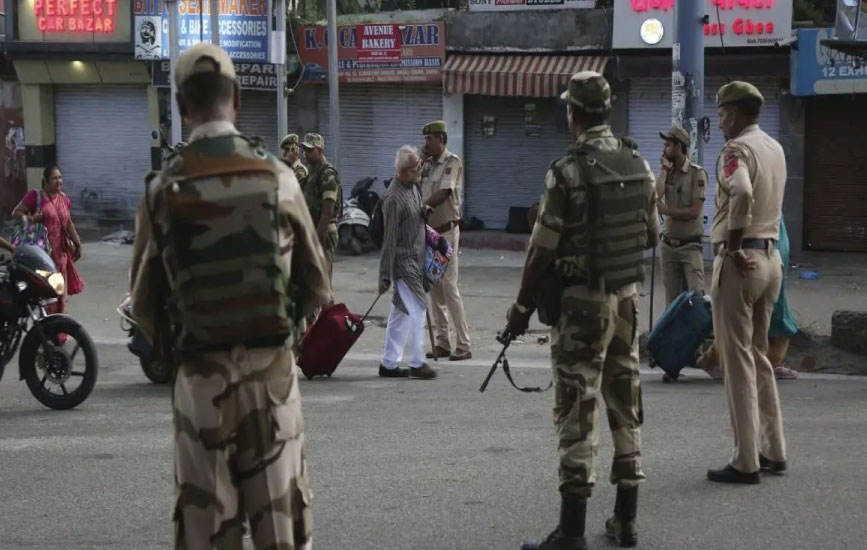
Security personnel stand guard at the entrance of Jammu Railway Station amid heightened vigilance following the Red Fort blast in Delhi (AP).
Over the decades, the people of India-administered Kashmir have been facing a systematic repression that extends far beyond militarisation.
Kashmir tears
The people of Kashmir have been subjected to a total and all-encompassing system of oppression, over 10,000 enforced disappearances, 8,000 custodial killings attributed to torture in custody, demographic engineering, over 350,000 domicile certificates issued to non-Kashmiris, political, institutional surveillance, arbitrary detentions, harassment, unlawful home demolitions, media strangulation, inhumane treatment, hate speech, and incitement to violence increased against Muslims.
When authorities suppress each dissent, snatch away the socio-political and cultural identity of the people of the region, ban their books, open liquor shops forbidden by their religion, hold vulgar fashion shows and militarise their land to the point that it becomes the world’s most heavily militarised zone, and allow its occupying forces to bluntly violate domestic and international laws without any accountability.
Then what scenario do such authorities create for the people, especially for the youth, when the entire population of the region is morally, politically, socially, and psychologically suffocated? What avenues of justice remain for the people of the region?
In such a completely disrupted structure, tyranny is not limited to external forms; it seeps into the mind, the workplace, the home, and the most personal corners of daily life like a toxin.
Systematic suppression and repression in India-administered Kashmir are eroding hope and creating widespread fear, often forcing people into unwanted choices.
Numerous reports from human rights organisations such as Amnesty International and Human Rights Watch document some of the worst human rights violations in the region, where demanding fundamental rights is met with arbitrary detentions, demolition of homes, and suppression of dissent, leaving the people with no avenues to seek justice.
In such a scenario, the pressure of oppression does not disappear; it transforms, and the state and its authorities are directly responsible for the consequences of this transformation.