
India–Bangladesh relations have worsened since the ouster of Sheikh Hasina Wajid. The chief determinant of bilateral ties has long been whether the Awami League is in power in Dhaka, as India has traditionally associated the party with the protection of its interests in Bangladesh. At other times, New Delhi and Dhaka have struggled to keep relations on an even keel, repeatedly falling into cycles of mutual suspicion, provocation and irritation. The current moment is part of this long-term pattern.
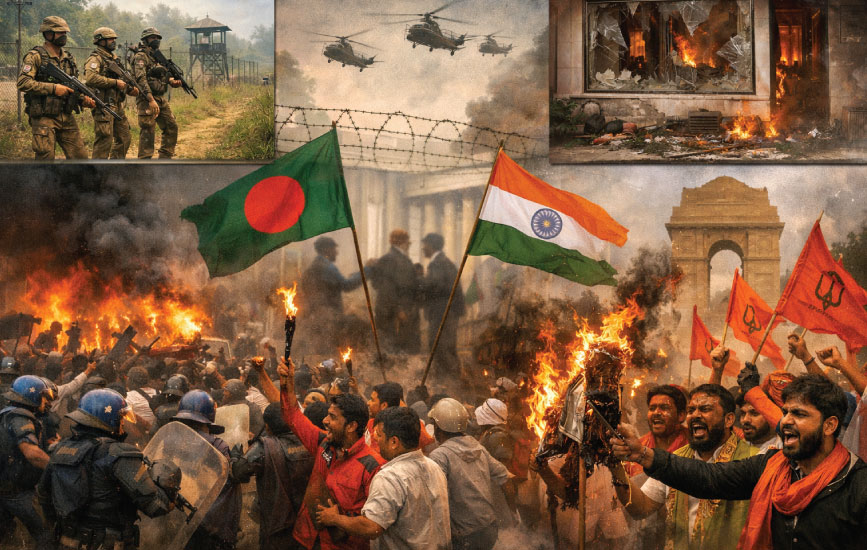
The latest phase of tension intensified after the killing of an anti-India Bangladeshi youth leader, Sharif Osman Hadi, who died at Singapore General Hospital on Thursday. He succumbed to gunshot injuries sustained during an assassination attempt in Dhaka last week. Following the incident, large numbers of people gathered to protest. The protestors believed that the Indian-backed Awami League was behind the assassination. The situation deteriorated further after the subsequent killing of another youth leader.
On December 23, 2025, the Indian High Commissioner in Dhaka was summoned by Bangladesh’s Foreign Ministry for the second time in ten days, citing concerns over security issues involving Bangladeshi diplomatic missions in India. Bangladesh condemned the attacks on its missions, warning that such incidents endanger diplomats’ safety and violate principles of mutual respect and peace. Dhaka urged Indian authorities to investigate the incidents, prevent their recurrence and ensure the security of Bangladeshi missions in line with international obligations.
Addressing the protestors, Bangladesh’s National Citizen Party (NCP) leader Hasnat Abdullah warned that if Bangladesh were destabilized, the fire of resistance would spread beyond its borders. He further stated that Bangladesh could offer sanctuary to “separatist and anti-India forces,” warning that such support might be used to isolate India’s northeastern region—remarks that drew loud applause from the audience.
Reacting to developments in Bangladesh, protests erupted in Kolkata, New Delhi and several other Indian cities, where Bajrang Dal and VHP activists demonstrated outside Bangladeshi missions following the lynching of a Hindu worker in Bangladesh. Carrying saffron flags and chanting slogans such as “Hindu Hindu Bhai Bhai” and “safety for Hindus in Bangladesh,” demonstrators attempted to march toward the missions but were stopped by heavy police deployment. Indian foreign affairs expert Robinder Sachdev termed the situation in Bangladesh “absolutely alarming” for India.
Meanwhile, reports indicate that India has reinforced its military posture along the Bangladesh border to secure the Siliguri Corridor, establishing new army garrisons in Bamuni (Assam), Kishanganj (Bihar) and Chopra (West Bengal), with another base reportedly under consideration in Mizoram. If the security dilemma deepens, India may be forced to draw manpower from the 14, 15, 16 and 17 Corps at a time when its army is already facing a shortfall of nearly 200,000 personnel.
What is unfolding between India and Bangladesh is not merely a bilateral dispute but a potential stress test for regional stability in eastern South Asia. The convergence of domestic political instability in Bangladesh, heightened nationalist mobilization in India and visible militarization along sensitive corridors such as Siliguri signals a dangerous feedback loop between internal politics and external security postures. If left unmanaged, these dynamics could transform political unrest into a sustained strategic liability, reinforcing insecurity across borders and undermining the region’s already fragile balance.
—The author is an Associate Research Officer at the Center for International Strategic Studies–AJK.