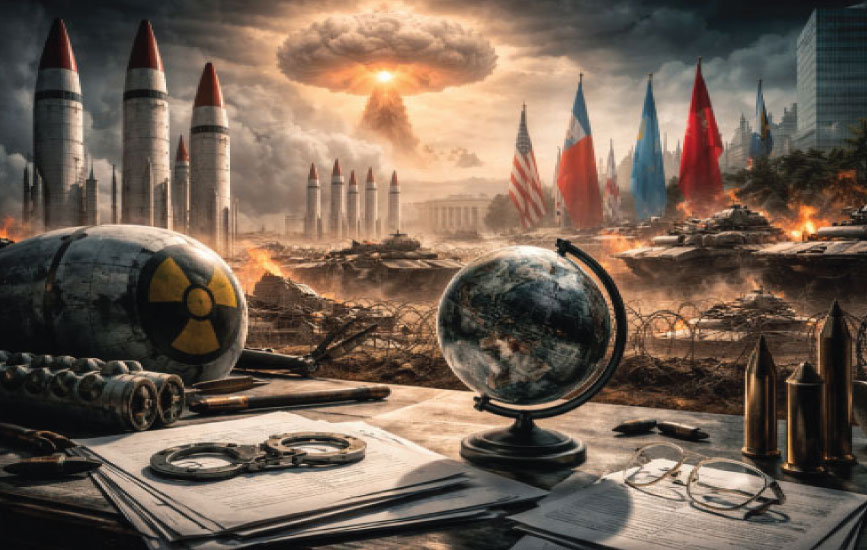
The year 2025 has witnessed unprecedented levels of conflict and warfare, leading to deep mistrust, intensified strategic competition, and increased modernization in both conventional and nuclear arms. These developments have created major setbacks for the global arms control and disarmament agenda. The efforts to promote restraint remained largely ineffective and no meaningful progress was observed. Arms control refers to unilateral, bilateral, or multilateral measures designed to limit, control, or restrict the role of weapons in both the conventional and nuclear domains. Such mechanisms act as stabilizing tools because they are built on mutual trust and dialogue, helping reduce the likelihood of war. When functioning effectively, arms control contributes to a more stable, secure, and predictable geostrategic environment as it lower military costs, and manage arms races by fostering cooperation between states.
As conflicts intensified across Europe, the Middle East, and South Asia, 2025 year observed unprecedented setbacks in arms control and disarmament realm. States fought wars in most parts of the world and to sustain war more arms trade was observed. The world witnessed the continuation of Russia Ukraine War that started in Feb 2022, the 12 Days War between Israel and Iran, and the 4 Days war between two South Asian Rivals Pakistan and India. The article evaluates the impact of war and geopolitical crisis on global arms control and disarmament efforts.
The global efforts in advocating arms control and disarmament continued through designated forums like Conference on Disarmament (CD) plenary sessions, NPT preparatory meetings and UN and its designated organizations like UNIDIR efforts to promote the necessity of collective action towards Arms Control and Disarmament agenda. However, like many past years, no real progress in this domain was observed. It will not be wrong to say that the strategic environment in 2025 have set huge setbacks to bilateral and multilateral arms control frameworks.
The War in Ukraine has intensified arms race in the European Region and eroded once established nuclear Taboo as nuclear rhetoric amplified. The US and allies continued to supply arms and sophisticated weaponry to Ukraine. As per SIPRI report of April 2025, the global military expenditure increased to $2718 billion in 2024 and wars in Europe and Middle East increased revenues from sales of arms and military equipment to up to 5.9%.
The US continued support for Ukraine have impacted the bilateral arms control arrangements between Russia and US as no dialogue or progress in NEW-Start treaty was observed- the last bilateral agreement that set limit on both states strategic weapons. The Russia and US contains 90% of total nuclear weapons and lack of dialogue and nuclear risk reduction measures have huge impacts on long term stability and peace.
Moreover, since President DonaldTrump assumed office, his policies towards Europe urging European states to take lead in security guarantees amid Ukraine war have also compelled European states like Germany, France, and UK to rethink their security doctrines. France and UK negotiated to extend security umbrella to Ukraine if US withdraws. Germany also showed renewed interest to acquire nuclear weapons and proposals for Europeanized deterrent based on British and French nuclear forces also surfaced in Germany after President Trump assumed office.
The mistrust and competing interest of Russia and US and its allies have been evident in every multilateral forum where negotiations were taking place in 2025 as instead of moving towards common grounds, the multilateral forums like Conference on Disarmament were also used to push political rhetoric against each other and no real progress was seen as no treaty was negotiated since 1996.SIPRI 2024 report suggest modernization of nuclear arsenals and warheads by all nuclear weapon states highlighting new nuclear arms race at a time when arms control are pushed to backburner.
The situation in Middle East especially the 12 Days war have led to a new phase in the institutional hostility between Iran and Israel setting huge setbacks towards efforts of arms control, non-proliferation and disarmament. The war began with air strikes by Israel on the military and safeguarded nuclear facilities of Iran, killing key nuclear scientists and military leaders which led to counter strikes by Iran. The US also joined Israel and attacked Iran nuclear sites including Natanz, Fordow and Isfahan with bunker buster’s strikes.
The targeting of nuclear facilities raised questions on NPT legitimacy and International Atomic Energy Agency (IAEA) role as the backbone of NPT Verification system. The US negotiations with Iran were also undergoing before the attacks although no remarkable progress was achieved. However, the military strikes led to criticism of IAEA and NPT as non NPT nuclear weapon state Israel have attacked an NPT nuclear weapon state Iran, and US being one of declared nuclear weapon states also joined Israel in attacks and caused a major blow to established norms to prevent non-proliferation. This also highlights that despite the existence of IAEA safeguards, the proliferation concerns of Iran were dealt with military means bypassing the actions approved by NPT and IAEA. Moreover, this action undermined NPT credibility and raised questions on IAEA as a neutral body. Iran officials also condemned IAEA role raising apprehensions of sharing of sensitive data by IAEA to Israel and US, raising serious questions on its credibility. This has also caused a major blow to regional arms control agendas in the Middle East as prospects of Iran going nuclear increased manifolds.
Likewise, South Asia didn’t remain elusive to war, and India once again attacked AJK and mainland cities in Pakistan in the pretext of Pahalgam incident. The war ended with India losing its 6 fighter jets and US playing the key role of mediator, but it once again surfaced the fragile nature of stability in South Asia. There are no bi-lateral arms control mechanisms between two nuclear states .Despite Pakistan’s long standing proposal on restraint regime in South Asia, India’s reluctance to come to dialogue has severed any prospects for long term peace and stability in the region. Onset of crisis after every few years highlight the urgent need of nuclear risk reduction measures between Pakistan and India.
The year 2025 highlighted a simple truth that peace requires constant investment and effort and if states will not prioritize cooperation over confrontation, instability will continue to shape future far beyond 2025.
Given these trends and amid these developments, it is clear that international mechanisms for arms control and disarmament need to be revitalized immediately. The international community has to depoliticize multilateral forums like the Conference on Disarmament, improve verification procedures, and resume negotiations between major powers especially Russia and US that hold world’s largest arsenals. To stop further escalation, regional confidence-building initiatives, fresh diplomatic engagement, and a persistent dedication to transparency are crucial. The world will become insecure and unstable if global leadership does not take coordinated action to stop the erosion of arms control. Moving forward, long term peace and stability requires coordinated efforts across forums and between member states to start dialogue, resolve issues and develop trust.
The year 2026 is approaching, and it is shaping up to be a critical juncture for international security and global governance. Several developments ranging from the expiration of the New START Treaty could fundamentally reshape strategic stability. Rather than resolving existing tensions, 2026 is likely to intensify complexity across multiple domains.
One of the most consequential developments is the expiration of the New START Treaty in 2026. This treaty remains the last standing arms control agreement between the United States and Russia. Reviving or extending it, however, appears increasingly difficult. In December 2025, a Russian representative stated that Moscow was awaiting a U.S. response to its proposal. Earlier, President Putin had offered to voluntarily maintain the treaty’s limits on deployed strategic nuclear weapons for one year. Former U.S. President Donald Trump described the proposal as “a good idea,” yet he also indicated that broader arms control discussions with Russia might only occur after the termination of the Russian invasion of Ukraine. While Trump expressed confidence that the Ukraine conflict could be resolved quickly, little tangible progress has been made. As a result, the strategic uncertainty surrounding New START remains unresolved as 2026 approaches.
The more fundamental challenge, however, lies beyond bilateral US–Russia arms control. Washington has increasingly argued that existing frameworks are outdated because they exclude China. Successive US national security strategies identify China as the primary long-term threat, while Russia is increasingly viewed as a shorter-term or secondary challenge. The United States has repeatedly sought to bring China into New START–type arrangements, but Beijing has rejected such proposals, citing the asymmetry between Chinese and US nuclear capabilities. Until this imbalance is addressed, China has made clear that it will not participate in formal arms control negotiations.
These tensions are further aggravated by broader geopolitical developments. The recent approval of an $11 billion U.S. weapons package for Taiwan is likely to deepen strategic mistrust between Washington and Beijing, complicating any future arms control dialogue through 2026.
Statements from Japanese leadership regarding the possible acquisition of nuclear weapons whether intended as strategic signaling or pressure on China risk triggering regional escalation. In earlier years, U.S. leaders also raised the possibility of resuming nuclear testing as leverage to draw China into arms control talks, a position reiterated again in 2025 ahead of meetings with Chinese leadership. At the same time, allies and partners increasingly question the credibility and scope of U.S. security guarantees, while Europe and other regions continue to expand defense spending. Iran’s nuclear issue remains unresolved.
Taken together, these dynamics threaten to weaken nuclear norms and undermine the broader nonproliferation order by 2026.
Author: Tayyaba Khurshid, Research Officer, CISS AJK.