As a responsible nuclear state, Pakistan regards nuclear security and safety as a top priority and national responsibility, as demonstrated continuously engagement with the international community to promote and maintain the highest standards of nuclear safety and security. Recently, Pakistan has revised its national export control lists regarding dual-use and sensitive technologies, mandating that for goods associated with nuclear, biological, and missile-related uses, the exporters should apply for government licenses.
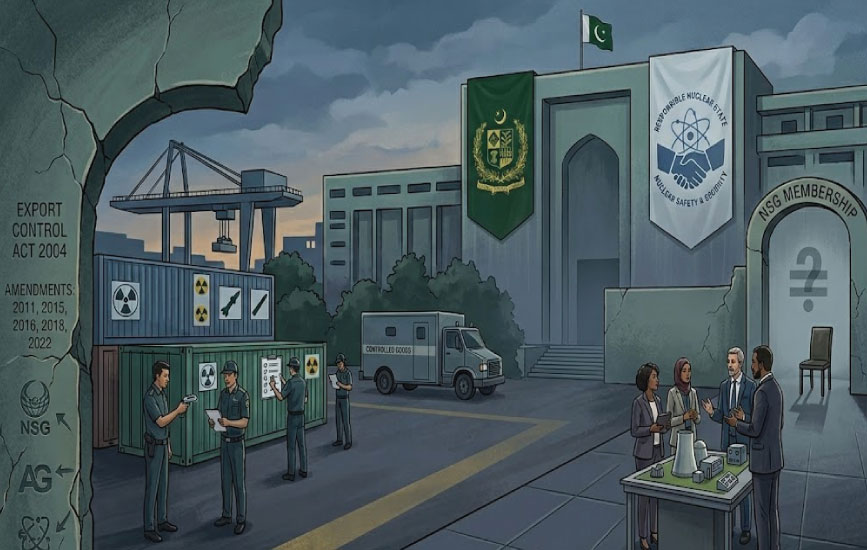
The updated lists, which were published in accordance with the Export Control Act of 2004, listed products, resources, machinery, and technologies that require prior authorization from the Ministry of Foreign Affairs’ Strategic Export Control Division.
To prevent the proliferation of weapons of mass destruction, the act is Pakistan’s primary legal framework for regulating the export of sensitive items. It will strengthen the controls over the trans-shipment, export, re-export, transfer of goods and technologies regarding biological, nuclear weapons, and missile delivery systems. This modification emphasizes Pakistan’s aim to further strengthen its export control regime and reaffirm its role as a responsible nuclear state, fully dedicated to the objectives of non-proliferation.
To ensure that Pakistan’s national controls remain up to date, effective, and aligned with international standards, this revision was part of SECDIV’s regular review process, conducted in consultation with relevant ministries and departments. Generally, governments utilize the export control lists to regulate trade for civilian applications, but they might be used for military purposes, such as dual-use technologies. The revised national export lists aimed to authorize legal trade under license to prevent the proliferation of nuclear weapons.
The control lists go through amendments in 2011,2015,2016,2018, and 2022, first published in 2005, showing Pakistan’s advancement in international regulations, compliance standards, and technology. The latest amendments harmonized the Pakistan nation export control lists with international nonproliferation regimes such as the Nuclear Suppliers Group, Australian Group, and Missile Technology Control Regime. These regimes coordinate the export control among participating countries to restrain the spread of nuclear weapons.
Pakistan, which meets all the benchmarks required to become a member of these regimes facing disparity. As a responsible nuclear state, it maintains bans on unapproved exports, restrictions, and a licensing system to examine proliferation concerns. Pakistan continuously excluded from the membership of the NSG and MTCR despite these initiatives highlighting structural imbalance in these regimes. By regulating the transfer of sensitive materials, missiles, and dual use technologies, export control regimes contribute to non-proliferation, but their discriminatory and selective approach towards some non-member states, like India, undermines their universality and credibility.
As in the case of South Asia, both Pakistan and India applied for the NSG membership in 2016 but received different treatment. In history, India received a special waiver from NSG despite being a nuclear state without being a signatory of Nuclear Nonproliferation Treaty, also getting support to become a member of it, and already gained entry in MTCR.
While Pakistan voluntarily follows the NSG guidelines showed willingness to join the Nuclear Suppliers Group, Australian Group, Missile Technology Control Regime, Wassenaar Arrangement, and demand equal treatment like New Delhi, but no consideration for these concerns. As these regimes’ decisions are based on strategic interests and political considerations, the power of these regimes is being weakened because of this selective approach.
Pakistan’s updated national export control lists reaffirm its role in accountability and support to international nonproliferation regimes. The question raises that the regimes are ready to go beyond the selective exclusion in return for Pakistan for these efforts. If the international export control regimes continue to work effectively and durably, it shows inclusiveness towards all countries that want to join these regimes without any preferential treatment towards one state.
Until then, Pakistan will continue to face discrimination in these regimes, where responsibility is desired, obedience is encouraged, but fair participation remains elusive, despite being a responsible technology-holding country. Today, nonproliferation demands that norms and rules be implemented in a nondiscriminatory and transparent way. As the supply chain becomes more complicated because of advanced technologies, exclusive approaches create the risk of gaps and mistrust rather than safeguards.
Export control regimes can also play a stabilizing role in prohibiting access to nuclear, missile, and dual-use technologies, as New START has expired between the US and Russia. These regimes can act as guardrails to support non-proliferation norms in the absence of a legally binding arms control treaty and constrain the arms race and modernization pathways.