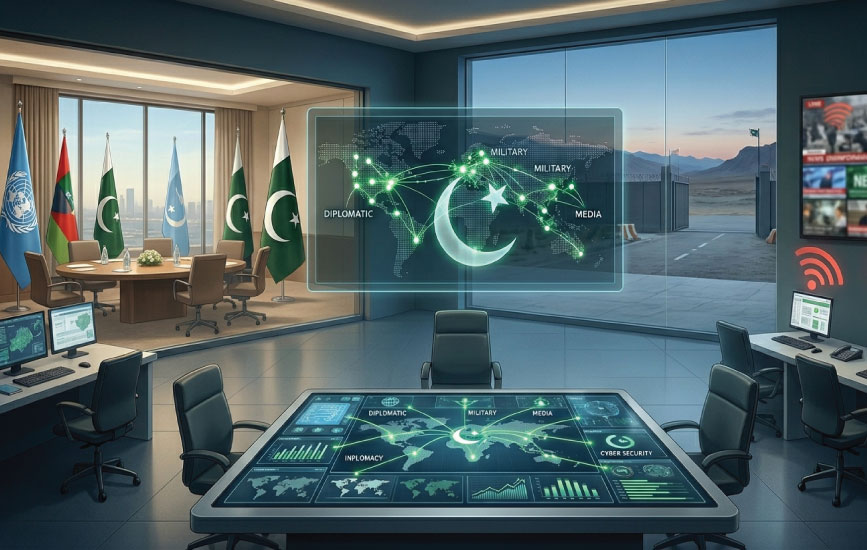
It has been a year since Marka-e-Haq. What is still striking is not how bad the crisis was but how well Pakistan handled it. In a region where small incidents can quickly get out of hand, Marka-e-Haq was an example of how a country can respond to a crisis in a careful and coordinated way. It was not a military problem but a test of how well Pakistan could handle things on many different fronts. Like diplomacy, information, cyber security, and how people felt about it.. What is important is that Pakistan showed it could do all these things in a coherent way, which is not always the case in a crisis.
At first, things happened in a way that’s all too common in South Asia. Before anyone could really investigate, Pakistan was blamed for what happened. This is what happened before like with the Pulwama attack and the Balakot airstrike. Indian media outlets were quick to build a story that was based on speed than on checking the facts. In these situations, what people think often becomes more important than what’s really true.
This time, Pakistan did not react in the same way. Of quickly making counter accusations, it asked for an impartial investigation. This was an effective move as it put the burden of proof back where it belonged. When this offer was not taken up it raised questions about how strong the original claims really were. Sometimes not saying much can be more revealing than saying a lot.
On the side Pakistan’s response was also very measured. There was no attempt to make things worse just to make a point or to get applause from people at home. The actions taken were careful, limited and clearly thought out to avoid starting a conflict. In a region with weapons, this kind of restraint is not a sign of weakness but of responsibility. As the Stockholm International Peace Research Institute has pointed out, both India and Pakistan have weapons that make it very risky to escalate a conflict. Against this background, Pakistan’s ability to defend its position without losing control of the situation showed a level of maturity.
Deterrence is not about what a country can do but about how it chooses to act. Pakistan’s response showed that it had the capability but not the control. In contrast, the quick attempt to shape the narrative on the side without real evidence created gaps that became harder to defend over time. When claims are made without proof, credibility suffers.
Diplomatically, Pakistan kept a tone. There were no appeals or exaggerated claims. Instead, it talked to partners in a consistent and composed way, reinforcing its position while keeping the conversation based on evidence. Organizations like the International Crisis Group have said that credibility in crisis diplomacy depends on being consistent, not loud. In this regard Pakistan’s approach ensured that its voice was heard in the discussion.
The information space told its story. Within hours, social media was filled with videos, misattributed images and coordinated messaging campaigns. Disinformation is no longer a side issue in modern crises it is central to them. What was different during Marka-e-Haq was Pakistans response. Official communication was quick and structured while independent analysts and digital communities actively pushed back against misleading content. Groups like the European Union DisinfoLab have shown how disinformation networks operate in the region and Marka-e-Haq was an example of this. The difference this time was that these narratives were challenged.
At home the public response seemed more grounded than in past crises. Rather than being driven by emotion, there was a broader sense that the situation needed careful handling. This alignment between what people thought and state policy created a degree of cohesion that strengthened Pakistan’s position.
Meanwhile, visible but equally important efforts continued along the borders. Cross-border tensions and attempts to destabilize did not disappear. Improvements in intelligence coordination and border management made them harder to carry out. Data from the South Asia Terrorism Portal shows that these low-intensity challenges are a constant in the region making it essential to be vigilant all the time.
Another important thing to note from Marka-e-Haq was the coordination among Pakistan’s state institutions. The civilian leadership, military command and diplomatic channels remained aligned, ensuring consistency in both messaging and action. This may seem normal. In times of crisis, it is often hard to achieve. That coherence helped Pakistan present a stance, reducing confusion and strengthening its credibility.
At the time, the crisis highlighted the limits of building a narrative without evidence. Quick media-driven claims can dominate headlines in the term but they are harder to sustain when scrutinized. Over time, inconsistencies become visible. Pakistan’s emphasis on information rather than just making a lot of noise allowed its position to hold more firmly.
Perhaps the important lesson from Marka-e-Haq is the value of restraint. In a region where things can escalate quickly the ability to control the pace and scale of response is critical. Pakistan showed that it could act decisively without losing control of the situation. That balance. Between resolve and restraint. Is what ultimately defines crisis management.
A year on the immediate tensions have eased. The lessons remain. Marka-e-Haq showed that modern conflicts are no longer fought on one front. Military preparedness, awareness, narrative management and institutional coordination all matter. And they must work together. Importantly, it reinforced a simple but often overlooked point: strength is not just about what you can do but, about how wisely you use what you have.