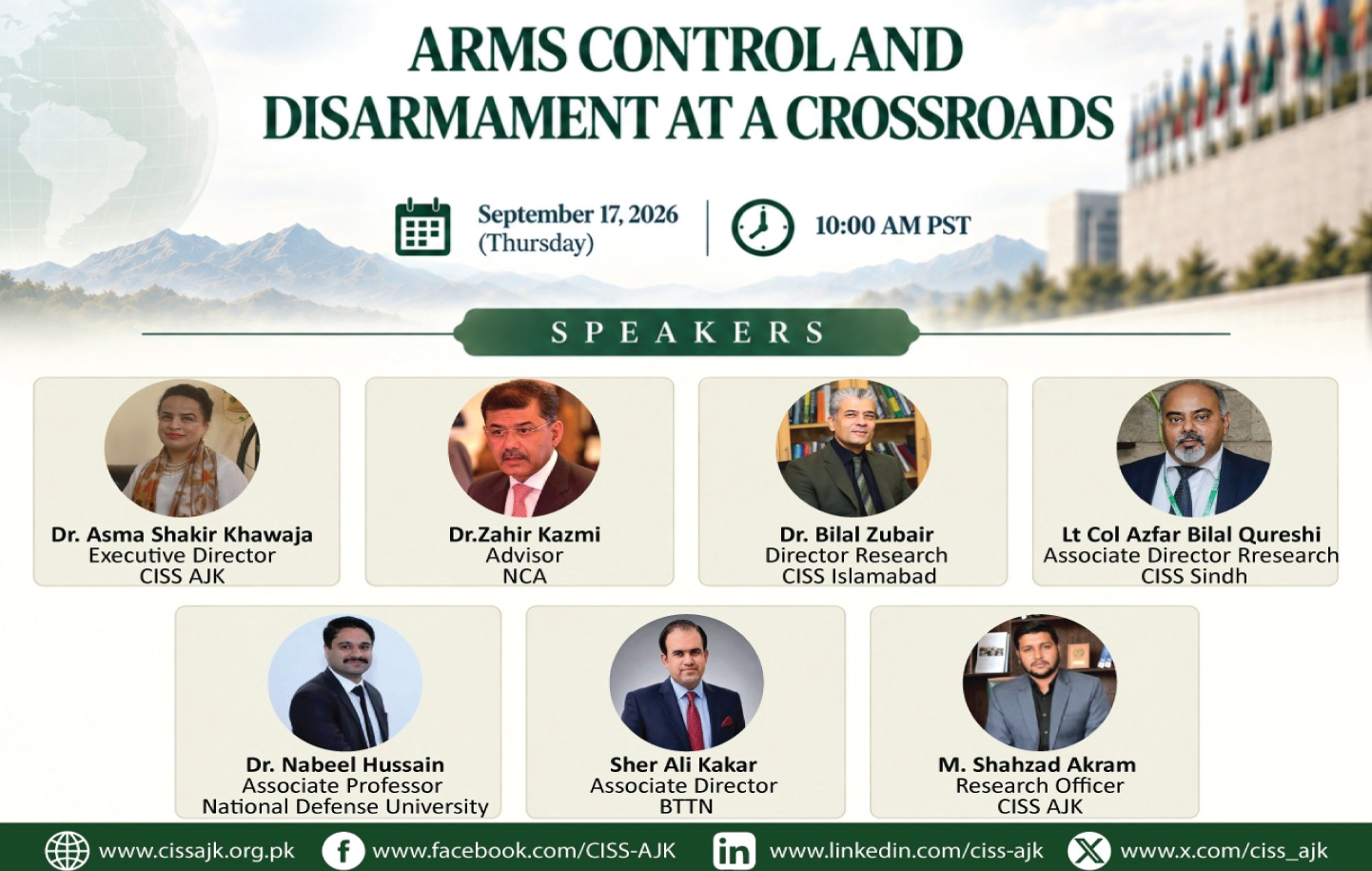
The webinar brought together experts and researchers to examine the evolving global arms-control landscape and its implications for international and regional strategic stability. Key takeaways from the speakers include:
🔹 Dr. Asma Shakir Khawaja
Executive Director, CISS AJK
➡️ Revitalising the global disarmament architecture requires stronger multilateral institutions, non-discriminatory approaches, and greater attention to the links between global and regional security.
🔹 Dr. Zahir Kazmi
Advisor, NCA
➡️ The Conference on Disarmament needs to move beyond procedural deadlock and advance substantive work on nuclear disarmament, negative security assurances, and preventing an arms race in outer space.
🔹 Dr. Bilal Zubair
Director Research, CISS Islamabad
➡️ Rising military expenditures and the weakening of arms-control regimes are contributing to a more competitive security environment shaped increasingly by geopolitical rivalry and emerging technologies.
🔹 Lt Col Azfar Bilal Qureshi
Associate Director Research, CISS Sindh
➡️ Intensifying geopolitical rivalries and competition in emerging domains, particularly outer space, make transparency and confidence-building increasingly important for strategic stability.
🔹 Dr. Nabeel Hussain
Associate Professor, National Defence University
➡️ An effective FMCT should follow a non-discriminatory framework that addresses both existing fissile-material stockpiles and future production.
🔹 Sher Ali Kakar
Associate Director, BTTN
➡️ Emerging technologies and evolving military doctrines are reshaping the strategic environment and creating new challenges for maintaining stability in South Asia.