

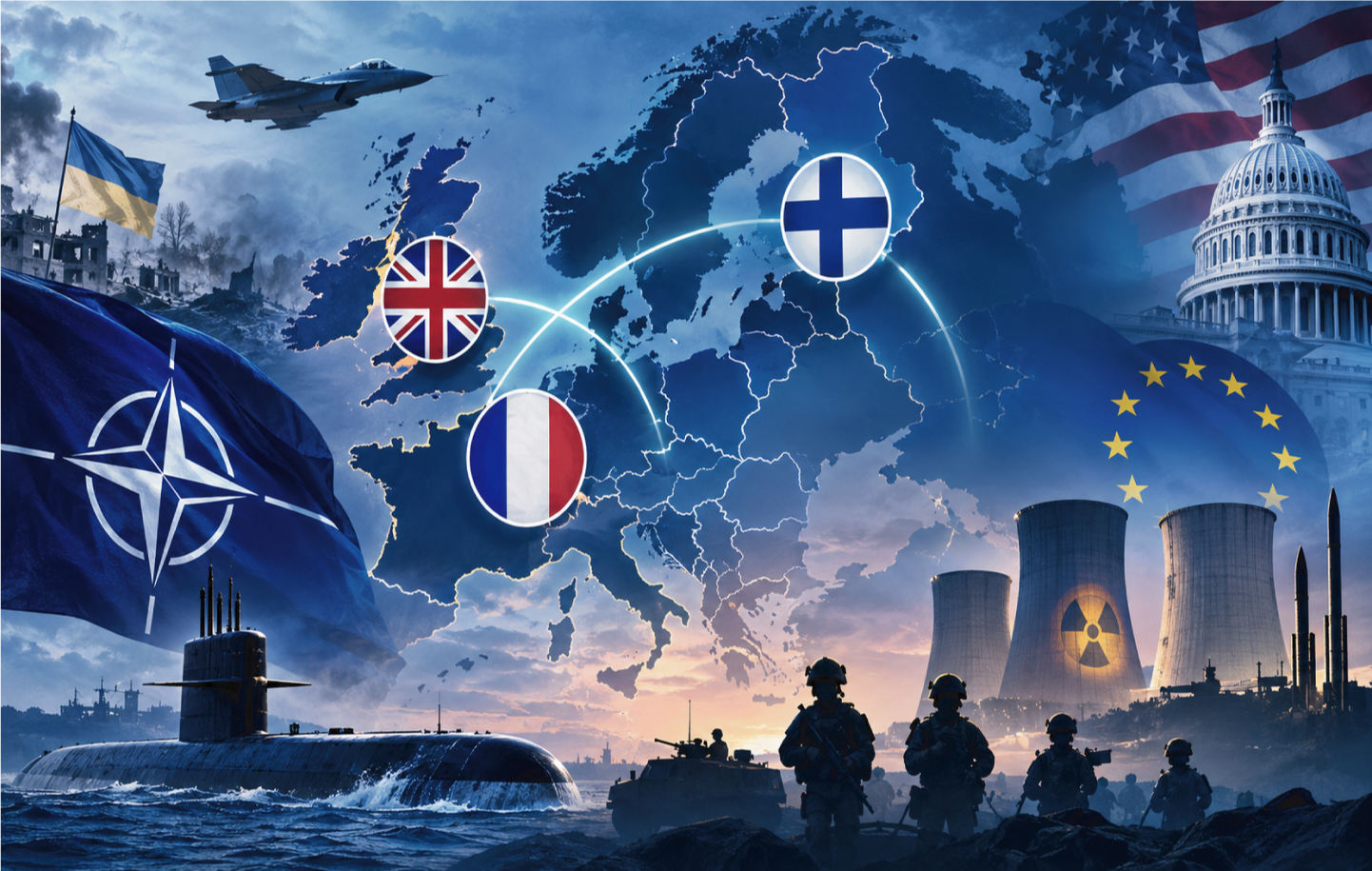
Wider international security environment includes the crisis in Ukraine, shifting U.S. defence obligations, and increased worries about missile and escalation dangers. The nuclear deterrence framework is entering an era of significant changes in Europe. For years, NATO’s collective security framework shaped European security. The Alliance’s supreme guarantee was established by the strategic nuclear forces of the US, accompanied by the United Kingdom and France’s independent nuclear forces. However, growing European emphasis on greater responsibility for continental defence, changing strategic conditions, and uncertainty surrounding the future pattern of U.S. security commitments are encouraging renewed discussion about the role of European nuclear capabilities. Without replacing NATO’s existing deterrence framework, recent developments involving France, the United Kingdom and Finland demonstrate this emerging evolution.
In March 2026, following France’s decision to develop what President Emmanuel Macron termed Forward Deterrence, the debate gained greater prominence. Macron announced that France needed to consider the European dimension of its vital interests. He emphasized that the initiative would remain sovereign and France would retain control over any decision to employ nuclear weapons. The concept sees greater consultation, participation in deterrence exercises, strategic signaling and, potentially, conventional contributions by partner countries to activities associated with French deterrence. Therefore, the concept does not amount to the creation of a European nuclear-sharing arrangement comparable to NATO’s nuclear planning mechanisms.
In September 2026, France and Finland announced that Helsinki would join French Forward Deterrence. Finland’s decision to participate in this initiative represents a significant development because it remains firmly embedded within NATO’s deterrence framework. For strategic signaling and managing escalation below the nuclear threshold, the two governments stated that cooperation would provide opportunities. To implement the cooperation, a Nuclear Steering Group is expected to be established soon. At the same time, Finnish President Alexander Stubb clarified that during peacetime Finland does not intend to station nuclear weapons on its territory. In September 2026, a parallel development is emerging around the UK and the Joint Expeditionary Force (JEF). JEF is led by the UK, trains forces across the North Atlantic, High North, and Baltic Sea to protect critical national infrastructure, strengthen joint command and control, and counter emerging threats. Ten participating nations of the JEF are all NATO members. The UK signaled deeper defence cooperation with Finland and other JEF members and is expected to sign a new defence agreement at a meeting in Oslo in November 2026.
However, the British approach differs from the French model. The UK already maintains an established nuclear deterrent based on continuous at-sea deterrence and explicitly assigns its nuclear forces to the defence of NATO. In its Defence Nuclear Enterprise 2026 Annual Update, published on 15 September 2026, the British government stated that the UK’s minimum credible independent nuclear deterrent remains assigned to NATO and that the country maintains continuous at-sea deterrence through its ballistic-missile submarine force.
The U.S. review of its force posture in Europe in 2026 has generated discussion among European allies about the future configuration of American military involvement. Shifting the burden away from the United States, it aims to make European nations take primary charge of their own conventional military defense. The withdrawal of the United States is changing the balance of responsibilities within the transatlantic security framework, gaining the highlight. These developments have also taken place alongside broader questions concerning the future distribution of defence responsibilities within NATO. While retaining NATO as the central institutional framework for collective defence, European states increasingly appear interested in developing additional capabilities and mechanisms that can strengthen their ability to contribute to deterrence and protect their sovereignty.
Amid Washington’s evolving responses to crises in different regions, including the war with Iran, the uncertainty surrounding U.S. security commitments has become more significant. The US willingness to adjust its military deployments and priorities in pursuit of its perceived national interests highlights the importance of European allies preparing for a wider range of strategic contingencies rather than relying exclusively on American assurances. In this context, Finland’s participation in France’s Forward Deterrence initiative can be understood as an additional layer of deterrence. Its significance lies in the possibility that European states are beginning to develop complementary arrangements to manage uncertainty about the future of U.S. engagement while preserving NATO’s central role in collective defence.
Therefore, the emerging European picture is diversification rather than replacement. NATO remains the central framework, while France is developing a distinct mechanism for deeper European involvement in its nuclear deterrence, and the UK continues to reinforce its role through NATO and wider defence partnerships such as the JEF. Finland’s participation in the French initiative, combined with its deeper defence cooperation with the UK and other JEF members, illustrates how a non-nuclear European state can strengthen its security relationships across several complementary frameworks. Current developments point toward a more complex deterrence structure in which NATO remains central and European states develop additional mechanisms for consultation, strategic signaling and defence cooperation. Rather than produce overlapping or competing deterrence arrangements for Europe, the challenge will be to ensure that these initiatives reinforce strategic coherence.
Ms. Nazia Sheikh is a Research Officer at the Centre for International Strategic Studies, AJK. She holds an MPhil in International Relations from the International Islamic University, Islamabad, Pakistan. She previously served as a Visiting Lecturer at the University of Azad Jammu and Kashmir, Muzaffarabad, Pakistan. Her research interests include arms control, disarmament, and nuclear non-proliferation. She has published research papers on nuclear security, deterrence, and international security, as well as op-eds in various national and international publications.