Key Takeaways:
- Pakistan’s 2016 application for Nuclear Suppliers Group membership remains stalled, while India’s 2008 country-specific waiver has sharpened criticism that NSG decisions are driven by geopolitics rather than consistent technical criteria.
- Islamabad argues it meets non-proliferation standards through its export controls, IAEA safeguards and nuclear-security arrangements, and warns that selective treatment risks strategic asymmetry in South Asia.
- The piece calls for clear, non-discriminatory membership guidelines and continued Pakistani transparency and IAEA cooperation to strengthen the credibility of the global non-proliferation regime.
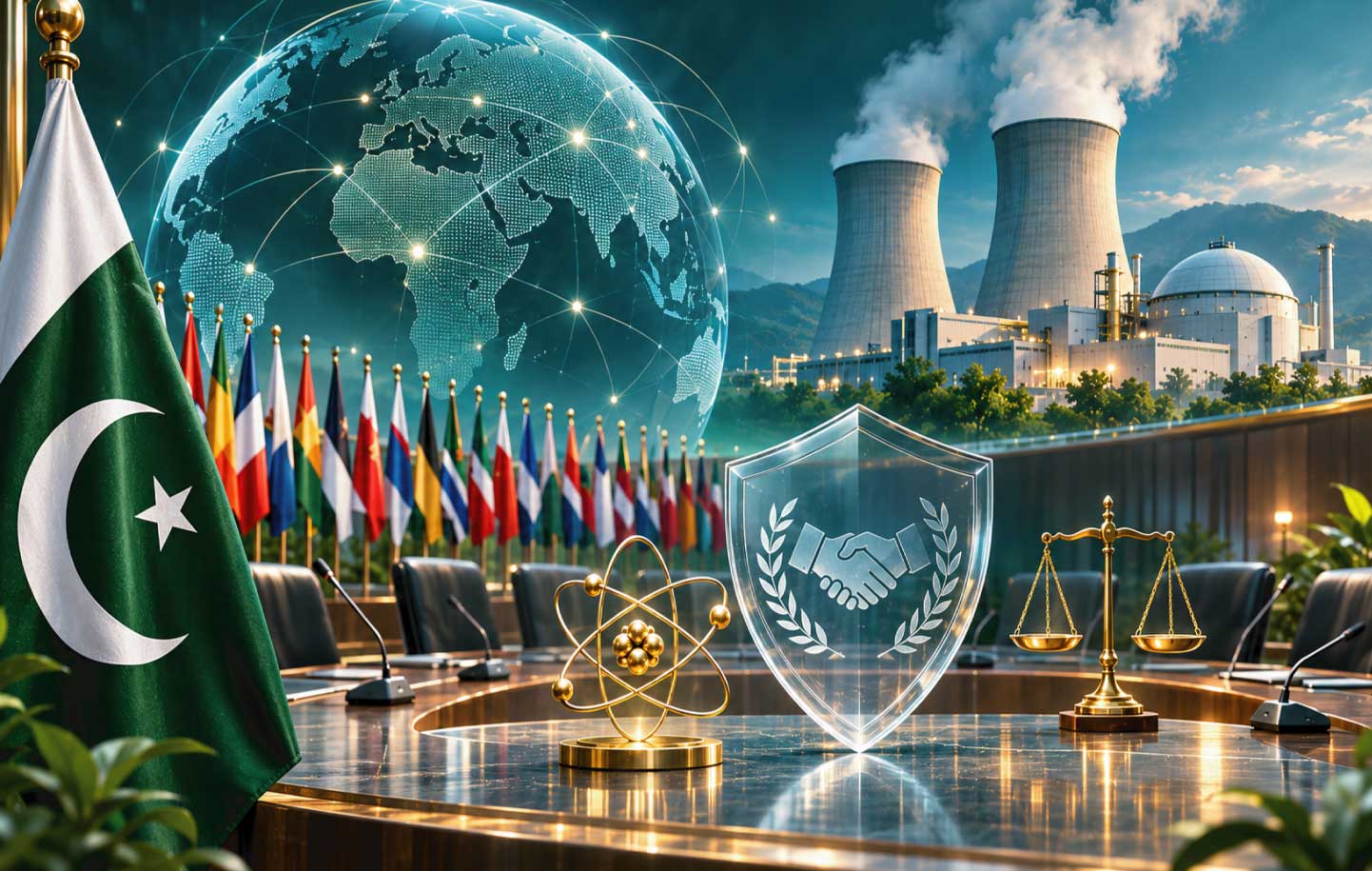
Pakistan’s candidacy for membership in the Nuclear Suppliers Group (NSG) was submitted in May 2016 without any consideration or response till today, which raises questions regarding non-discrimination, peaceful use of nuclear energy, and the credibility of the international nuclear non-proliferation regime. This has become important since the country-specific waiver was granted to India in 2008, and the Pakistani application has been stalling in the political process. The contrast has made the debate sharper around the issue of whether NSG membership is based on a consistent technical basis or driven by other geopolitical factors.
The NSG was established after the first nuclear test conducted in India in 1974 and aims to control nuclear exports, prevent the misuse of nuclear materials and technologies, as well as to promote their peaceful application. It has a consensus decision-making process, and any decision on admission to the group must be approved by the participating governments. The exceptions in the group are risky because they threaten to damage confidence in uniformity of rules for the international nuclear order.
Pakistan’s arguments for NSG membership are its non-proliferation credentials, national export control framework, its IAEA safeguards, and its nuclear safety and security arrangements. It has a robust export control system and is also cooperating with the IAEA, indicating its continued involvement with international nuclear governance. Pakistan has also reiterated the need to harmonize national export control lists in conjunction with international regimes such as the Missile Technology Control Regime (MTCR), Australia Group and the NSG. These are all initiatives that are pertinent to its technical and regulatory capacity to participate in multilateral export control systems. It is therefore crucial that technical qualifications are not lost in the game of geopolitics and a clear and fair membership policy is established, especially for non-NPT nuclear weapon states.
Membership deadlock also has implications for strategic stability in South Asia. Favoring one state over others, but not applying the same standards to the other, can help foster strategic asymmetry and amplify regional security issues. As India is rapidly moving toward nuclearization, it would also have access to preferential international cooperation, which would impact the regional strategic balance. Non-discrimination is, therefore, crucial in maintaining regional stability and avoiding more competitive pressures.
But Pakistan’s NSG non-membership has larger implications for its nuclear cooperation with other countries. This deadlock has restricted its fuel cycle services and technologies, and its ability to influence global nuclear policy, while limiting its supplier options. While civil nuclear cooperation with China is an important aspect of Pakistan’s nuclear development, it also relates to its membership in the NSG, which has a bearing on the recognition of uniform standards among the nations.
In the meantime, more and more geopolitical competition and new technology developments are defining the future of nuclear energy cooperation. Four possible courses of action have been identified: fragmentation into supplier blocs, regime hardening, selective accommodation, and principled adaptation. Fragmentation and selective accommodation may exacerbate divisions, but principled adaptation may be a potential path to balance the goals of non-proliferation and evolving international energy needs. Politically, this would enhance the legitimacy of the non-proliferation framework and facilitate peaceful nuclear energy development, though this is difficult.
Nuclear governance is becoming increasingly complex as a result of emerging technologies. Cybersecurity issues in nuclear facilities should be further addressed and coordinated with relevant international organizations and countries, such as the IAEA and China. Private sector initiatives in India’s nuclear power also pose questions on their effects on regional stability and nuclear security. Likewise, the small modular reactors (SMRs) offer new challenges for international cooperation in nuclear energy. The guidelines by the NSG are applicable to reactors, including SMRs; however, their role may be more relevant as the technology progresses.
Sustained diplomatic effort and continued efforts in building up national arrangements are required for Pakistan to meet these challenges. It would be helpful to publish regular reports that are accessible to the public on export control implementation and enforcement, continue to cooperate with the IAEA and peer review, and continue training in nuclear safety and security to support its regulatory capacity. Strengthening export control effectiveness could be achieved by strengthening the role of licences and coordination between the relevant authorities and customs institutions. Pakistan should also expand its civil nuclear cooperation efforts, including technical cooperation with a broader number of countries and institutions in all spheres, including nuclear safety, medicine, agriculture, and regulations.
The IAEA’s completion of Pakistan’s first-ever mission under the International Physical Protection Advisory Service (IPPAS) is a significant step in its nuclear security collaboration. It can build on its existing partnership with international peer-review mechanisms and capacity-building activities to further enhance its nuclear security practices. In parallel, the efforts of principled diplomacy and communication for lowering nuclear threats in the region with India are important parts of Pakistan’s broader strategic stability efforts.
The membership of the NSG is not only an issue of Pakistan’s membership in international export control arrangements, but it is also a challenge to the consistency, credibility and adaptability of the global non-proliferation regime. The NSG must have clear membership guidelines that are objective and not discriminatory and applied in the same pattern for all applicants. A principled approach will enhance the legitimacy of the group, foster peace through nuclear cooperation and also contribute to the strategic stability of South Asia.