
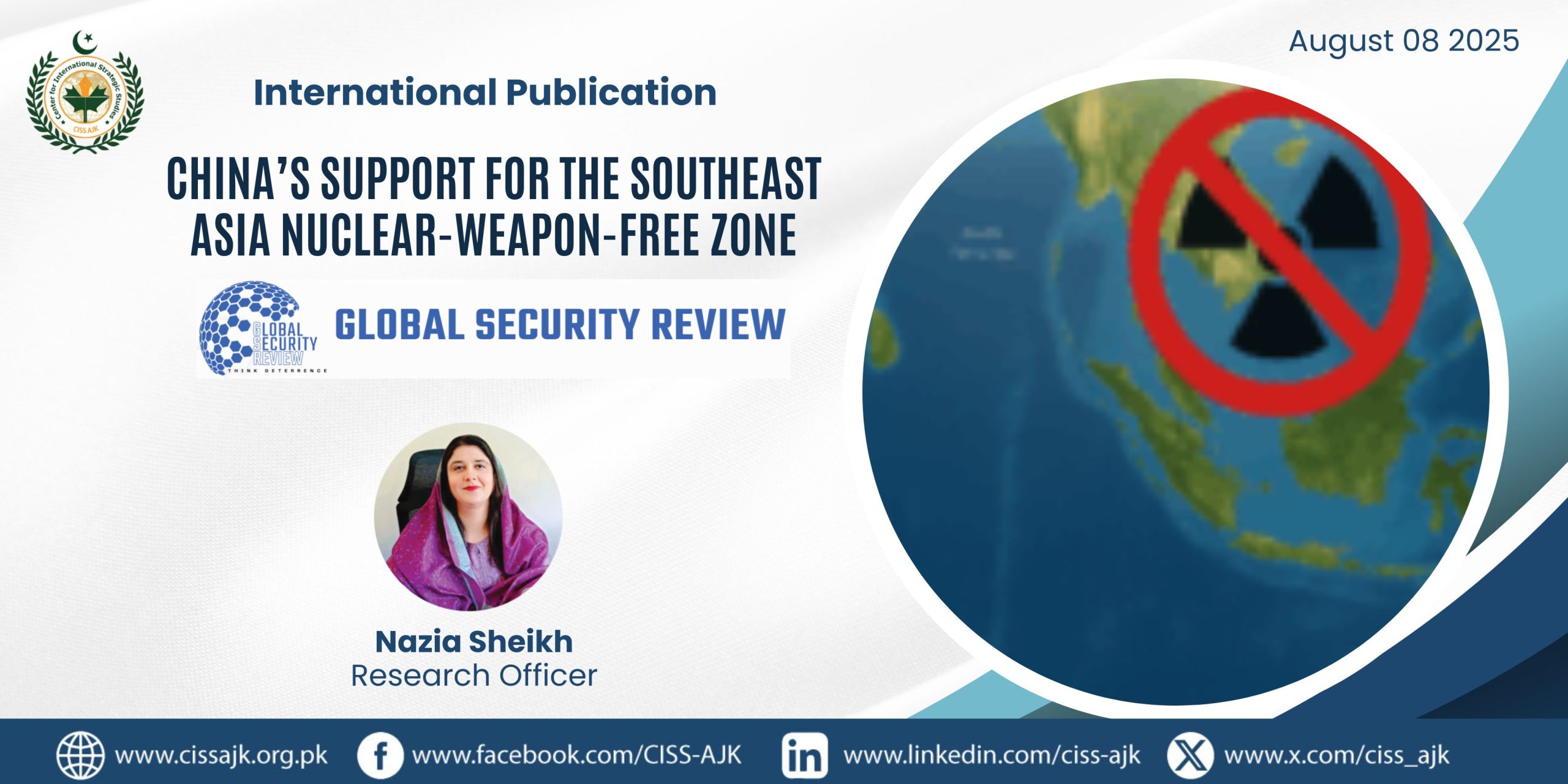
The recent decision by China to sign the Southeast Asia Nuclear-Weapon-Free Zone (SEANWFZ) treaty marked a significant shift in regional nuclear diplomacy and a positive step for nonproliferation and arms control. The SEANWFZ, also known as the Bangkok Treaty, was established in 1995 as an initiative of the Association of Southeast Asian Nations (ASEAN) to protect Southeast Asia from nuclear threats, promote peaceful nuclear cooperation, and develop a culture of restraint from use and threatening the SEANWFZ states.
China became the first nuclear state to sign this treaty’s protocols because the treaty aligns with its national security strategy and active-defense doctrine, which includes the unconditional no first use of nuclear weapons against non-nuclear-weapon states. Russia also expressed a willingness to sign. The US is evaluating its approach, boosting the chances of it being ratified worldwide.
While maintaining political neutrality can assist in lowering the risk of nuclear brinkmanship, SEANWFZ relies on ASEAN’s ability to manage great power competition. SEANWFZ is intended to provide “the regional pathway” to the ultimate objective of a world free of nuclear weapons.
Despite the treaty’s normative strength, four recognized nuclear weapon states (NWS), under the Nuclear Non-proliferation Treaty (NPT), France, Russia, the United Kingdom, and the US, do not provide assurances, or “protocol signatures,” which are essential for the effectiveness of SEANWFZ. By joining the protocol, the nuclear weapons states would be required to uphold the treaty, abstain from actions that would violate it, and offer negative security assurances (NSA), such as the promise not to use or threaten to use nuclear weapons against the SEANWFZ states or within the zone.
The strategic interests of the major powers historically cross in Southeast Asia. Many regional states continue to have tight security relations or security alliances with outside countries. This is the fundamental cause of the NWS’s failure to sign its protocol. Beijing, which stands apart from other hesitant nuclear weapons states, frequently cites strategic ambiguity and alliance duties and has repeatedly stated that it is willing to sign the agreement. Its recent remarks confirm this commitment.
While strengthening long-standing cooperation with ASEAN, China’s decision to sign the nuclear-free zone established a norm regarding big powers assisting in the regional disarmament framework. By supporting SEANWFZ, China contributes significantly to a regional standard that deters the use, threat, or deployment of nuclear weapons. Along with that, China is also supporting larger international nonproliferation objectives, which is especially important considering global nuclear modernization tendencies and growing geopolitical tensions.
It is also noteworthy that this move by China comes at a time when the world is increasingly inclined toward acquiring military platforms and modernizing its already possessed weapons. China’s decision to sign a nuclear-weapon-free zone is also important for the credibility of international law and regimes governing disarmament. It will strengthen their provisions and set a precedent for other regional and global powers to follow China’s footsteps for global stability and security.
Strategically, China’s adoption of SEANWFZ can help counter the perceptions of rising assertiveness in the South China Sea by presenting itself as a responsible nuclear power committed to regional stability and nonproliferation. Diplomatically, China’s relationships with ASEAN strengthened and deepened, with its broader goal of a multipolar world where regional agreements carry more influence.
Notably, it also differs from the American position in Asia, where Washington’s long-standing nuclear deterrence approach frequently makes backing for nuclear-weapon-free zones difficult. China’s strong support for ASEAN’s nuclear-weapon-free zones boosts the global nonproliferation drive despite continuous disruptions to major treaties, such as the collapse of the Intermediate Nuclear Forces Treaty (INF) and the precarious situation of New START (Strategic Arms Reduction Agreement). Furthermore, in a zone that has so far rejected the lure of nuclear weapons, it strengthens the moral case for nuclear abstention.
China’s willingness to sign the SEANWFZ is a tool for norm-setting and cooperative security. The US and other nuclear-armed nations must follow suit for the treaty to be successful. ASEAN won diplomatically with China’s SEANWFZ commitment, but it needs other nuclear weapons states’ support. ASEAN’s efforts act as a small but significant barrier against the proliferation of nuclear weapons with China’s backing, reminding that regional actions can still be crucial in determining the parameters of the global nuclear order as strategic uncertainties across the world increase.
Nazia Sheikh is a Research Officer at the Centre for International Strategic Studies, AJK.