

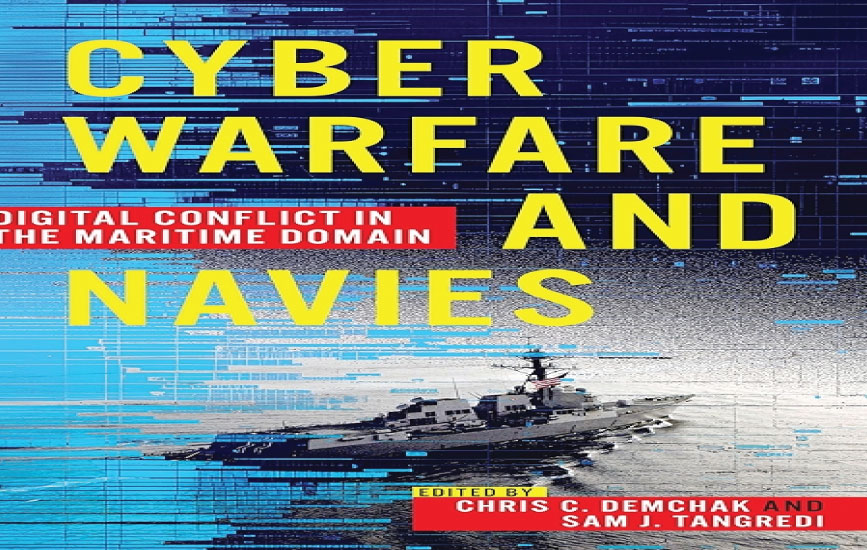
Cyber Warfare and Navies contends that contemporary maritime power, both military and commercial, is now inseparable from digital networks, rendering it susceptible to large-scale cyber disruptions that can reverberate throughout the global economies. The editors anticipate a grim truth: as approximately 85 percent of the world’s trade and 70 percent of liquid fuels transit by sea, any assault on ships, port-handling equipment, shipping firms, and maritime suppliers can disrupt manufacturing and retail supply chains across the globe. The book argues that neither navies nor commercial shipping can sail out of cyber threats, and preconditions a programmatic analysis of vulnerabilities, organizations, doctrine, and defense in the maritime domain.
The editors represent a powerful indicator of the book’s ambitions. Chris C. Demchak is the Grace Hopper Chair of Cyber Security and senior cyber scholar at the Cyber and Innovation Policy Institute at the U.S. Naval War College. He has vast experience of working on the topic of wars of disruption and resilience and great-systems conflict in the digital era as an intellectual toolkit that would be well-suited to the systems-level approach of the book. As a retired U.S. Navy surface warfare officer and current Leidos Chair of Future Warfare Studies in the Naval War College, Sam J. Tangredi is a practitioner-scholar who has been informed by experience as a commanding officer at sea and as a strategic planner at the Pentagon. They offer a volume that integrates organizational diagnostics with operational realism and looks to shift the debate past slogans toward the structure, powers, and human capital required to implement a maritime cyber defense.
The book considers both naval and commercial maritime cyber dangers, as an interconnected ecosystem, rather than separate spheres, is one of its strongest characteristics. Explicitly covering the naval fleet (U.S. Navy, Marine Corps, and Coast Guard) and the digital logistics chains that support global shipping, the volume places cyber defense not as a specialty but as a necessity that should be addressed both as part of fleet operation and as part of national economic security planning. The book not only covers the navies of allied and adversarial powers with comparable attention but also gives equal attention to the organizational relationship between the U.S. sea Services and the U.S. Cyber Command. Moreover, the book also presents a composite view of the manner in which various navies are organizing, preparing, and codifying doctrine to conduct cyber operations at sea.
Another organizational reality that the book faces is that naval leaders initially found it challenging to recognize cyber warfare as a fleet issue, primarily due to the belief that physical isolation of vessels and the maritime domain provided some form of protection. That presumption has withered away because afloat platforms and port systems are now strongly networked. The description indicates that the U.S. Navy created Fleet Cyber Command with Tenth Fleet forming its operational element. As the Navy portion of the U.S. Cyber Command, those initiatives have not provided the degree of integration and warfighting impact foreseen. Book Reviews 273Journal of Advanced Military Studies Considering its edited nature, the volume appears to be aimed at bringing several specialist lenses together, between critical maritime infrastructure and at-sea operations, and between allied doctrine and adversary tactics and strategy. Interestingly, one of the contributors to the chapter on subsea communications cables and conflict is Dr. Camino Kavanagh (King’s College London), who confirms that the book highlights the undersea fiber networks that convey data around the world quietly and that act as strategic arteries during crisis and war. This issue aligns perfectly with the framework of maritime and cyber matters, encompassing both commercial and military assets. Concerns have increased during the past few years, as the U.S. Naval Institute Proceedings highlighted that the U.S. Navy, in particular, lacks a coherent, scalable strategy for integrating information warfare and cyber operations with fleet maneuver, with perceived gaps in vision, force structure, authorities, and resilient architectures.
The synopsis of the book, which focuses on organization, doctrine, and practical recommendations, is consistent with that criticism and expands the range to include allied and adversarial opinions, as well as the commercial maritime context. The book has successfully filled a long-standing gap between academic and cyber discourse and the demands of fleet operations and ports. A gap that has too frequently reduced “cyber” to risk registers that are abstract, lacking any connection to the force package, to electromagnetic maneuver, and to logistics. Second, the focus on the organization and equipping of navies to perform cyber operations, as well as the doctrines thereof, is comparative in nature and helpful to practitioners by design, not description. Third, the plans to include opponents like China and Russia, as well as allied navies, place the debate in a real strategic competition environment and do not limit it to a U.S.-centric mirror. This is what makes the book particularly applicable to warfighters and leaders in the maritime industry, who currently seek actionable frameworks rather than a simple threat list. Perhaps the most obvious criticism that can be applied to edited volumes is that coherence requires a heavy editorial hand to bring together chapter methods, terminology, and prescriptions. According to the synopsis, the report will provide recommendations on enhancing maritime cyber operations. However, the value of these recommendations to practitioners will depend on whether they are prioritized, resourced, and effectively implemented within realistic chains of command and acquisition schedules. Proceedings commentary has identified precise requirements, ranging on the one hand to the creation of Navy-owned, Service-retained maritime cyber teams under fleet commanders and, on the other hand, to the further expansion of cyber warfare engineer billets, and the modernization of networks and the development of tools and readers will seek to find evidence and cases in point either to support, or to refine, or to dispute such prescriptions.
Another possible disconnect, based on the specific chapters, is the extent to which the volume delves into the specifics of operational technology and industrial control systems at sea and on land, as well as the hybrid types of cyber-physical threats they present. There is a lack of clear understanding of how to identify the weaknesses of port-handling equipment and supply chains, as well as the organizational interfaces between the U.S. Navy, Marine Corps, Coast Guard, and USCYBERCOM. The marBook Reviews 274Vol. 16, No. 2 time audience will be interested in case studies or vignettes relating fleet functions to terminal operations, shipboard engineering control systems, and the realities of multivendor legacy equipment. The book is best suited for naval officers, information warfare practitioners, and cyber engineers, as it provides a cross-sectional analysis of organizational design and doctrinal evolution across various navies within the context of the geopolitical realities of great power competition. Coast Guard authorities and maritime regulators can use its information to identify commercial maritime weaknesses and civil-military coordination requirements in the maritime domain. Port operators, shipping executives, and terminal operators will recognize their risk landscape in the litany of related systems now vulnerable to sabotage, disruption, and exploitation, as described.
Cyber Warfare and Navies is unique because it discusses the maritime cyber risk as a civil-military operating issue, rather than a collection of security controls. Demchak and Tangredi utilize their cross-functional strengths to produce a volume, as the official description unequivocally notes, which maps threats, surveys how navies are preparing and equipping to counter cyber operations, and provides recommendations to enhance maritime cyber defenses. Including more specialized subjects, such as the use of subsea communications cables and autonomous vessels, points to the practical concerns with the infrastructure and platforms on which future conflicts at sea will be made possible. Although the final test of any edited set is continuity and particularity, the framing and authors apparent in the public domain suggest that a reference may guide the development of doctrine, design of exercises, and investment decisions at fleet and port scales.
Muhammad Shahzad Akram is a research officer at the Center for International Strategic Studies, Azad Jammu and Kashmir, Pakistan.