

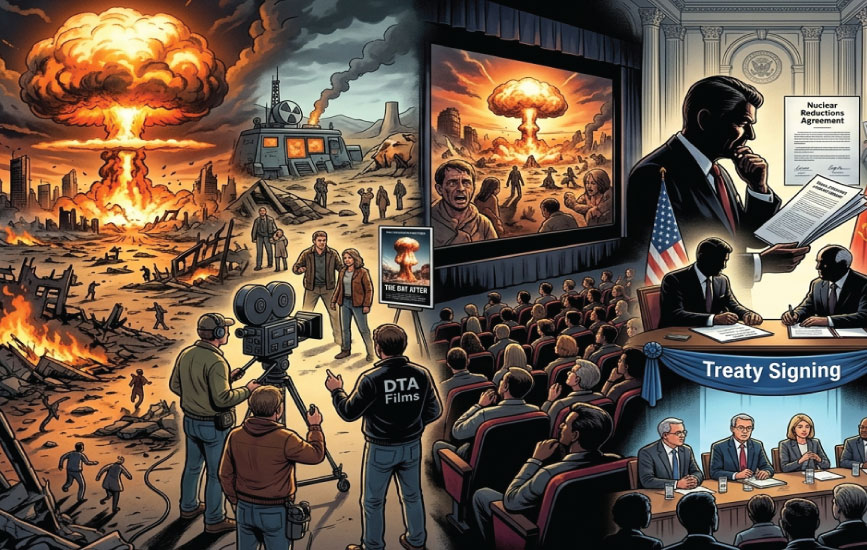
Movies regarding nuclear war have traditionally brought the threat of apocalypse before our eyes and influenced how societies understand the dangers of atomic weapons. Iconic films such as The Day After (1983) and The House of Dynamite (2025) dramatize situations that were once restricted to secret war games. By unleashing the havoc and human cost of nuclear war, these movies make ordinary people, as well as officials, including presidents, reflect on strategy, survival, and the urgency of arms control. They generate public discussion and, in some instances, even influence policy. For example, the film The Day After had real political effects, including influencing President Ronald Reagan, who, after watching the film, went on to negotiate arms control treaties with the Soviet Union. In the same way, analysts hope that the new thriller by Bigelow will open fresh discussions that reduce the nuclear threat and pave the way for arms control. Moreover, The House of Dynamite influenced leaders to rethink the future of arms control and disarmament. By engaging the masses, these movies establish a constituency for arms control, which other media can hardly accomplish on their own.
Films can transform minds and inspire action by making nuclear threat feel real. The Nuclear Threat Initiative (NTI) interviewed 2,000 Americans regarding The House of Dynamite and compared those who viewed the trailer with a control group. Individuals exposed to the trailer were far more inclined to support nuclear reductions: 75.6% of viewers believed the world would be a safer place without nuclear weapons (compared to a much smaller portion in the control group), and 74.3% thought that they should take action to reduce nuclear danger. In a democracy, shifts in public opinion can push leaders to toward negotiation and disarmament.
This is not the first time this has occurred. An instant survey conducted after the premiere of The Day After revealed that the number of Americans who supported stricter arms control had risen dramatically, according to a CBS News/New York Times survey. During the 1980s, polls showed that The Day After influenced public attitudes, and one study found that the film generated significant debate on disarmament among both the general public and policymakers. Such films create public discussion and, in some instances, even reshape policy. For example, after The Day After was released, various Democratic and Republican presidential aspirants began to speak more eloquently about nuclear systems, as the issue became part of public discourse. In 1984, both Reagan and Mondale discussed nuclear war and defense in detail, which might not have been possible without such a wake-up call.
More recently, director Kathryn Bigelow has expressed hope that The House of Dynamite will engage younger generations in the nuclear debate. Early indications suggest that it is already doing so, as searches for nuclear weapons on Google surged across the country during the week of the film’s premiere.
Advocacy groups focused on arms control often capitalize on such opportunities. The United Kingdom (UK) has used the film Threads to develop lectures on survival planning and disarmament. Likewise, once House of Dynamite became available on streaming platforms, think tanks were quick to release the policy briefs on the missile-warning dilemma and the need for enhanced communication system with adversaries. The members of Congress have used these films in hearings to dramatize worst-case scenarios; in broader public discourse, advocates have drawn on them to argue that arms control, or even zero-nuclear-weapons policies, could help break the cycle depicted.
Movies like The Day After and The House of Dynamite open space for discussion. They create a desire for real action by generating unease among citizens about the risks of nuclear conflict. When nuclear issues fade from the headlines, such films reawaken awareness and inspire citizens to push back against the growing nuclear arms race. One recent study argues that the problem of the democratic deficit in nuclear policymaking can be addressed by raising public awareness through film. When citizens are better informed and motivated, they place pressure on leaders to act.
By revealing scenarios once confined to secret war games, films perform a public service by exposing the dangers of nuclear war and prompting critical questions, such as how can we prevent it and whether deterrence is enough. They give abstract statistics a human dimension. Arms control expert Daryl Kimball has argued that such encourage reflection on what must be done to avert nuclear war, as well as on the role individuals can play in advancing peace and the security of a nuclear weapons-free world.F
rom Dr. Strangelove to Oppenheimer to The House of Dynamite, films have been an effective tool of nuclear education. By using the unthinkable as a narrative device, filmmakers have long awakened society from its complacency. Even recent additions to this canon, especially The House of Dynamite, continue this tradition in the context of modern dangers. They films expose audiences to the strategic dynamics and human stakes of nuclear confrontation that were previously confined to maps and classified simulations.
According to one defense analyst, such movies present realistic scenarios that, until now, were limited to high-level war games under strict secrecy. Public support for arms control is likely to grow when people are confronted with these realities. The House of Dynamite and similar films offer hope that nuclear issues are being taken up by a new generation. When people observe, reflect, discuss, and ultimately demand a safer world, art fulfills its highest purpose by helping to steer society in a different direction. In this way, realistic nuclear thrillers are not merely entertaining; they can also spark the debates and actions necessary to prevent the real-life disasters they portray.