

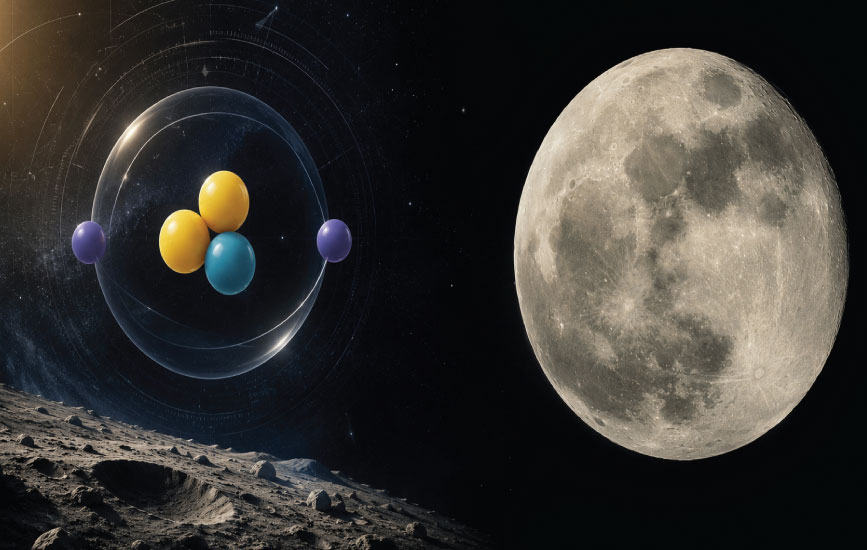
THE DEBATE SURROUNDING THIS ISOTOPE IS NOT MERELY ABOUT NUCLEAR FUSION, BUT ABOUT THE INTERPLAY BETWEEN EMERGING TECHNOLOGIES, INTERNATIONAL LAW, POWER AND ECONOMIC TRANSFORMATION. HELIUM-3 REPRESENTS A POTENTIAL STRATEGIC BREAKTHROUGH BECAUSE IT LINKS THE EARTH’S ENERGY TRANSITION TO THE DEVELOPMENT OF EXTRATERRESTRIAL RESOURCES, REQUIRING POLICYMAKERS TO DEFINE RULES FOR GOVERNANCE.
THE NEW SPACE RACE does not simply reprise Cold War symbolism. It is a structural competition over infrastructure, supply chains, and future energy systems. While flags and prestige defined the twentieth-century contest, permanence defines today’s return to the Moon. As China promotes its International Lunar Research Station with Russia and the United States develops the Artemis program, the Moon is becoming a vital node in the global energy architecture.
Helium-3, a rare isotope found on the lunar surface, sits at the heart of this shift. If fusion technology advances, it could become one of the most significant energy sources of the twenty-first century. Billions of years of solar wind exposure have left the lunar regolith rich in helium-3, while the isotope remains sparse on Earth. Scientists estimate the Moon may hold more than a million tons.
The strategic importance of helium-3 lies in its future potential rather than its current viability, as large-scale extraction remains technologically daunting and economically uncertain. However, the development of effective helium-3 fusion reactors would overturn global energy hierarchies.
Consequently, this discussion has moved beyond speculative science fiction. It is now a matter of strategic positioning.