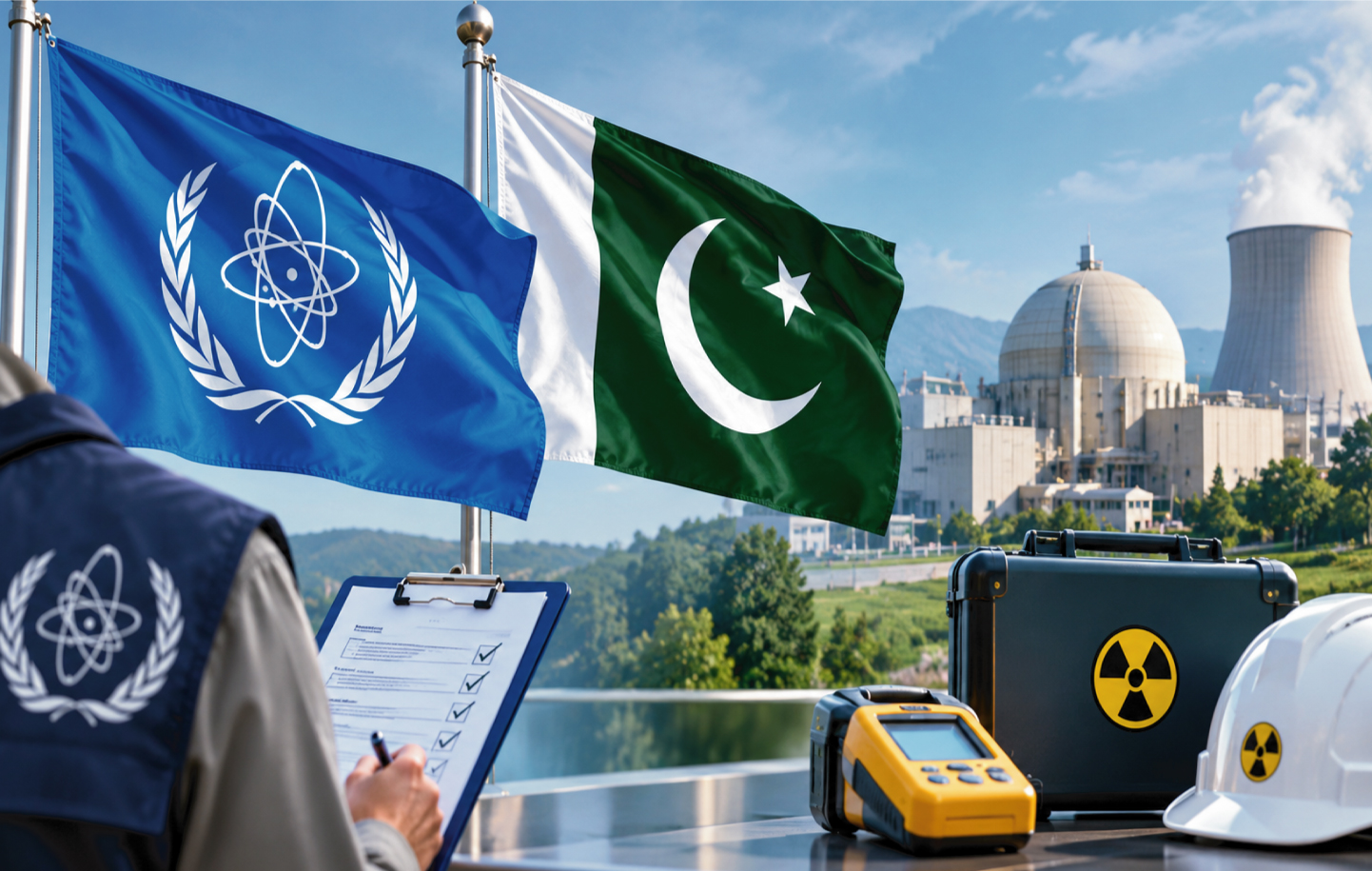
Nuclear security rarely makes headlines when it works. It’s success is seen in what doesn’t happen: the material that doesn’t get diverted, the facility that does not get broken into, the emergency that does not escalate into crisis. It is one of the most significant and least noticed forms of international cooperation, developed slowly over the years. There is no better example than the partnership between Pakistan and the International Atomic Energy Agency (IAEA).
Pakistan’s nuclear programme has been in existence for over 50 years and it has a civilian nuclear power fleet of around one-sixth of its energy requirement. A programme of this size and duration requires a legislative, regulatory and institutional security plan, and that is what Pakistan has focused on. Safety and security in the sector is regulated by an independent regulator, the Pakistan Nuclear Regulatory Authority. NISAS, a Collaborating Centre as designated by the IAEA, is located beside it. The Pakistan Center of Excellence for Nuclear Security (PCENS) is engaged with the Agency to develop security capacity. These bodies work together to translate a commitment on paper into trained personnel, tried and tested processes and a culture of vigilance.
Strong national institutions are only the starting point. The more telling measure of partnership is what a country does with that capacity for others. PCENS has become a focal point in the region for training and knowledge sharing. It has signed a Practical Arrangement with IAEA at the 2024 International Conference on Nuclear Security and has conducted a progressively increasing number of courses at the national, regional and international levels. In a formal move, Pakistan has now requested the Agency to award Collaborating Centre status to PCENS, which it is already doing de facto.
NISAS is an equally outwardly oriented organization. It has hosted a course for 23 officials from 17 countries, including representatives from Africa, the Middle East, Central and South Asia, this year, which was based on the IAEA’s guidance on regulatory infrastructure and operational safety and emergency preparedness. It also hosted an IAEA workshop for focal points of 13 countries on denial of shipment, an ongoing barrier to the shipment of radioactive materials such as medical sources and industrial sources across the borders. Such peer learning enables countries to address the common challenges in a collaborative manner, instead of individually.
There needs to be proof that arrangements function effectively when under pressure if they are to be credible. Pakistan has participated in the IAEA’s ConvEx exercises involving emergency notification and assistance arrangements; and has registered national assistance capabilities to the Agency’s Response and Assistance Network. It conducted its second National Radiation Emergency Exercise in September, and observed ConvEx-2e with international experts, including from the Agency.
The best kind of transparency is inviting others to review it. PNRA recently hosted Pakistan’s first International Physical Protection Advisory Service (IPPAS) Mission. The mission included a review of Pakistan’s legislative and regulatory framework for nuclear security of nuclear materials and facilities, as well as review of a specific nuclear facility. IAEA team of experts after 12-day review found out that, “Pakistan has established a robust nuclear security regime for the physical protection of its nuclear materials and facilities.” Pakistan is also expected to host the Agency’s annual meeting of Nuclear Security Support Centres in November.
Pakistan’s contribution towards nuclear safety and security extends beyond bilateral work. In April, Pakistan hosted the 10th Review Meeting of Convention on Nuclear Safety, the outcomes of which are expected to further enhance global safety practices. It has also supported new Agency programmes like ATLAS (atomic technologies licensed for applications at sea).
Nuclear security is a shared good in the first place. No state can ensure its own resources and infrastructure while another neighbouring state is lacking, and capacity constructed in one nation sets the benchmark for everyone else. Pakistan is moving toward the commissioning of a new reactor C-5 and its experience as an operator and trainer would be applicable to countries that are building regulatory capacity. Partnerships of this kind stay healthy only if they keep evolving. The circle of beneficiaries can expand to more states with emerging nuclear programmes and developing regulatory capacity. But investment in people should remain, as only trained and alert professionals can provide security, not equipment.
The development of the IAEA-Pakistan relationship was not a one-off or a single agreement. It developed gradually through institution building, training, exercises and missions, each adding trust to the last. The world will require many more partnerships of this kind, rooted in openness, learning from each other and a shared sense of responsibility for nuclear security, as nuclear technology spreads to more countries and more applications.
Author’s Bio: Syeda Tahreem Bukhari is an Associate Director at the CISS-AJK.