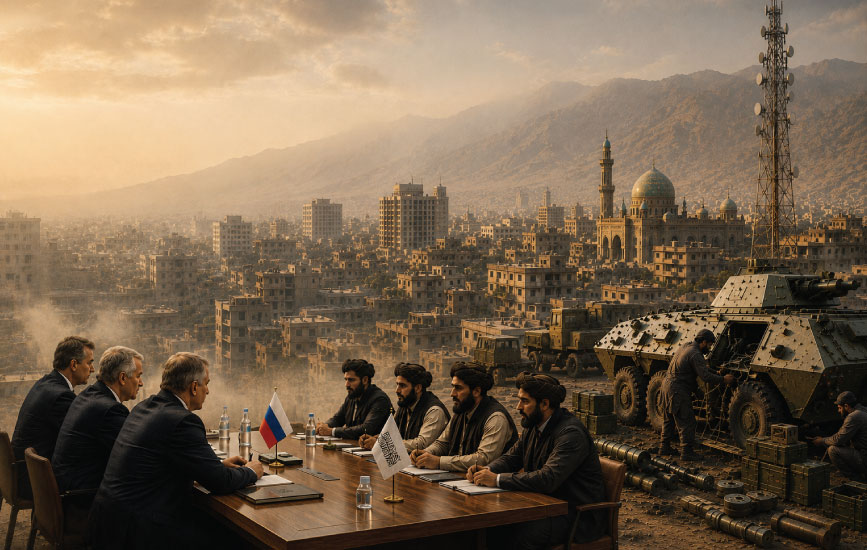
The recent visit to Kabul by a high-level Russian delegation, led by Alexey Komkov (head of the FSB’s Fifth Service), Deputy Director of the FSB, Vasily Osmakov (Russian Ministry of Defense) and Dmitry Novikov (FSB South Asia portfolio) marks a new opening of diplomatic relations between Russia and the Islamic Emirates where Russia has gone beyond the status of a diplomatic observer to active military partner of the Taliban. They discuss the restoration of Soviet-era military equipment, the supply of new weapons and ammunition, technical cooperation on maintenance, and the launch of a joint air defense system. This clearly indicates rearmament.
Washington’s military presence in Central Asia remains a concern to Moscow, which continues to seek to prevent its establishment there. Secondly, ISIS-Khorasan is a direct threat to the Russian homeland, as seen in the attack on the concert hall in Moscow in 2024. Despite the ideological shortcomings of the Taliban, they are regarded as the best means of containing them in the north. Third, it embeds itself in Kabul, thus gaining influence over a country that borders three Central Asian countries that are part of its security alliance with Russia (Tajikistan, Uzbekistan, Turkmenistan), but also causing headaches for its competitors, especially the Pakistani government.
The magnitude of cooperation remains somewhat unclear, but the trend is evident. Afghanistan has hundreds of Soviet-made armored vehicles, artillery, Mi-17 and Mi-35 helicopters, and Su-22 aircraft that were left behind by Dostum’s forces, the Soviet army, and captured Afghan national army stocks. Russian technical teams are now repairing these platforms. The Taliban Air Force, which has been grounded since they came to power, is being incrementally rebuilt with Russian help.
According to several regional intelligence reports, Russia has begun providing small arms, heavy machine guns, ammunition (including 7.62×39 and 5.45×39 shells, RPG-7 rounds, and 122mm/152mm artillery shells), and a few anti-drone systems. Since 2022, the UN Panel of Experts reports on Taliban sanctions have repeatedly identified materials originating from Russia being sent into the country via discreet routes. The exact numbers have been classified, but UN Panel of Experts reports on the Taliban sanctions have consistently pointed to the flow of Russian-origin material into the country since 2022, and it has been done in discreet ways. The mention of “joint air-defense” in the leaked document is particularly worrying. This is probably intended to include upgrading existing Soviet surface-to-air systems, as well as the possible deployment of newer Russian MANPADS or short-range systems. The strategic takeaway is making it a lot more expensive for any future American or Western special operations forces to operate in Afghan airspace.
The high proportion of FSB representatives in the delegation indicates a close relationship on intelligence matters, particularly regarding ISIS-K networks. Russia is providing signals intelligence and targeting data, and is probably getting back some HUMINT from the Taliban on the Central Asian jihadist campaign. For Pakistan, these developments are extremely dangerous. The Taliban, who seized power in Pakistan in August 2021, have been giving shelter and active support to Tehrik-i-Taliban Pakistan (TTP) to Pakistan’s chagrin. The Pakistan Institute for Conflict and Security Studies (PCST) reported on the rise of TTP attacks in Pakistan, from 250 in 2021 to more than 900 in 2024. Now the group can move around freely in Afghan territory as compared to 2014.
Russia’s move to bolster this Taliban regime has two negative impacts on Islamabad. Which indirectly helps the TTP by sharing logistics, training base, and ideology. If the Taliban is better armed and more confident, there is less chance they will make a move toward crushing their ideological cousins. Since the invasion of Ukraine by Russia, relations between Moscow and Islamabad have been souring. There is friction on all fronts with Pakistan’s non-public backing of Ukraine at the UN, its military ties with the United States (which have been tense), and its ongoing military cooperation with India. Russia’s support for the Taliban gives it leverage against one of the countries it is growing more wary of.
However, persistent suspicions within the Pakistani security community suggest that some members of the Russian intelligence community have been in contact with the TTP as part of classic great power hedging. It is open to debate whether that is direct “backing” or not. Still, the strategy’s impact is obvious. The Durand Line is the most volatile ever. Better-equipped TTP fighters are beginning to retake control of the Taliban controlled Afghan territory, as Pakistani military operations in North Waziristan and Khyber districts are getting better. Close cooperation between Russia and the Taliban further fuels the ongoing tension between the two and makes the anti-terrorist operation for Pakistan more costly.
Russia is making a strategic mistake it made in the 80s, only now it’s on the other side of the equation. In helping to give birth to a more capable, battle-hardened, and militarily supported Islamic Emirate, Moscow is the midwife to a terrorist hub that will not be confined to Afghanistan. The Central Asian republics know this. Pakistan understands this. So deep are Iran’s reservations that they will even criticize them. It seems that only one place, Moscow, does not think it can wait on this tiger forever. Following the utter debacle of the 2021 withdrawal, the United States and its allies created a vacuum that is filled by Russia, Iran, and the Taliban themselves in an unholy trinity of convenience. As always, the Afghan people and the Pakistani security establishment are the victims, and now they will have to deal with a Taliban, armed by the Russians, who have embraced the Pakistani state as the next battleground. This new military axis directly complicates Pakistan’s existential struggle against militancy on its western border.