

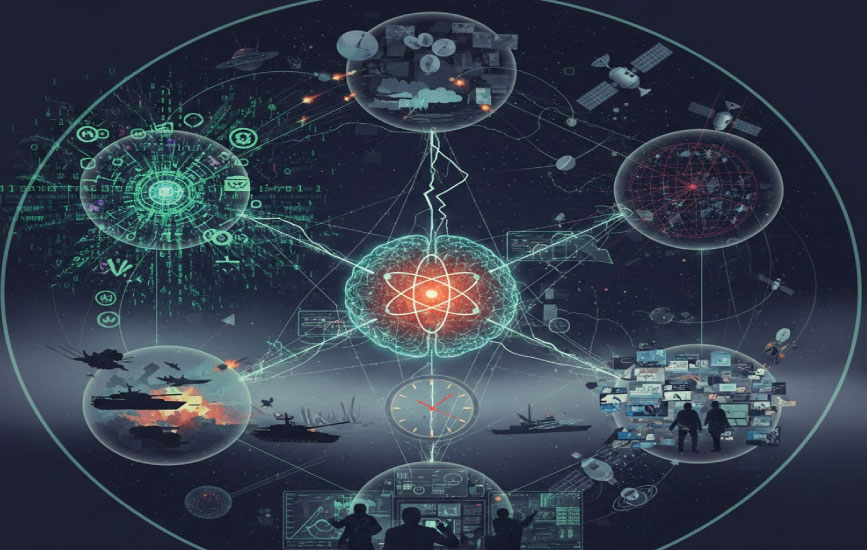
Deliberate decisions to use nuclear weapons are no longer what drives nuclear escalation in the strategic environment of today. Rather, it is becoming more influenced by events taking place in many spheres i.e cyber, space, conventional, informational and nuclear, in which the activities, which were meant to be limited, can have strategic implications much wider than intended. In this regard, intent is the least threatening factor; however, the biggest danger is uncertainty.
The conditions of nuclear deterrence have changed because of modern warfare. The Cold War deterrence was based on relatively fixed assumptions: definite signaling, thresholds and some predictability in adversarial behavior.
Nowadays, these assumptions are slowly wearing out. Competition in the military is no longer competitive on isolated fronts, but instead, the interconnected nature of these areas causes the escalation dynamics to be quicker, more secretive, and much more difficult to control.
Loss of clarity is also one of the characteristics of multidomain conflict. Numerous military resources have now been used in both conventional and nuclear functions thus making a blur between the tactical and strategic operations. By interfering with such dual-use systems, be it by cyber intrusion, electronic warfare, or conventional attacks, states will not be able to determine the true motive of the act. This ambiguity may be perilous in a crisis.
The attack conducted by cyber operatives to collect intelligence or to test defenses can be taken to mean that they are trying to shut down nuclear command-and-control systems. In the same vein, any action taken that interferes with space-based assets can be viewed as a pre-emptive action towards a more strategic attack. Under such conditions, calculated strategy is less to blame, and fear, suspicion, and worst-case assumptions are the factors leading to the escalation.
The technological development has greatly shortened the decision-making time. Hypersonic weapons, live surveillance, automation and the development of artificial intelligence decrease the warning time but accelerate military operations. Speed is not always beneficial as it suppresses stability. The political leaders and military commanders can be compelled to make high-stakes decisions based on partial information at times of extreme time pressure.
The outcome is a strategic environment in which restraint is more difficult to practice, and preemption seems more and more enticing. Under these circumstances, even small events may develop to huge crises.
Cyber and space are especially disrupting since it works mostly beyond the conventional grounds of deterrence and arms control. Cyber activities are twenty-four hours round the clock, hard to trace, and mostly unnoticeable to the general population. However, their potential to disrupt early-warning systems, the communications networks, and reliability of data is enormous.
Any interruption or manipulation of data temporarily can be sufficient to undermine the trust in the critical systems in case of a crisis. Trust in information is destroyed and this effect is more likely to make decision-makers believe that something bad is happening. This is the same case with space systems.
The modern military operations such as nuclear deterrence relies on satellites, which are weak and very vulnerable. Any form of limited interference is sufficient to impair strategic stability without the need to cross any specific red lines.
Even in the face of these facts, most of the nuclear doctrines are still based on old assumptions. They give much attention to nuclear weapons without paying enough attention to the impacts of activities in other areas in the decision-making of nuclear weapons.
Even the arms control agreements have not kept up with it and have mostly been limited to nuclear delivery systems but have not taken into consideration the cyber and space interactions. This is a serious deficiency in military capability against strategic governance.
States are also developing their multi-domain toolkits fast, but the mechanisms of the control of the escalation between the domains are not yet developed. This is leading to an increase in capability of the international system but also brittle.
Multi-domain escalation risks are amplified in a time of ever-increasing geopolitical competition. The competition among great powers and the conflicts within the region and the unresolved ones provide such conditions under which the crises are not only possible but also more hazardous.
Multi-domain dynamics offer an extra dimension of risk in geographically close locations like South Asia where geographic close proximity, previous tensions, and short warning times already put pressure on crisis stability. The same trends can be traced in US-China and NATO-Russia relations, where competition is having an increasing presence in cyberspace, space, and conventional space, along with nuclear deterrence.
The similarity of these cases is that they all have a vulnerability to misinterpretation. It is extremely challenging to differentiate between signaling, coercion, and preparation to escalate when there are various areas in action at one time. Toward a New Approach to Escalation Management
When there is a higher chance of a nuclear war arising due to an error than a deliberate intention, then to avoid it there must be a change in the thought process of the strategy. Today, nuclear risk management requires a comprehensive solution involving the consideration of cyber, space and conventional operations as a central element of escalation dynamics rather than peripheral issues.
These comprise revising doctrines to mirror multi-domain facts, enhancing openness of the two-use systems, enhancing crisis communication pathways, and creating conventions that restrain destabilizing conduct in cyber and space. Otherwise, the global community will have to find solutions to crises with instruments that were created to operate in an extremely simplified world.
In the case of Pakistan, multi-domain build-up can no longer be considered as a peripheral issue, but as the primary one. Due to the characteristics of a regional environment, where decision-making is compressed, military systems are dual-use, and where cyber and space vulnerabilities are expanding, the possibility of nuclear escalation becomes more of a question of distortion than an intent. Controlling this risk thus necessitates the need to change the capabilities-based deterrence thinking to the escalation-controlling concept.
The strategic planning of Pakistan should consider the way activities in the cyber, space, and conventional space can be used to shape perceptions of the nuclear at the time of crisis. It is just as important to maintain decision time, system resilience, and confidence in command-and-control networks as it is to maintain deterrence credibility.
No less significant is doctrinal clarity, which marks out cross-domain realities and marks out restraint and strategic responsibility. On the regional and international front, Pakistan ought to be proactive in norm-building and risk-reduction efforts in the areas of cyber and space security.
The ambiguity in the fragile deterrence environment in South Asia can be mitigated with even the limited confidence-building measures. In the long run, the strategic stability of Pakistan, as well as its ability to stave off crises accidentally escalating in an increasingly interconnected battlefield, will be determined by its capability to maintain contraceptive strength, but not only that.