The May 2025 crisis between India and Pakistan demonstrated Pakistan’s ability to handle a high-tech, intensive military aggression without passing the nuclear threshold. By prioritizing targeted, restricted reprisal over significant escalation, Pakistan adopted a balanced approach to conflict management. The operation Bunyan-um-Marsoos was a significant event that enhanced Pakistan’s operational preparedness and reinforced its strategic signaling within the regional deterrence framework. This operation also highlighted the evolution of deterrence dynamics in South Asia, described by restraint, accuracy, and planned readiness to operate in the grey areas below the nuclear threshold.
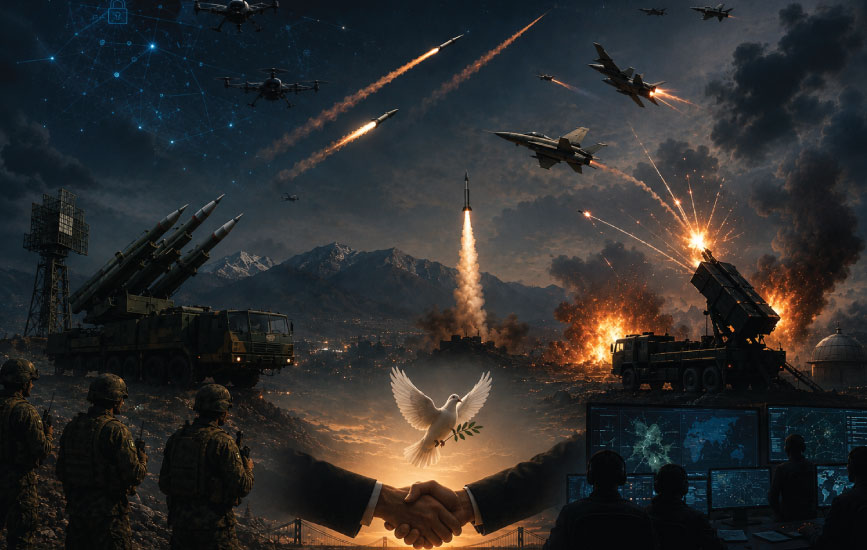
On the night of May 6-7, 2025, India launched Operation Sindoor against Pakistan, including multiple missile strikes conducted across the LOC in Azad Kashmir and mainland Pakistan. In response, Pakistan launched Operation Bunyan-um-Marsoos, attacking Indian military installations engaged in offensive operations. These reportedly included high-value infrastructure such as air defence systems, missile storage sites, forward Headquarters, and logistical nodes. The deployment of Fatah-series surface-to-surface ballistic missiles, beyond visual range weapons, and multi-domain capability highlighted Pakistan’s increasing emphasis on coordinated warfare and precision.
By targeting only military targets, Pakistan restored deterrence while preventing uncontrolled escalation. This operation sent a clear message that any attempt aimed at violating Pakistan’s sovereignty would be handled with a targeted and proportionate response. Pakistan’s capability to break India’s advanced air defence system reflects the limits of defence systems in countering Pakistan’s punches. Moreover, Islamabad outlined its response aligned with legal validation of self-defense according to the United Nations Charter Article 51.
Operation Bunyan-um-Marsoos challenged predominant assumptions regarding India’s conventional superiority and also reinforced Pakistan’s position as a responsible nuclear state capable of exercising restraint under pressure. At domestic level, the operation boosted national cohesion while internationally it indicated that coercive strategies and escalation would not continue without consequence.
A significant characteristic of this crisis was the addition of multi-domain capabilities, which included cyber elements and precision strike technologies, reflecting the shifting character of modern war. Pakistan’s response was intended to inflict losses while remaining below the critical escalation thresholds, exemplifying how conventional and nuclear deterrence can coexist without quick escalation to a high level of clash. This strategy encountered traditional concepts of stability that often describe rigid separation between conventional and nuclear fields.
In South Asia, the crisis also echoed earlier patterns of conflict where false narratives, rapid escalation, and disinformation played important roles. The repeated actions by India without clear verification mechanisms raise worries about misperception and crisis instability. In an already fragile strategic environment, such dynamics jeopardize established norms and increase the possibility of unplanned escalation.
Pakistan’s response demonstrated the resilience of its deterrence posture, contrary to India’s intention to establish a norm of limited conventional strikes below the nuclear threshold. India’s effort to test escalation supremacy through limited force faced consequences, both diplomatic constraints and military consequences. This conflict raises important questions regarding the durability of coercive strategies in a nuclearized region, especially when both states have enough reciprocal capabilities.
The crisis highlights the continued significance of restraint, dialogue, and adherence to international law in maintaining regional stability. Long-term peace in South Asia cannot be secured through one-sided efforts or coercive actions while military capabilities continue to grow. Confidence-building measures, sustainable dialogues, and a pledge to peaceful conflict resolution remain necessary. Long-lasting peace will not depend on the utilization of force but on the collective enthusiasm of regional actors to prioritize diplomacy over confrontation.