

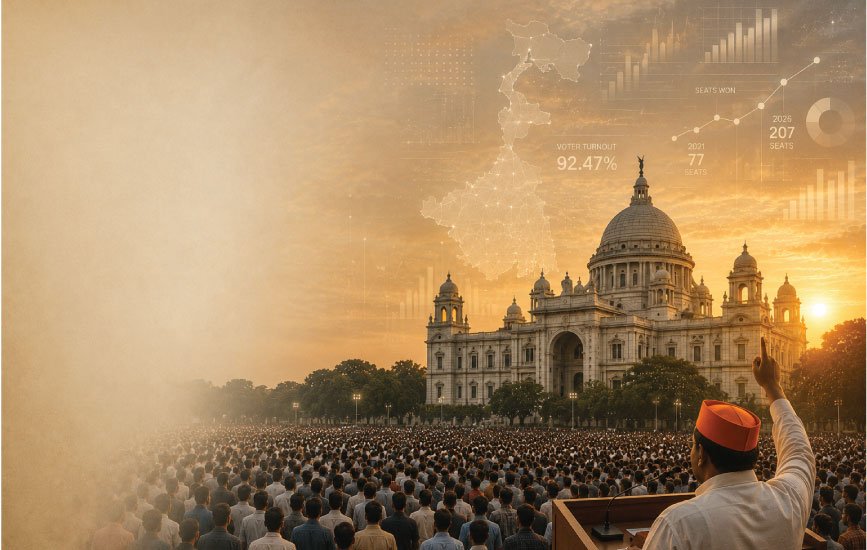
The outcome of the assembly elections in West Bengal, on 4 May 2026, marked a fundamental change in the political scenario of Eastern India, robbing the Trinamool Congress (TMC) of its majority for the first time in 15 years and ushering in the Bharatiya Janata Party (BJP) as a major governing party. This transition in the electoral process, marked by data-driven campaigns and loud, amplified messages in the digital realm, resonates with the wisdom of an ancient Roman, Quintus Tullius Cicero. As his brother Marcus was running for the consulship in Rome in 64 BC, Quintus wrote a pragmatic and sometimes ruthless manual for electioneering, entitled the “Commentariolum Petitionis,” focused on the importance of securing favours, hope, and personal attachment. Two thousand years later, the BJP’s successful siege of the “citadel” of Bengal seems to be a reincarnation of these ancient principles in a “chameleon-like” regional strategy, in the “art of the promise,” and a precise organisational machine to topple the existing supremacy.
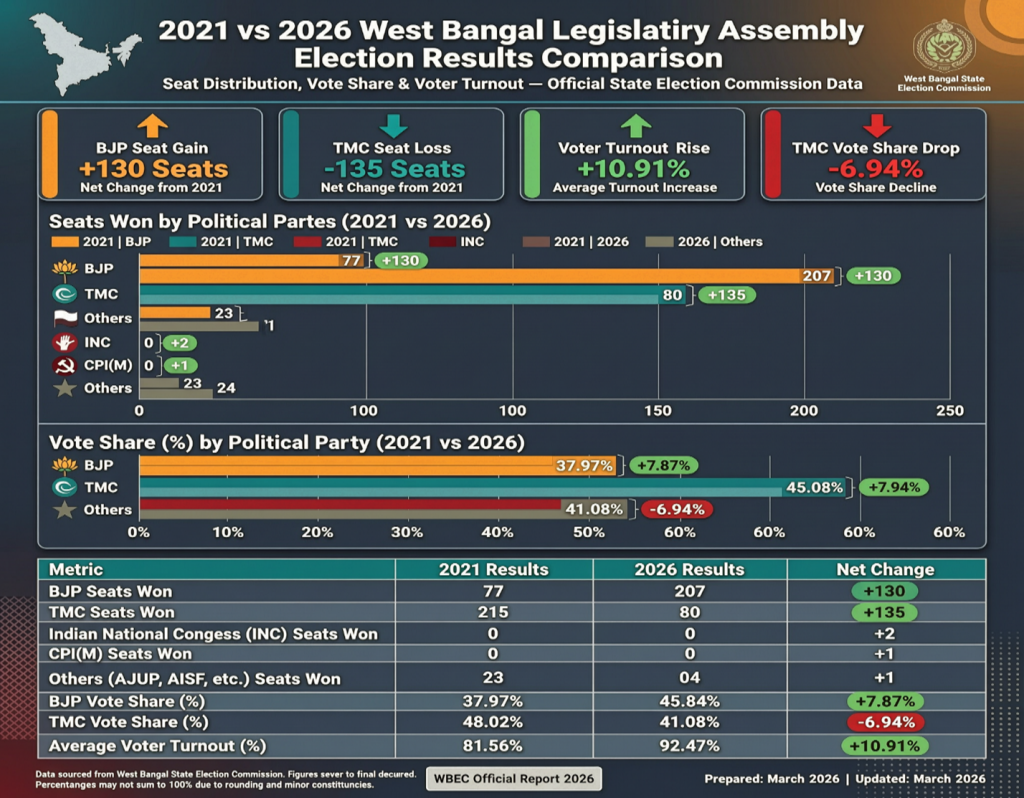
The magnitude of the BJP’s win in 2026 is one of the biggest electoral defeats in Indian history since Independence. The BJP managed to stay over the majority line of 148 seats with a comfortable margin of 59, making the transition from 77 seats in 2021 to 207 in 2026. The catastrophic decline of the TMC, from 215 seats to 80, was matched and, in some ways, surpassed by this increase. This is not just about a shift in the electorate in a few districts; it is about a statewide realignment in nearly every district.
Source: General Election Management System: West Bengal State Election Commission
In the 2026 polls, the voter turnout in West Bengal reached a record high of 92.47%. This may be a statistical artefact due to the contraction of the total electorate during the Special Intensive Revision (SIR), but the absolute number of votes cast increased, especially in the SIR phase one constituencies, which saw an increase of about two lakh votes from the 2021 count. The BJP’s strength in 270 of its 293 counted seats (with a gain of more than 10% in 95 of them) proves how deep the anti-incumbency wave has been, and how much “hope” voters had for a new order, alongside “goodwill” towards the challenger, as Quintus Cicero would have put it.
Quintus Cicero’s favourite saying to his brother was “promise everything to everyone”. He noted that voters are motivated above all by their own interests and that the “most important part of your campaign is to bring hope to people”. For 2026, in West Bengal, this Ciceronian pragmatism was reflected in the “war of the doles”. The TMC’s welfare bailiwick, focused on the Lakshmi Bhandar scheme with women targeted in the same way, was countered by a more aggressive offer from the BJP: the Annapurna Bhandar promise, which pledged to increase the monthly stipend to INR 3,000.
The magnitude of the BJP’s win in 2026 is one of the biggest electoral defeats in Indian history since Independence.
The BJP’s welfare policy was not only a matter of policy but also of “the art of the promise” and “personal attachment”. The party initiated the Matri Shakti Bharosa Card campaign, which involved gathering more than 1.60 crore forms from women voters, as a result of which a commitment from the party’s manifesto became a tangible reality. This strategy worked well by bringing down the TMC’s usual lead among women, who had been the main bastion for Mamata Banerjee in the past. Quintus Cicero said that a candidate should be a “chameleon”. The BJP’s national growth strategy was tweaked in 2026 to address immediate, specific economic concerns at the level of the Bengali household: to defuse the strongest social coalition, the BJP out-promised the incumbent.
Quintus Cicero’s Commentariolum is about “knowing your enemies and those against you”. In today’s election operations, this includes handling and checking voter registers. Presented in the middle of the 2026 election, the SIR of the electoral rolls was a controversial process that resulted in the removal of nearly 9.1 million names, or about 12% of the electorate. The Election Commission of India (ECI) said the procedure was driven by a need to cleanse the voter list, assuring it was a “bloodless” exercise to eliminate dead voters and illegal duplications. In contrast, the TMC and civil society groups argued it was a “bloodless political genocide” that was intended to disenfranchise migrant and minority communities.
Statistical Correlation
Source: CEO West Bengal
Analysis indicates that the SIR had a major but controversial influence on the final count. The number of voters removed from the electoral rolls in 28 seats the BJP won was greater than the party’s actual margin of victory, with 26 of these seats being TMC bastions in 2021. The result was an environment of distrust and allegations that eventually required intervention from the Supreme Court. Justices like CJI Kant and Justice Dipankar Datta grappled with the size of the “logical discrepancy” list of 1.36 crore voters, in which discrepancies were highlighted if a voter’s name was written with variant spellings as “Datta” vs “Dutta” or “Roy” vs “Ray”. Strategically, the SIR was used to leverage the many advantages of being the incumbent at the central level, effectively re-mapping the electoral landscape before the first ballot was cast.
The voter bloc of Muslims, making up around 27 to 30% of West Bengal, has traditionally proven to be a permanent wall against the BJP’s growth. Quintus Cicero’s ideas were that it is advisable to recruit “supporters from diverse sources” for the candidate and divide “the opponent’s supporters.” The BJP effectively exploited a deep division within the minority community in 2026, which found itself split among the TMC, Congress, CPI (M), and regional groups such as Humayun Kabir’s Aam Janata Unnayan Party (AJUP).
Minority Belt Tally Analysis

Source: Times of India
This transformation is most visible in Murshidabad. In 2021, the TMC won 20 of 22 seats. However, in 2026, the TMC was reduced to just 9 seats, while the BJP reached 8 seats, and the AJUP and Congress built their own secondary corridors of influence to claim the remaining 5. This fragmentation allowed the BJP to win or fiercely contest these electorates without having to capture the majority of the minority vote itself. This is a classic Ciceronian tactic of “exploiting the weaknesses” of the opposing coalition by dividing a large demographic bloc into competing interest groups.
The BJP followed Quintus Cicero’s dictum of being a chameleon and tailored its expression and speech to resonate with the audience across the state’s diverse regions. In North Bengal and the “Matua Belt”, the party resorted to identity and citizenship pledges in support of the CAA. In South Bengal and Kolkata, it shifted its tone toward governance failure, corruption, and women’s security.
The BJP held on to its strongholds of 2019 and 2021 in Jalpaiguri and Cooch Behar, playing to the local sentiments regarding “Kolkata dominance” and celebrating regional heroes. In its outreach to the communities in the Junglemahal region, including Purulia and Jhargram, the party shifted its focus to the Kurmis and promised them constitutional recognition for the Kurmali language. This targeted social realignment illustrates a “structured, data-backed and narrative-driven campaign” that refused to succumb to a one-size-fits-all approach. The BJP successfully reached out to various sections, from the Adivasis and Gorkhas to the Matua and Rajbanshi communities, through “embedded actors” serving as local influencers.
Quintus Cicero reminded everyone that a candidate’s reputation is his most important asset and that he should “remind voters about the sexual scandals…and rumors of corruption” surrounding opponents. The BJP in West Bengal used its accountability strategy by approaching the issue with a highly structured charge sheet, both at the State level and at the 220 constituency level, with Amit Shah’s state charge sheet released first, followed by localized editions. This narrowed the attack on the TMC and made the poor implementation of governance a matter of individual grievance for the voter rather than an abstraction.
The biggest symbolic success of this strategy was the defeat of Chief Minister Mamata Banerjee in her own bastion of Bhabanipur. Her former protégé and current adversary, Suvendu Adhikari, beat her, in the heart of Kolkata, echoing his previous tight victory in Nandigram. The seat of the “Consul” was lost, serving as a catalyst for the “statewide sweep” and an indicator of the end of “political invincibility”.
Lastly, a device of sorts that would have done a Roman political manager proud, sustained the BJP’s victory: the Praetorian booth machine. The party set up committees in 70,671 booths, with almost 8.76 lakh workers assigned to specific roles. The backbone of the entire campaign was this “booth machine,” which enabled constant, data-driven mobilisation.
The party spoke to the youth by blending “symbolism with policy messaging,” organised the Narendra Cup football tournament, attracting 1200 teams. This cultural link, along with the “Chakri Chai Bangla” (Bengal Wants Jobs) campaign, enabled the BJP to position itself as an “economic necessity”. The BJP was successful in involving the youth in their own cultural and social sphere (the football field) and fostering a “personal attachment” and “goodwill” that Quintus Cicero defined as the ultimate “assurance” of votes in an election.
The BJP’s massive surge to a commanding majority in 2026 has turned on the age-old principles of Ciceronian electioneering. The art of the promise, the manipulation of hope, the division of enemies, and a relentless focus on booth-level mobilisation have shattered the impression that consolidated minority populations are an insurmountable barrier to the BJP’s success in winning power in the state. The TMC’s leadership has to introspect and understand how its “invincible” alliance broke up and why the party’s welfare narrative hit a “limit” in the face of the BJP’s alternative provider narrative. In this new age, in which West Bengal is ruled by the same party as the Centre for the first time in more than five decades, the verdict of 2026 stands as a testament to the timeless wisdom of Quintus Cicero’s ancient handbook for modern politicians.