

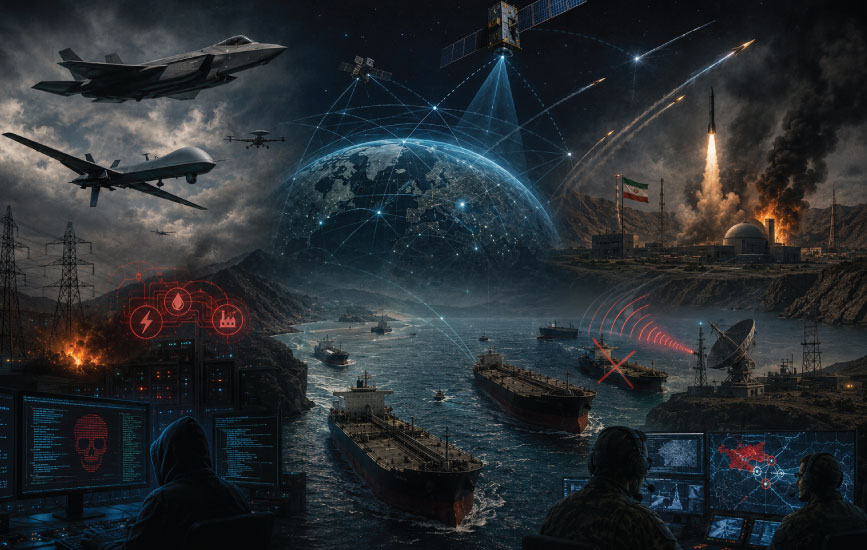
Missiles, drones, oil routes, nuclear sites, and regional alliances are typically used to explain the US-Iran conflict. That makes sense, but it’s not enough. Cyber networks, satellite navigation, marine data systems, and space-enabled military infrastructure may be the most significant battleground of our time. This is the debate that is lacking. Stronger aircraft, deeper bunkers, and longer-range missiles won’t be the only factors in the future of warfare. It concerns who can interfere with the unseen mechanisms that underpin contemporary nations.
Iran’s conventional military might is inferior to that of the United States. In terms of airpower, surveillance, naval reach, and space-based command systems, the United States holds a decisive advantage. However, that power also breeds reliance. Satellites are used in US military operations for missile warning, navigation, communications, and targeting. This is the point at which asymmetric warfare becomes effective.
Iran was the first to learn this lesson. Iranian nuclear centrifuges were damaged by code rather than bombs in the 2010 Stuxnet attack, which is commonly blamed on the United States and Israel. It demonstrated how software may have physical repercussions. Since then, organizations with ties to Iran have made investments in cyber disruption as a means of pressure and punishment.
In 2026, that pattern is evident once more.
CISA and other US agencies issued a warning in April about Iran-affiliated cyber attackers taking advantage of operational technology devices utilized in vital infrastructure, such as electricity, water, and local government systems. According to the notice, hackers have hacked at least 75 devices and occasionally disrupted operations.
This is important since office software is not the same as operational technology. It regulates sensors, industrial equipment, pumps, valves, and public utilities. In addition to stealing data, a breach may have an impact on actual services.
By satellite is the second front. Significant GPS spoofing and jamming has been reported from the Persian Gulf near the Strait of Hormuz, one of the major energy chokepoints in the globe. Unreliable positional data has necessitated that certain crews rely more on radar, visual markers, and manual navigation.
There is a serious technical issue here. Insurance prices rise, traffic slows, accidents become more frequent, and oil markets respond when ships are unable to trust their location. Thus, strategic economic impacts can be achieved without a missile strike by a low-cost electronic disruption.
Space is the third front. Satellites are essential to modern warfare, yet public discourse still mostly envisions space warfare as anti-satellite missiles destroying things in orbit. That is rather limited. Targeting ground stations, interfering with GPS, jamming satellite communications, and distorting data traveling between space assets and consumers on Earth are the more pressing threats.
In the context of the Iranian conflict, US Space Command authorities have recognised the increasing significance of satellite communications and GPS jamming. This demonstrates that space is no longer merely a background support system. It is a component of the battlefield.
The political and legal divide is the true strategic divide. International law is still lagging. When the 1967 Outer Space Treaty was drafted, space was primarily under state control. In the modern world, where military operations are supported by commercial satellites, private communications networks and civilian digital technologies, it falls short.
This leads to hazardous ambiguity. Is a commercial satellite a military target if it offers communications or imagery utilised in combat? Is it an attack on civilian infrastructure or electronic warfare if GPS disruption impacts both civilian tankers and naval forces? How should a state react if a cyberattack renders a water infrastructure inoperable during a military emergency? These issues are still perilously unanswered.
Confusion-induced escalation is the risk. Electronic and cyberattacks are frequently difficult to promptly identify. A state could not know right away if a disruption was caused by a criminal actor, a proxy organization, an enemy military unit, or a technical malfunction. This uncertainty can lead to retaliation before the facts are known during a difficult crisis.
For this reason, the US-Iran confrontation is significant outside of the Middle East. Smaller regional powers, including China, Russia, India, and Pakistan, are observing. It’s not only that missiles are important. The more profound lesson is that industrial controllers, satellites, ports, cables, cloud systems, and navigation signals are becoming strategic pressure points.
In this transition, no nation is innocent. The US employs cutting-edge space and cyber capabilities. Asymmetric disruption is used by Iran. Tools for this environment are also being developed by China, Russia, Israel, and other countries. Morality is not the only problem. The problem is that there are no defined guidelines, boundaries, or limitations as the world moves toward a conflict-ridden area.
The main contention is that the most hazardous front in the conflict between the United States and Iran could not be the most obvious one. It can be a quiet struggle for infrastructure that both the military and the general public rely on. Future conflicts might not start with missiles striking capital cities or tanks crossing borders.
Ships losing their ability to navigate, satellites being jammed, industrial systems acting strangely, and unexplained communications failures might be the first signs. The world is ready to count missiles. It is not equipped to manage an invisible conflict.