French President Emmanuel Macron’s March 2 speech, which outlined the future course of French nuclear deterrence, sparked a major debate over European security and its implications for the international nuclear order.
Proposing a framework of forward deterrence shows readiness to extend deterrence to European allies. Macron has positioned a new nuclear doctrine at the core of the evolving dynamics of the European security environment, raising important questions about the future of nonproliferation, given that France is a NPT signatory state.
According to Macron, the strategic environment has changed over the past few decades due to the deterioration of the international order and the weapons control framework. The situation that compels France to adopt a more assertive stance on its nuclear and disarmament policy includes Russia’s non-ratification of the Comprehensive Nuclear-Test-Ban Treaty, the failure of the Anti-Ballistic Missile Treaty, the Intermediate-Range Nuclear Forces Treaty, and New Strategic Arms Reduction Treaties, the possible restart of nuclear testing, and China’s refusal to engage in any form of negotiation, as mentioned by Macron.
France’s long-standing stance that it will not engage in an arms race and does not aim for numerical parity with any other nuclear power was also reaffirmed, along with a change in nuclear doctrine. The President also reiterated France’s opposition to a flexible nuclear response doctrine, stating that French nuclear weapons are “exclusively strategic” and not meant for use in combat. This explanation seems to be projected to mitigate concerns that a reduction in the nuclear threshold could result from the arsenal’s growth.
It is necessary to understand Macron’s speech in light of the increasingly precarious security situation in Europe. Since the start of the Russia-Ukraine conflict, perceptions of threat have changed significantly across Europe. The conflict has brought the prospect of nuclear escalation back into strategic calculations and reignited worries about widespread conventional warfare in Europe. It is required to reassess the effectiveness of current security arrangements and the long-term viability of deterrence mechanisms, most of which were developed during the Cold War, much needed today.
The North Atlantic Treaty Organization remains the cornerstone of transatlantic security. European states have been motivated to examine ways to enhance their own defence capabilities due to concerns about the long-term reliability of external security guarantees, particularly those offered by the United States. France’s shifting nuclear doctrine highlights the persistent importance of national interest and strategic independence amid growing international uncertainty from realist perspectives.
Events such as the U.S.–Israel strikes on Iran’s nuclear sites in June 2025 and continued military actions in February 2026, despite ongoing talks reveals U.S. policy changes and the interest-based behavior of great powers. For example, Washington recently temporarily lifted sanctions on Russian crude oil through short-term waivers to help stabilize global energy markets disrupted by Middle Eastern conflicts. These actions demonstrate how sanctions are adjusted according to evolving strategic and economic priorities, balancing geopolitical goals with market needs. Together, these approaches reinforce a fundamental realist principle: in an anarchic world system, states prioritize self-reliance, strategic autonomy, and the advancement of their national interests.
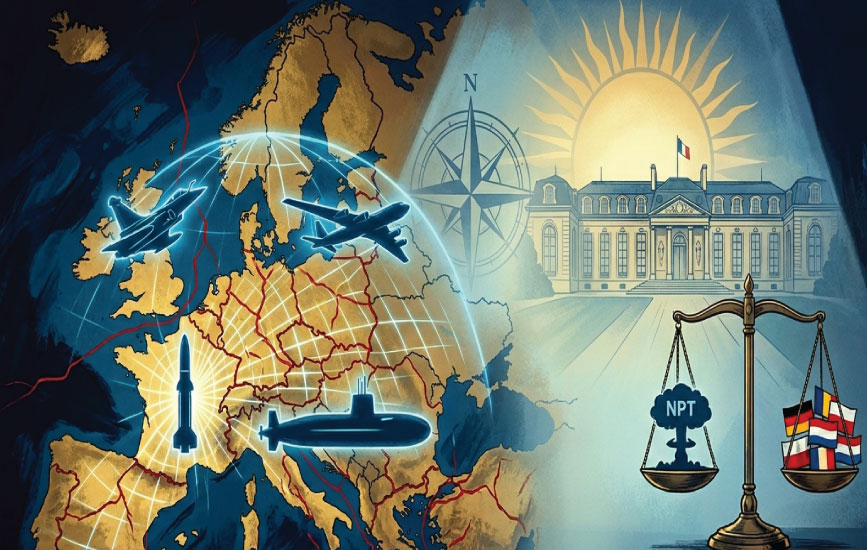
France would expand its stockpile of nuclear warheads and not reveal the number of nuclear weapons, in addition to promising greater cooperation with interested European partners. Its nuclear bombers might be stationed at the air bases of numerous European nations, including Germany, Poland, the Netherlands, Belgium, Greece, Sweden, and Denmark, and they could participate in exercises of France’s air-launched nuclear capacity. The French proposal for a forward deterrence to Europe also criticized the US-led NATO security system, which would eventually replace it with a powerful nuclear weapons system for the European nations.
The strategy aims to strengthen collective deterrence and European security by strengthening strategic cooperation with European allies. According to Macron, a more robust European deterrence capability would support transatlantic security agreements while also advancing Europe’s long-term strategic independence, and crucially, the doctrine seeks to enhance NATO’s nuclear umbrella rather than replace it. The important question is whether increasing nuclear deterrence is a defensive response to a worsening security situation or whether it can lead to the development of new deterrence dynamics in Europe.
The only nuclear-armed nation in the European Union, France, seems more interested in placing its nuclear capabilities as a comprehensive pillar of European security in this changing environment. France holds a special place in the worldwide nuclear orders as one of the five countries authorized by the Treaty on the Non-Proliferation of Nuclear Weapons to possess nuclear weapons. According to the NPT Article 4, nuclear-weapon nations pledge to pursue talks toward ultimate disarmament, and a perception of double standards is created when nuclear states expand or modernise their arsenals while simultaneously promoting non-proliferation. Such an approach can undermine the non-proliferation regime’s credibility and exacerbate trust deficits among non-nuclear-weapon states that see insufficient progress in disarmament.
Another significant concern is for non-nuclear-weapon states, as non-NPT states may perceive this as evidence that nuclear weapons are still essential tools for maintaining national security if major countries keep highlighting the importance of nuclear deterrence in their security plans. Nuclear weapons are presented as necessary for the security of countries that possess them, while other states are supposed to permanently abstain from obtaining them. This relationship perpetuates what academics frequently refer to as the deterrence legitimacy paradox. Major nuclear powers in recent years have made significant investments in modernizing their nuclear arsenal, such as China, Russia, and the US. A new report by the Stockholm International Peace Research Institute (SIPRI) in 2026 highlighted that the US remained the world’s largest arms exporter with a 42 per cent share of global exports during 2021-2025. France ranked second with a 9.8 per cent share, while Russia was third with 6.8 per cent.
The future of strategic stability is becoming increasingly uncertain as a result of the weakening or collapse of numerous important arms control frameworks. In this context, nuclear deterrence is gradually seen as an essential instrument for controlling competition between major powers. Therefore, Macron’s idea might be more revealing of a larger trend in which deterrence is once again at the center of discussions about international security than a particular policy change.
The doctrine’s long-term effects on regional security and international non-proliferation rules will depend on how the initiative is carried out, even though its goals are to improve European strategic autonomy and reinforce deterrence as it represents France’s larger quest for European security autonomy in the era of shifting alliances, escalating international tensions, and geopolitical unpredictability. How France creates a balance between these conflicting goals will not only determine Europe’s strategic future but also have an impact on the legitimacy and durability of the international non-proliferation regime.