IN an international system strained by geopolitical rivalries and fragile supply chains, the emerging helium crisis from disruptions at Ras Laffan Industrial City demands urgent attention.
Overshadowed by the Iran war’s energy and security impacts, this less visible shock threatens critical sectors worldwide. Helium, often dismissed as a niche industrial gas, is a strategic resource with no viable substitutes in high-tech and medical applications. Qatar, the world’s second-largest helium producer, supplied roughly one-third of global demand in 2025. Its annual output of 63 million cubic meters, tied to natural gas processing, was abruptly halted when Ras Laffan operations stopped.
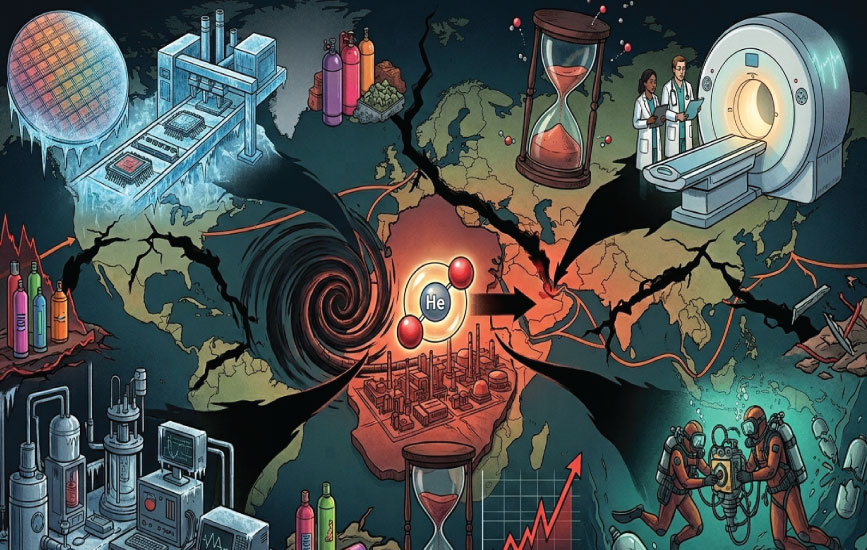
The consequences are immediate. Global markets are losing an estimated 5.2 million cubic meters of helium per month. Unlike oil, helium cannot be stockpiled; it gradually escapes even advanced storage systems and must reach end users within 45 days. This physical constraint transforms any disruption into a rapidly escalating crisis.
Prices have already doubled. If interruptions persist 60 to 90 days, projections suggest a further 25 to 50 percent increase, potentially pushing prices beyond $2,000 per thousand cubic feet—over four times the levels at the start of 2026. This is not merely a price shock; it is a structural supply crisis with cascading effects. At the centre lies the semiconductor industry. Advanced chip manufacturing relies on helium for cooling and ultra-clean production environments. Major firms such as Samsung Electronics, SK Hynix and TSMC are particularly exposed. South Korea sources nearly two-thirds of its helium from Qatar, while China relies on it for over half of its needs. In an era of semiconductor shortages and technological competition, disruptions risk amplifying vulnerabilities in the global tech ecosystem.
Healthcare faces equally serious risks. MRI machines depend entirely on liquid helium to maintain superconducting magnets. With 40,000 to 50,000 MRI units worldwide, even short-term disruptions could delay procedures, increase costs and strain healthcare infrastructures. Scientific research is another casualty. Laboratories using cryogenic systems, spectrometers and advanced physics equipment cannot function without helium. Prolonged shortages could halt critical experiments, delaying innovation and undermining global scientific progress.
Specialized industries are also affected. Deep-sea diving operations require helium-based breathing mixtures. Disruptions in Qatar’s broader industrial output—including fertilizers, methanol and polymers—compound pressures on global agriculture and manufacturing supply chains. Major industrial gas companies, including Air Liquide, Linde plc, Air Products and Chemicals and Iwatani Corporation, are managing the disruption, yet their ability to compensate is limited by near-absent spare global capacity.
Even if production resumes immediately, recovery remains prolonged. Industry estimates suggest restoring supply chains could take four to six months, extending the vulnerability window to nine months. The broader lesson is clear: the helium crisis underscores the strategic importance of seemingly obscure materials. Like rare earths or semiconductor-grade neon, helium is a critical input whose disruption reverberates across sectors.
This moment demands a reassessment of resource security frameworks. Diversifying supply, investing in recycling technologies and developing strategic reserves, however technically challenging, must become priorities. For industry leaders, the crisis is a stark reminder of the risks of concentrated supply chains in volatile regions. The Iran war is not just an energy crisis; it is a stress test for the resilience of the modern technological order. Helium, invisible and overlooked, has emerged as one of its most critical fault lines.