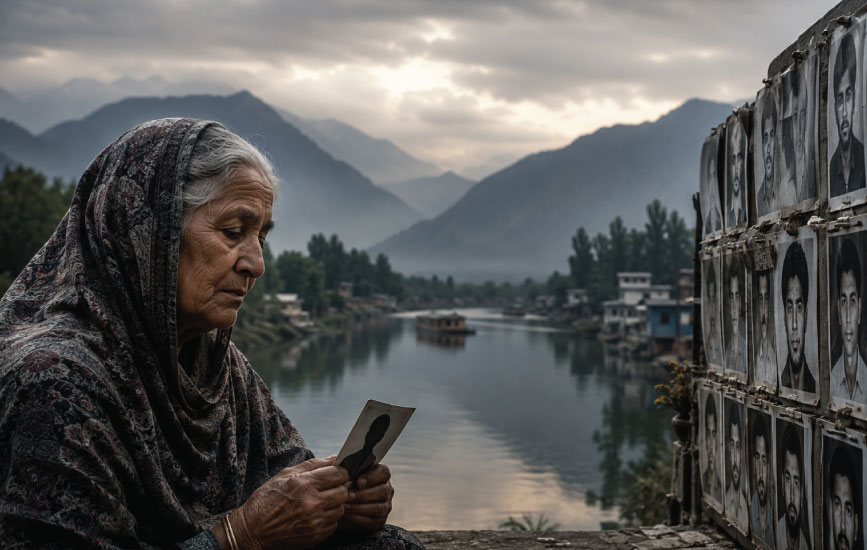
Kashmir is the place in the world where people have spent decades searching not only for the living, but also for the dead or disappeared. In this world, a heavily militarized and occupied region, the absences have become an enduring reality several wives live as “half widows” without certainty of loss, mothers wait for sons who never return, and children grow into adulthood carrying memories of fathers who vanished into custody. In this landscape, the passage of time has not resolved grief; it has merely institutionalized uncertainty.
The recent case of receiving a death certificate for the disappeared Abdul Rashid Wani in Indian Administrated Jammu and Kashmir reopens wounds for his family, who struggled for years of searching and court battles, and the court declared him dead. His son, Junaid Rashid, was only 5 years old when his father was disappeared in July 1997 by the Indian army. Junaid, who is 34 now, said, “If this had happened earlier, I think Kashmir would look different, our lives would look different, and my mother’s health would be something else.”
Imagine a kid who spent 29 years of his life, including his childhood and adulthood, in search of his father. His mother lived in uncertainty, wondering whether her husband was alive, and spent 29 years as a half-widow, waiting for him. Her wait was not just sitting and looking for signs of his return. It was about struggles and sacrifices: how she looked after her kids, managed financial issues, ensured her children’s education, and spent her savings in search of her husband.
The experience of Abdul Rashid Wani shows the deep gap between meaningful justice and legal recognition. As per the court’s judgements covered by police investigation, he was detained by an Indian army officer, killed during custody, and subsequently his body was disposed of. Despite this acknowledgement, no information about the location of his dead body has been given to the family, nor has the judicial process translated into criminal accountability. Only what the family received after 3 decades of struggle was official recognition of loss, but not the truth or the dead body they were looking for. Justice in enforced disappearance cases requires more than only giving death certificates.
The case of Abdul Rashid Wani is not isolated in Kashmir; the Association of Parents of Disappeared Persons (APDP) has documented 8,000 cases. Now the remaining families of the disappeared persons are also in tension; what will their wait reveal for their loved ones? What they will receive live person, a death certificate, or a dead body? Their lives are passing in uncertainty. The persistence of this uncertainty has converted disappearances from individual tragedies into a collective social experience.
The burden of disappearance has also fallen heavily on the women of Kashmir, whether she is a mother, sister, wife, or daughter, many of whom have lived for decades suspended between hope and mourning. There are stories of mothers
The case of “half widow” hits more painfully those who left burial spaces empty, refusing to accept that their sons were gone until their bodies could be returned. The example of this pain is “Shumali Begam,” mother of the prominent martyr Muhammad Maqbool Butt, who was subjected to death in Tihar Jail in New Delhi in 1984. Butt’s body was never returned to his family, and his mother waited 42 years for its return. The unfulfilled wish of his mother has become part of Kashmir’s collective memory, representing a tragedy in which the families in Kashmir continue to seek not only justice but also fundamental human dignity of laying their loved ones to rest.
The uncertain legal status of the “half widows” has not only put them in a life full of struggles and sacrifices; it is complicated by property rights, inheritance, remarriage, and access to social protections, leaving them in psychological trauma.
The people of Kashmir have the right to know the truth; they sought answers about why their loved ones disappeared. Where are they? How did they die? Where are their dead bodies? And whether those responsible would ever be held accountable? These are the main question they should be answered at least.
In Kashmir, the issue extends beyond disappeared persons in 2009; the Association of Parents of Disappeared Persons documented 2,700 unidentified graves in several districts of Kashmir. The Jammu and Kashmir State Human Rights Commission acknowledged the presence of many unidentified bodies and also recommended DNA testing for identification, but these recommendations remain unimplemented.
For the Kashmiris, the issue of enforced disappearances is no longer solely about the past; it is about the credibility of the rule of law in the present. For authorities in Kashmir, a death certificate may close an official file, but for the people of Kashmir it cannot close a wound; it opens an unending window of sorrow. It also opens a file for the authorities about how transparent their process. Killing Kashmiris during custody, hiding the truth from families for years, thinking that revealing half-truths after decades will fade away or close the case. This delusion of the occupying forces is not working for Kashmiris.
A society cannot claim to uphold justice while families are left searching for the truth long after their loved ones have disappeared. Until every family is given answers, every victim is accounted for, and those responsible are held accountable through due process, the wounds of enforced disappearance will remain open, reminding the world that justice delayed is, indeed, justice denied.