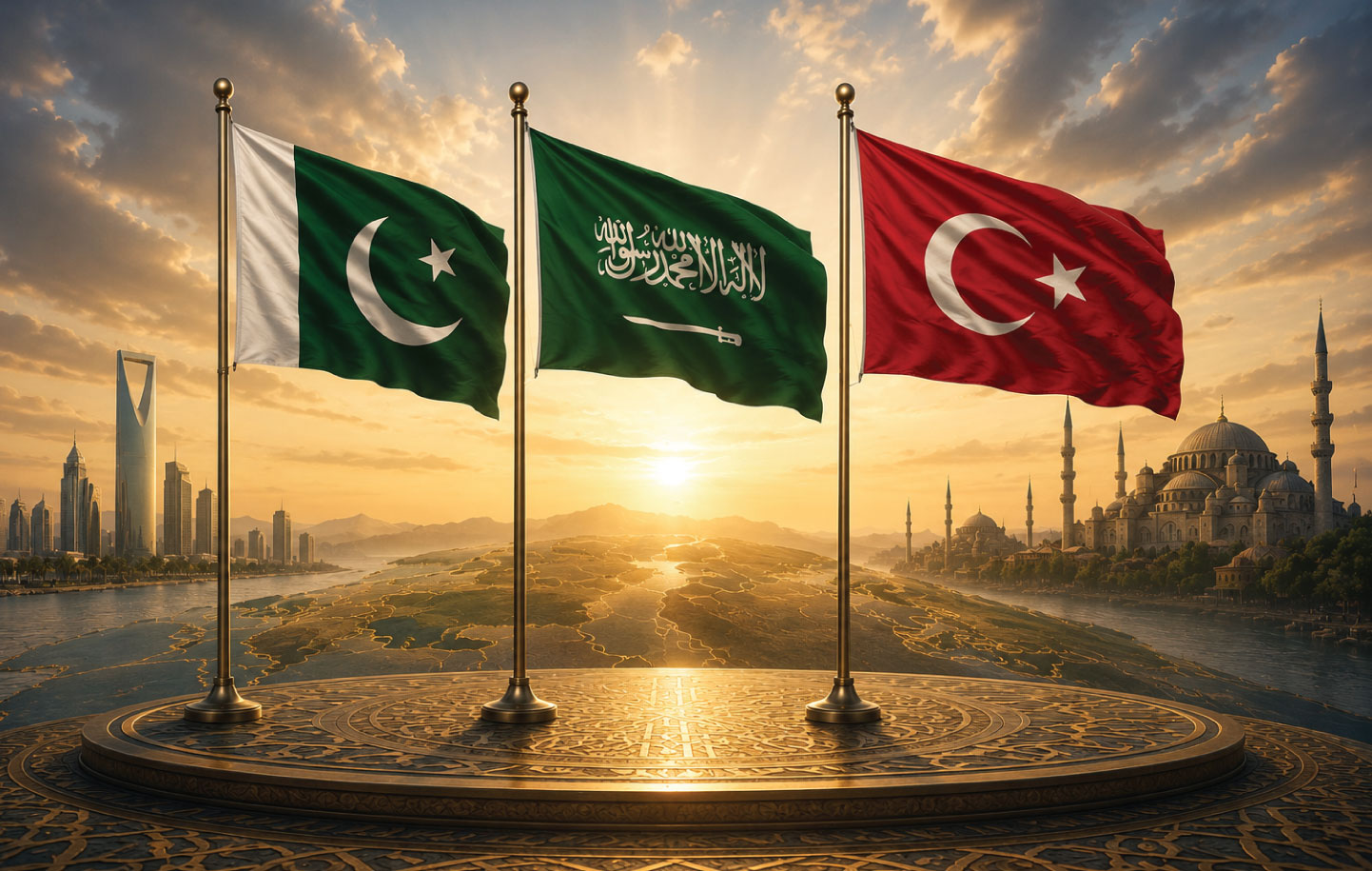
THE Makkah Accord signed by Pakistan, Saudi Arabia and Turkiye on August 7, 2026 marked a significant development in the evolving security architect of Middle East and South Asia. The Agreement seeks to strengthen the collective security of three states, where attack on one of the three states would be considered as an attack against them all, creating a collective defence framework. The Makkah Joint Defence Pact should not be viewed as a sudden creation of military bloc but an institutionalization of longstanding historic ties and intensifying diplomatic and defence relationships among the three states. For India, significance of the pact lies in something more consequential. The future crisis with Pakistan could no longer remain confined to the traditional India-Pakistan military equation as the pact introduces new strategic variables. Though the Accord does not necessarily represent an anti-India alliance, but it could make future India-Pakistan crises more complicated, less predictable and potentially more difficult to contain. Even if Riyadh and Ankara have no intention of getting involved, confusion about what qualifies as an “attack” on Pakistan could confound India’s calculations during a future India-Pakistan crisis.
The Agreement surfaced against the backdrop of previously expanding bilateral and multilateral defence relationships among Pakistan, Saudi Arabia and Türkiye. For decades Islamabad and Riyadh have maintained security and military relations. The Strategic Mutual Defence Agreement of September 17, 2025, brought these relationships to a more formalized strategic level. The pact aimed to bolster joint deterrence against aggression intended at either state and boost defence cooperation. The Makkah Agreement extends this strategic logic into trilateral framework. Pakistan’s relationship with Türkiye also expanded significantly, particularly in the area of military training, defence technology, defence industrial cooperation and broader strategic coordination. A significant foundation for a trilateral framework has been established by the two nations’ growing institutionalization of their security cooperation. At the same time, relations between Saudi Arabia and Türkiye have also significantly improved, especially in the areas of security and defence. Ankara and Riyadh’s increased defense-industrial ties and strategic communication have helped to create a more comprehensive framework that can include Pakistan.
From a deterrent perspective, the strategic value of Makkah Agreement is its ability to integrate three different types of strategic might under a single security framework. Pakistan provides military expertise, human capital and strategic depth. Saudi Arabia brings investment resources, economic leverage and geopolitical influence. Türkiye contributes an increasingly sophisticated defence industry, including capabilities in unmanned systems, naval platforms and other military technologies. Combining these resources might enable defence diplomacy to go beyond political statements and include cooperative defense-industrial projects, military education, institutional capacity building and technology collaboration. The changing environment would have implications for India, where New Delhi has simultaneously deepening its strategic partnership with the US, while, courting itself as a counter balance to China. India’s expanding strategic and defence cooperation with the US was aimed at strengthening its position in the Indo-Pacific and beyond.
The first major implications for India concern Pakistan’s growing network of alliances. Pakistan already maintained closer defence and strategic ties with China and defence cooperation with Türkiye. Saudi Arabia’s involvement lends the Agreement more significance. The cumulative effect would be more significant than bilateral agreement. The second implication for India concerns Pakistan’s defence resilience. Türkiye has emerged as a prominent exporter of armed drones, naval systems and other defence equipment. Its defence relationship with Pakistan has included cooperation in areas such as unmanned systems and submarine modernization. A Saudi-Turkish-Pakistani framework could potentially allow Pakistan to rebuild inventories, acquire new platforms and expand its missile or drone capabilities. It would diversify Pakistan’s defence ecosystem. The third and the most important implication is escalation uncertainty. In future conflict with Pakistan, India would have to consider the possible outcomes of collective defence commitment, whether Türkiye would be providing military or technological assistance and Saudi Arabia providing diplomatic or financial backing. Though, uncertainty itself can have strategic consequences. If Indian planners must account for the possibility of external military assistance, financial support or diplomatic intervention, the escalation ladder in a future India-Pakistan crisis becomes more complicated.