

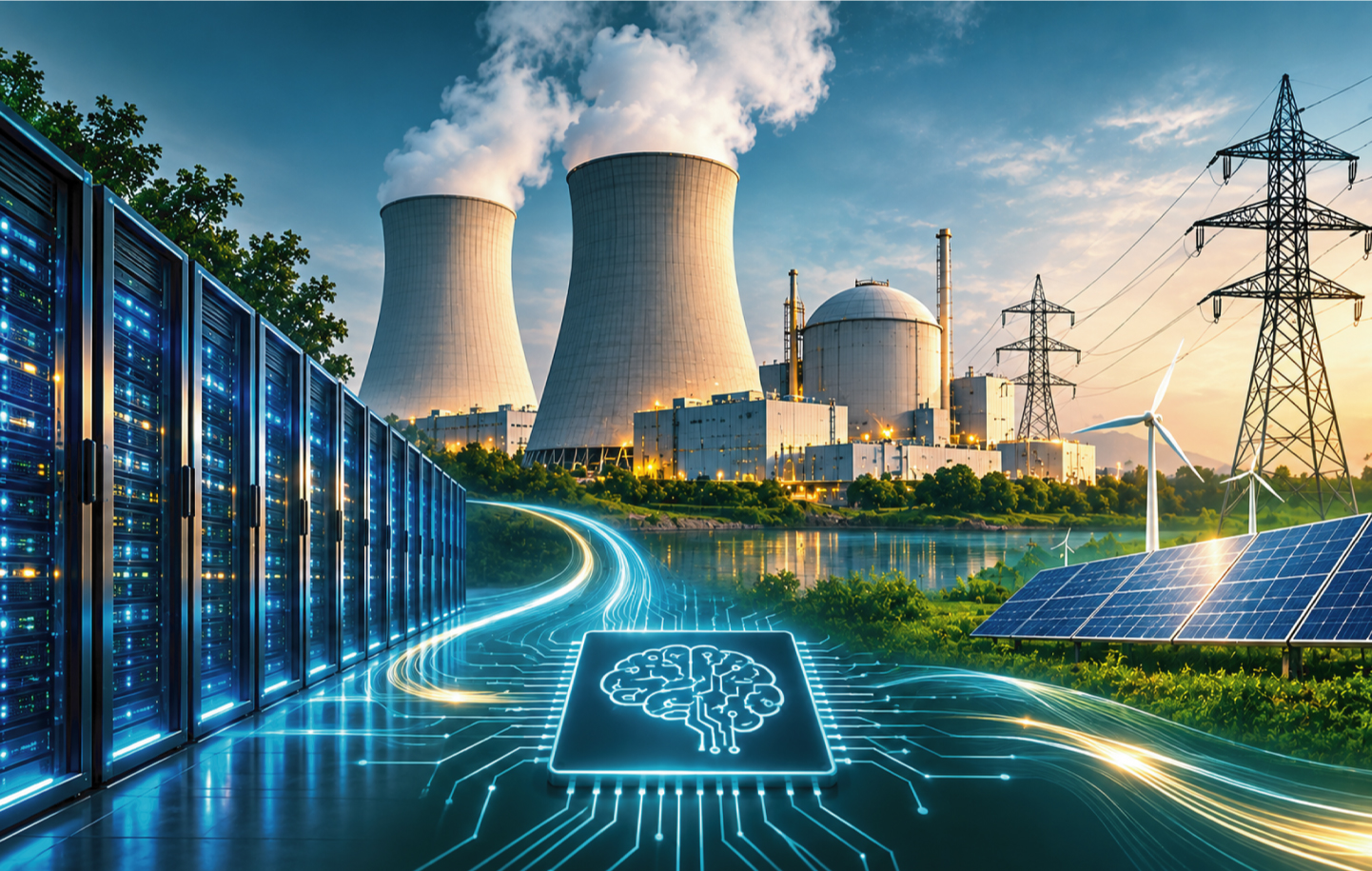
Artificial intelligence runs on electricity. Every query sent to a chatbot is processed in a data center, and data centers do not sleep. In 2024 they used about 415 terawatt-hours (TWh) of electricity, around 1.5 percent of global consumption. The International Energy Agency expects this to more than double to about 945 TWh by 2030, slightly more than Japan uses today.
lobally, this is only about a tenth of new electricity demand. In some countries it is far larger. In the United States, data centers are set to account for almost half of demand growth to 2030.
This article argues that nuclear energy is becoming part of the infrastructure of the digital economy. It is not the cheapest or fastest source of new power. But it is the only source that is both low-carbon and available every hour at the scale data centers need. Over the next five years, this role depends on existing reactors. After 2030, it depends on whether new reactors arrive on time and on budget.
Data centers need power every hour
An AI training cluster cannot pause when the wind drops. What matters is not how much a power plant produces in a year, but how often it runs. Nuclear performs best on this test. U.S. reactors operated at a 92 percent capacity factor in 2024. In 2023, wind ran at about 34 percent and solar at 23 percent.
Renewables will still supply much of the new power. The IAEA expects them to meet half of the growth in data center demand through 2035, while natural gas adds another 175 TWh. This makes sense because wind and solar are cheap and quick to build.
Nuclear covers the hours they cannot. These are windless nights, cold winter evenings and heat waves. In these hours, gas is the usual backup, and that is a problem for technology firms with climate targets. Meta’s carbon footprint rose 20 percent to 8.2 million tonnes of CO2-equivalent as AI pushed up its power use. These firms need power that is firm and clean. Nuclear is the main option that offers both.
Technology companies have moved from talking about nuclear energy to signing contracts for it. Microsoft has a 20-year agreement with Constellation to restart Three Mile Island Unit 1. The reactor closed in 2019 for economic reasons. It will return as the Crane Clean Energy Center, adding about 835 megawatts, with restart expected in 2027. This shows how much the market has changed. A reactor that was not worth running a few years ago is valuable to a buyer who needs firm, carbon-free power around the clock.
Meta went further in January 2026. It announced deals for up to 6.6 gigawatts by 2035. They include 20-year purchases of more than 2.1 GW from three existing Vistra plants. They also include funding for two TerraPower reactors of 345 megawatts each, which will not deliver power before 2032, and support for Oklo’s planned 1.2 GW campus in Ohio. Google has agreed with Kairos Power to add 500 MW of advanced nuclear capacity by 2035. The first plant, Hermes 2, will supply 50 MW to the Tennessee Valley Authority by 2030.
These deals follow a clear order. Existing plants come first because they deliver power now. Restarts and uprates come next. New reactor designs come last, with technology companies helping to fund them. This matters because a long contract gives a developer a guaranteed customer, which makes it easier to raise money for a new reactor. Technology firms are now doing a job that governments and utilities once did.
The gap between promises and delivery
The promises are larger than what can be delivered soon. Most of the new reactors in these deals start operating between 2030 and 2034, and the first units are small. Hermes 2, for example, is only 50 MW.
The numbers show the gap. Meta’s 6.6 GW and Google’s 500 MW would together produce about 57 TWh a year at a 92 percent capacity factor. It is only about 5 percent of the IAEA’s base-case data center demand for 2035, which is around 1,200 TWh. The IAEA also warns that the outlook is uncertain, with 2035 demand anywhere between 700 and 1,700 TWh.
Costs add to the risk. In 2023, NuScale and a group of Utah utilities canceled the first planned small modular reactor project in the United States. The target price of its power had risen from $58 to $89 per megawatt-hour, according to the Institute for Energy Economics and Financial Analysis. First-of-a-kind reactors almost always cost more than later copies. That is normal for new technology, but it means early buyers carry the risk.
Two points follow. First, new demand in this decade will mostly be met by gas and renewables. Nuclear’s near-term role is to keep the existing fleet running, and the United States alone has 94 reactors.
Second, buying power from an existing plant does not add new supply. It moves clean electricity from the public grid to one customer. This is acceptable when the buyer also pays for new capacity, as Meta does through its support for uprates and new reactors. But it should not be assumed.
What Needs to Be Done?
Protect the existing fleet. Most U.S. reactors were built between 1967 and 1990, yet they ran at a 92 percent capacity factor in 2024. They are the cheapest firm, low-carbon power available, and they can close early for economic reasons, as Three Mile Island Unit 1 did in 2019. It is now due to restart in 2027. Regulators should speed up license extensions and uprates, and support restarts where plants are intact.
Require buyers to add supply. Meta says it pays the full costs of the energy its data centers use. This should be a rule, not a promise. Large data center connections should fund new generation or grid upgrades, and household bills should not rise. Otherwise, “clean energy” claims can hide the fact that supply has not grown.
Fix the pipeline for new reactors. Licensing is slow: Kairos Power’s Hermes 2 received its construction permit in November 2024 but is not due to operate until 2030. Costs are the other risk. NuScale’s estimate rose from $58 to $89 per megawatt-hour even with a $1.4 billion Department of Energy cost-share award. Governments should require independent cost reviews before committing public money.
Plan the grid and the sites together. A data center also needs transmission lines and a grid connection. The IEA advises investing in new generation, better grids and more efficient data centers. Data centers should be sited near existing firm power and spare grid capacity, and nuclear sites are natural candidates.
The same logic applies outside the United States. Pakistan has a base to build on: nuclear plants supplied 16.6 percent of its electricity in 2025, and its reactors operate under IAEA safety standards. It should plan its next plants together with its digital strategy, and keep the same discipline: publish costs, protect household consumers and plan the grid in advance.
Electricity is the hidden input of the digital economy, and nuclear energy is the main way to supply it firm and clean. The first contracts have started to change the market. But a contract is not a power plant. Data centers are being built now, and they will take power from whichever source is ready first. Policymakers who protect existing reactors, set clear rules for buyers and fix the pipeline for new plants will decide whether that source is nuclear energy or gas.
Hira Bashir is Associate Research Officer at centre for international strategic studies Azad Jammu and Kashmir. Her area of research is civilian use of nuclear technology.