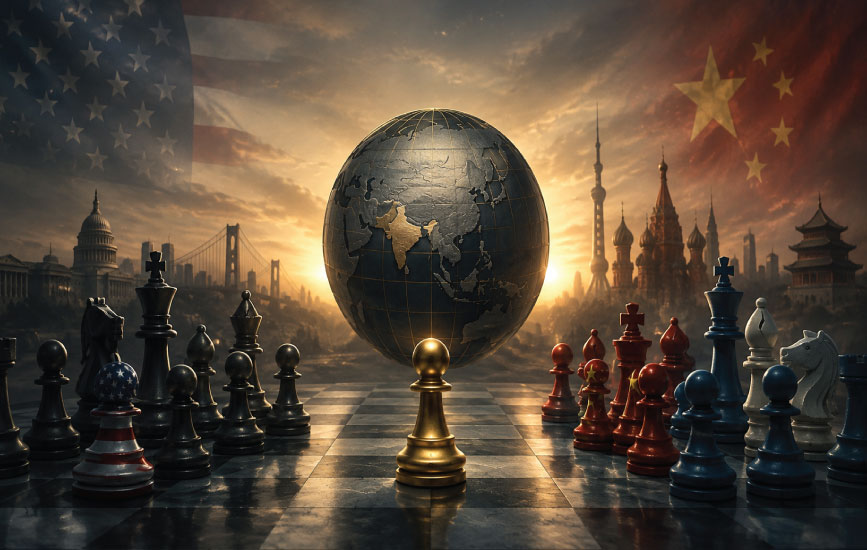
This paper examines India‘s strategic autonomy from the Cold war to the era of great power competition. It explains how India was theoretically pursuing strategic autonomy while in practical terms it was securing its strategic interests from both blocs. The research highlights India‘s position in the Cold war era and the great power competition and analyze how it would no longer be possible for India to pursue its strategic interests from rival blocs under the umbrella of strategic autonomy. The historical twenty years of peace agreement with Russia including defence and economic relationship, US-India strategic partnership and India‘s economic reliance on China have been analyzed to examine how India is pursuing its strategic interests from Russia and China being a strategic partner of the US while courting itself as a counter balance to China. The study is analyzed through the lens of neo-realism by Kenneth Waltz, which defines how state behavior is determined by the international system and the distribution of power. The deeper structural realities that defines the patterns of cooperation or conflict in international system constrains India‘s room for maneuver. The research paper highlights as the great power competition intensifies, India lost the strategic space to exercise its will. India finds it more challenging to uphold its non-alignment policy as the possibility of being drawn into greater confrontation increases.
India’s Strategic Autonomy in the Age of Great Power Rivalry
117