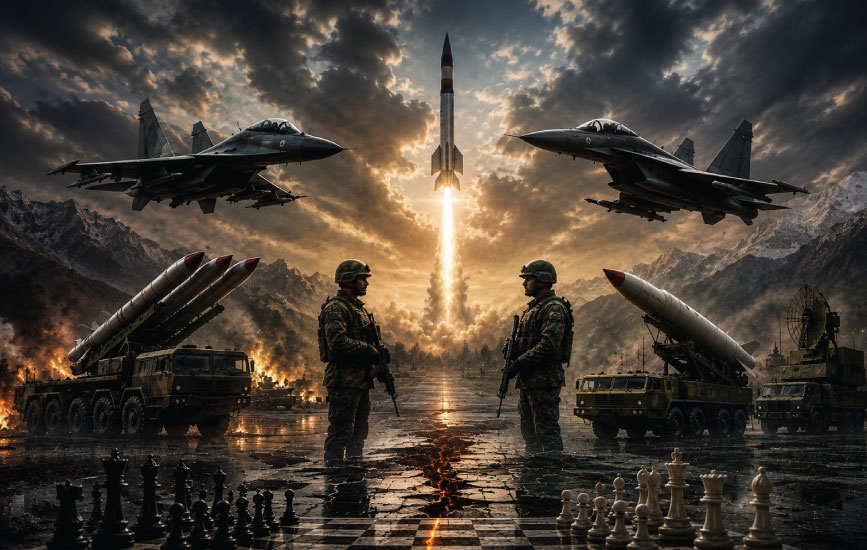
The debate surrounding limited war in South Asia has once again gained attention following recent arguments suggesting that Pakistan’s strategic posture makes limited conflict more likely between India and Pakistan. This interpretation, however, misreads the regional security environment and overlooks the actual source of instability. Pakistan is not seeking to create space for limited war; rather, it is responding to India’s growing attempt to normalize coercive military action under the nuclear shadow.
Since 2016, India has pursued an increasingly aggressive doctrine based on so-called “surgical strikes” and punitive conventional operations designed to remain below Pakistan’s nuclear threshold. This approach assumes that India can conduct controlled military action without triggering a wider strategic response. Such thinking is dangerous because it attempts to rewrite the logic of deterrence in a region where geography, military proximity, and compressed decision-making timelines make escalation highly unpredictable.
The central problem lies in India’s belief that conventional superiority can create strategic freedom. New Delhi’s strategy seeks to convince both domestic and international audiences that limited war is possible despite the presence of nuclear weapons. However, South Asia is not a Cold War theatre with deep strategic buffers and extended escalation ladders. Here, military actions unfold rapidly, and even a conventional strike can produce immediate strategic consequences.
One of the most underexamined aspects of this debate is India’s deployment of the BrahMos missile missile system. India officially presents BrahMos as a conventional precision-strike weapon, yet it has long been discussed internationally as a nuclear-capable platform. Its integration with the Sukhoi Su-30MKI fighter aircraft and deployment at strategically significant bases adds another layer of ambiguity.
In crisis conditions, such ambiguity becomes highly dangerous. A missile perceived as potentially nuclear cannot be treated as an ordinary conventional weapon. Strategic signaling becomes blurred, and the risk of miscalculation rises sharply. If India employs a dual-capable missile during a crisis, Pakistan cannot be expected to interpret it through a purely conventional lens. This is precisely how escalation traps emerge.
Ironically, much of the criticism directed at Pakistan ignores this Indian ambiguity while focusing almost exclusively on Pakistan’s deterrent posture. Pakistan’s Babur cruise missile, by contrast, has largely been associated with strategic nuclear deterrence and has been treated as such in official and public discourse. This reflects declaratory clarity rather than deliberate ambiguity. The assumption that Pakistan uses uncertainty irresponsibly often relies more on speculation than on actual evidence of operational behavior.
Pakistan’s doctrine of Full Spectrum Deterrence (FSD) is also frequently misunderstood. It is often presented as an aggressive doctrine implying automatic nuclear escalation in response to any military action. This is analytically incorrect. FSD is not a doctrine of reckless first use; it is a doctrine of denial. Its purpose is to ensure that no level of aggression appears safe or cost-free to the adversary.
Within the broader framework of Credible Minimum Deterrence, Full Spectrum Deterrence provides Pakistan with the ability to respond across the spectrum of conflict—conventional, sub-conventional, and strategic. It is designed to close the gaps India seeks to exploit. Deterrence works not by guaranteeing war, but by making the prospect of war strategically unattractive.
Pakistan’s conduct during the 2019 Balakot crisis and the May 2025 military confrontation clearly demonstrates this logic. In both cases, Pakistan exercised restraint while maintaining strategic credibility. It responded in a calibrated manner, avoided uncontrolled escalation, and preserved deterrence stability. This did not indicate weakness, nor did it prove nuclear irrelevance. Rather, it showed mature political control and disciplined crisis management.
Those who argue that these crises prove the usability of limited war misunderstand the function of nuclear deterrence. Nuclear weapons are not meant to be used frequently; their success lies in preventing full-scale conflict. Pakistan’s restraint did not validate India’s limited war doctrine—it exposed its limitations. India failed to convert military signaling into strategic advantage because Pakistan denied it escalation dominance.
Another weak comparison often made is between Pakistan-India crises and Iran-US tensions. Such comparisons are strategically flawed because Iran is not a declared nuclear weapons state. Pakistan’s credible and survivable nuclear capability fundamentally changes escalation dynamics. In South Asia, escalation is faster, less predictable, and far more dangerous because both sides operate under immediate strategic vulnerability.
The presence of Pakistan’s strategic force readiness, including the Army Reserve Force Command (ARFC), reinforces this deterrence structure. It signals that escalation cannot be controlled solely by Indian assumptions of conventional superiority. Any attempt to create space for limited war must account for the possibility that escalation may move beyond India’s preferred boundaries.
This is why the concept of limited war under the nuclear threshold remains largely an illusion in South Asia. A limited war may begin with conventional intentions, but it cannot guarantee conventional outcomes. Once initiated, escalation becomes shaped by perception, uncertainty, and survival calculations rather than neat doctrinal assumptions.
India today faces what may be described as conventional force frustration. Despite its larger conventional military capabilities, it cannot confidently use force against Pakistan without risking unacceptable escalation. This frustration is not evidence of Pakistani aggression; it is proof that deterrence is functioning exactly as intended.
The real destabilizing factor in South Asia is not Pakistan’s deterrence doctrine, but India’s persistent effort to create political and military space for controlled war under the nuclear shadow. Pakistan’s strategy seeks to deny that dangerous illusion. Full Spectrum Deterrence is not a threat to peace, it is one of the primary reasons peace, however uneasy, continues to hold.